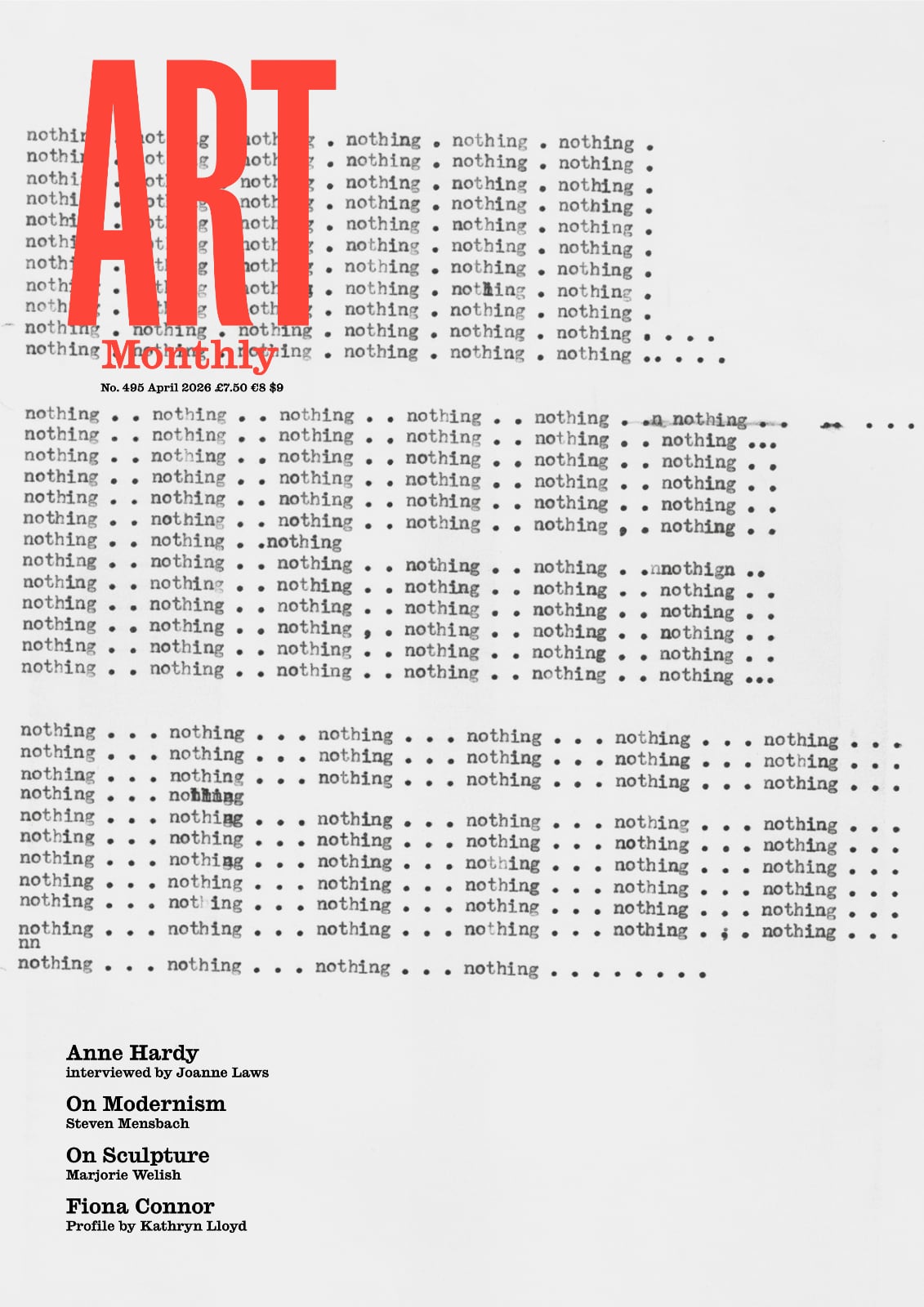
Art Monthly 495
April 2026
Anne Hardy
interviewed by Joanne Laws
On Modernism
Steven Mansbach
On Sculpture
Marjorie Welish
Fiona Connor
Profile by Kathryn Lloyd
Buy Now – select:
Want to read this right now?
Get instant access to the entire back catalogue via Exact Editions from only £8.99!
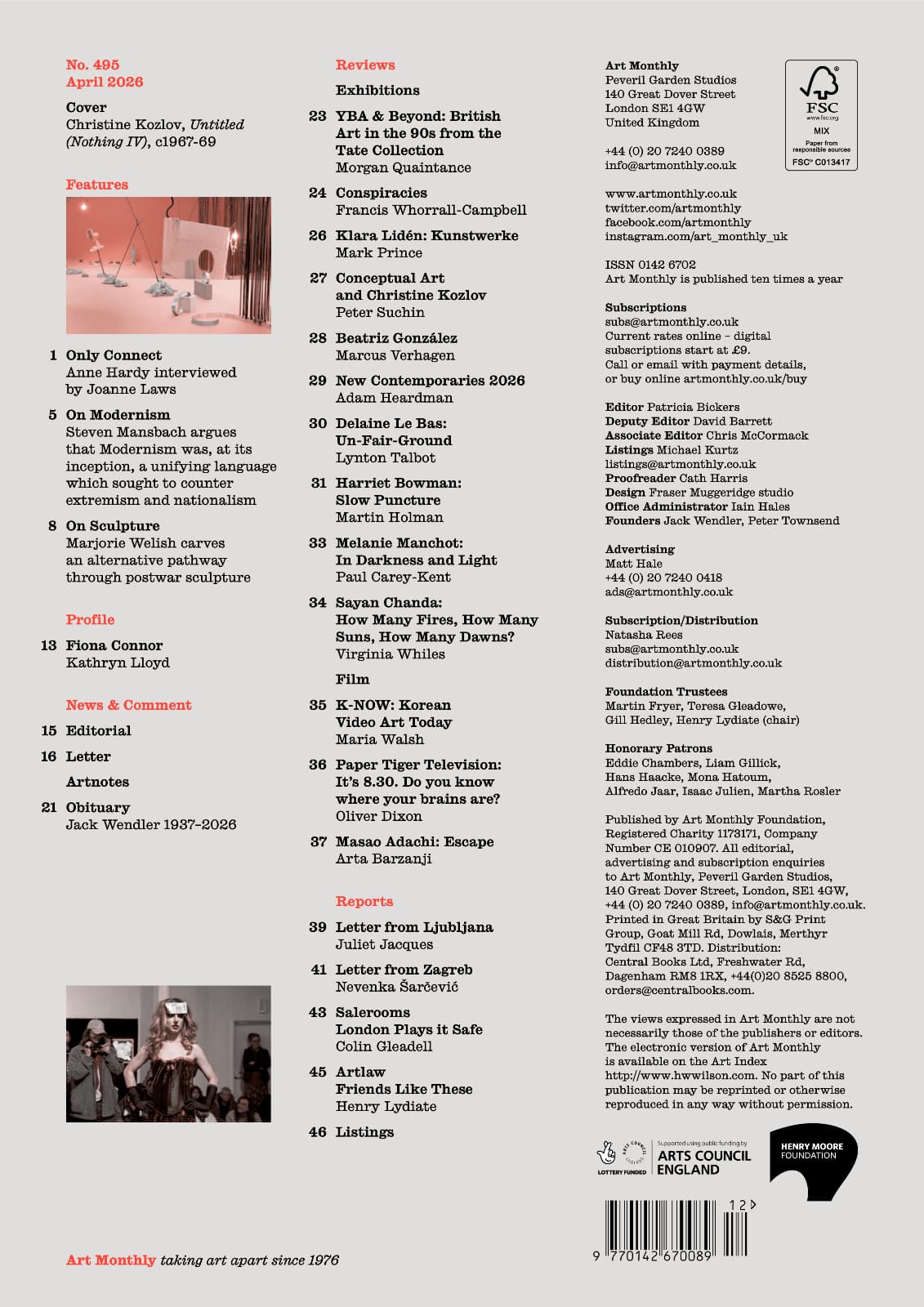
Contents
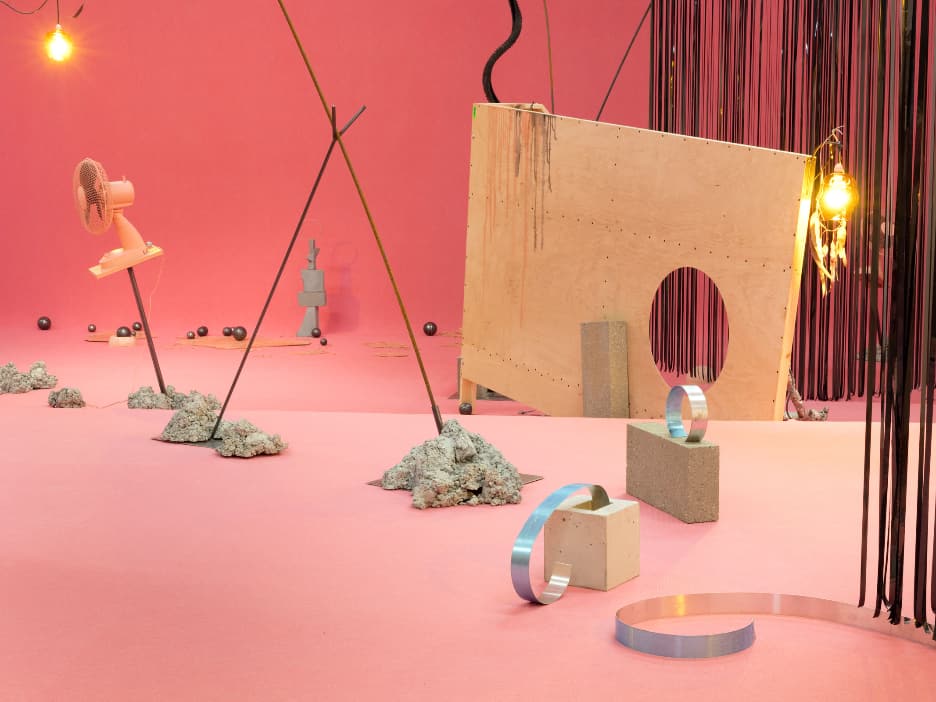
Anne Hardy, Falling and Walking (phhhhhhhhhhh phossshhhhh crrhhhhzzz mn huaooogh), 2017
Interview
Only Connect
Anne Hardy interviewed by Joanne Laws
Found objects are everywhere, they’re affordable to work with and have intriguing material qualities, but I’m more interested in them as materials or objects that do not have an inherent or recognised value – as things full of potential, to become or to be, very much like ourselves.
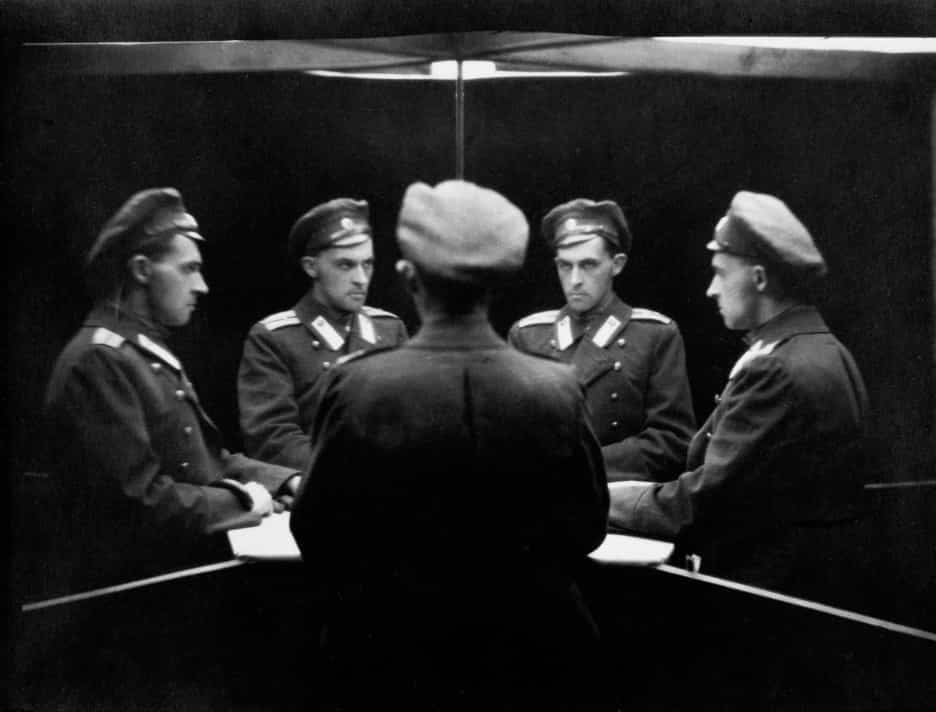
Stanisław Ignacy Witkiewicz, Multiple self-portrait in mirrors, Saint Petersburg, c1915
Feature
On Modernism
Steven Mansbach argues that Modernism was, at its inception, a unifying language which sought to counter extremism and nationalism
Ironically, when Modernism was finally free to be uncovered, exhibited and advocated in post-Soviet Russia and throughout so much of its former imperium, it was frequently conjoined with a revived nationalism because each ‘liberated’ state sought to reassert its national distinctiveness.
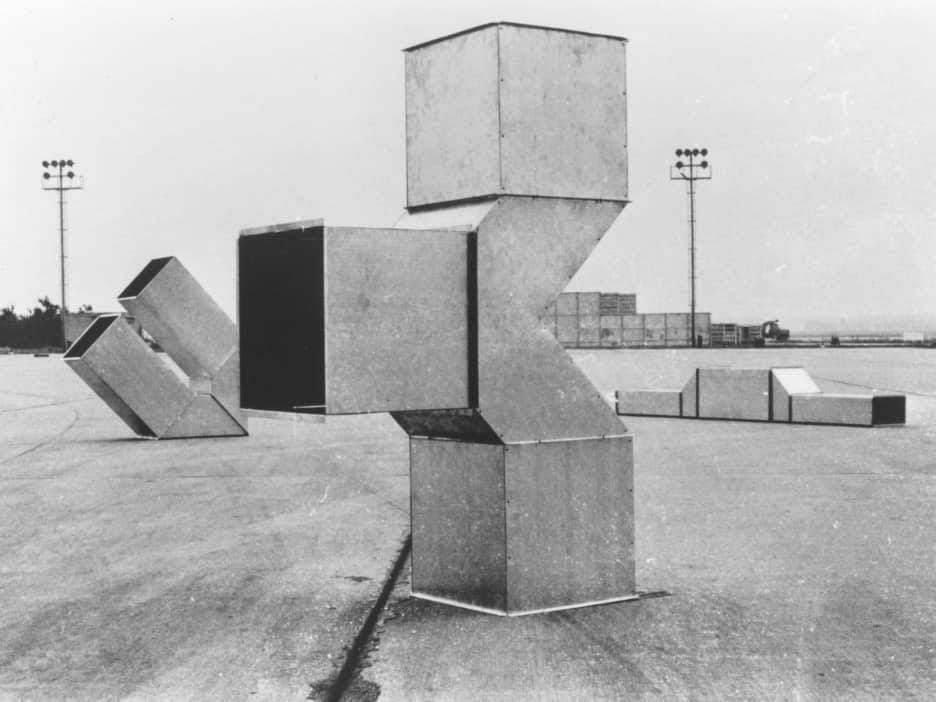
Charlotte Posenenske, ‘Vierkantrohre (Square Tubes), Series D’, 1967
Feature
On Sculpture
Marjorie Welish carves an alternative pathway through postwar sculpture
Devastating world wars have clearly altered the course of cultural politics, and they have significantly rewritten the remit of sculpture. Improvisation and bricolage refocused the very sense of making, unmaking, doing and undoing.
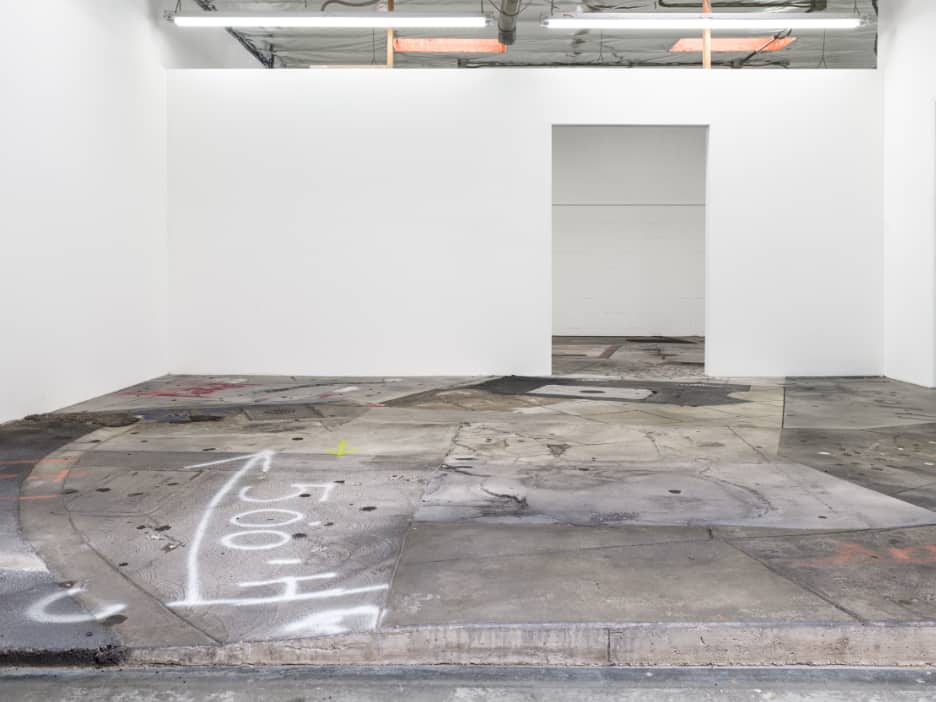
Fiona Connor, Continuous Sidewalk, 2023
Profile
Fiona Connor
Kathryn Lloyd
As much as her sculptures are indistinguishable from readymades, they also invert the conventions on which that category depends. Fiona Connor’s objects are found but not yet ready; they are an addition to rather than a subtraction from the world.
Editorial
One Battle After Another
The Oscars success for the remarkable documentary Mr Nobody Against Putin was a reminder of the power of state propaganda as well as the possibility to resist, a timely message in an era when leaders from east to west increasingly seek to control the media message.
Pavel Talankin tells us that nearly 20,000 teachers left their jobs rather than be party ‘to a system that is indoctrinating children’.
Letter
On Being Iranian
Vali Mahlouji despairs at the social, cultural and psychological condition of being Iranian after half a century of ideological intolerance.
Artnotes
T103 Terminator
Tenants at Glasgow’s Trongate 103 cultural hub, including Transmission and others, face eviction; the Venice Biennale faces protests over its decision to allow both Russia and Israel to present national pavilions; Art Dubai postpones this month’s fair as war rages in the region; activists place guerrilla art interventions in the Louvre and outside Buckingham Palace protesting Jeffrey Epstein’s cronies; curator Ben Broome devises a neighbourly art project only for south London locals; plus the latest on galleries, people, prizes and more.
Obituary
Jack Wendler 1937–2025
Patricia Bickers
Michael Craig-Martin
Liam Gillick
Andrew Wilson
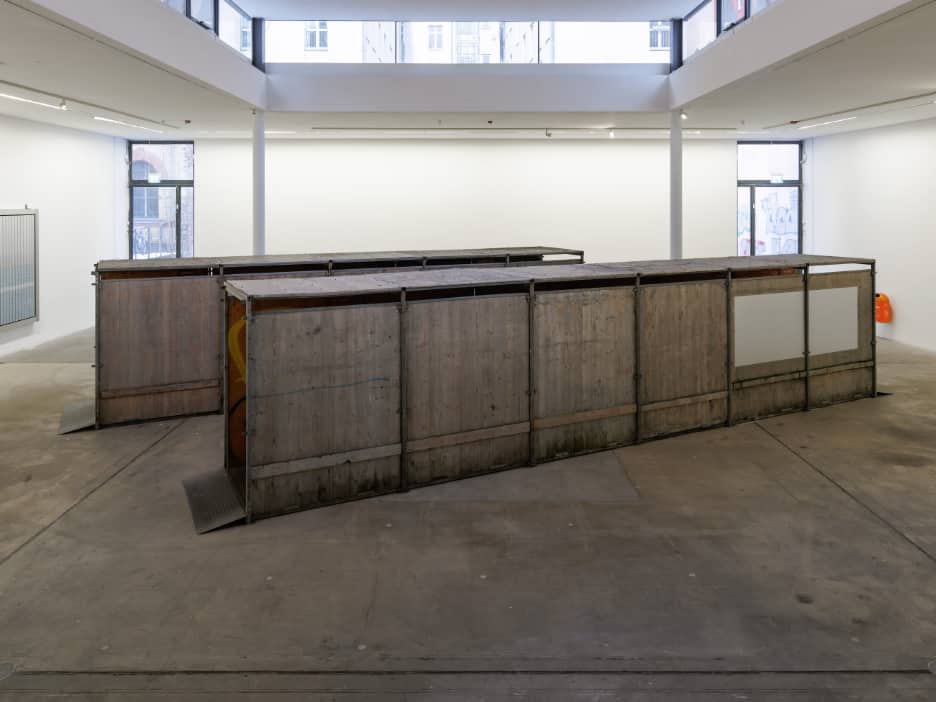
Klara Lidén, ‘Kunstwerke’, KWI, Berlin
Exhibitions
YBA & Beyond: British Art in the 90s from the Tate Collection
National Art Centre, Tokyo
Morgan Quaintance
Conspiracies
Warburg Institute, London
Francis Whorrall-Campbell
Klara Lidén: Kunstwerke
KW Institute for Contemporary Art, Berlin
Mark Prince
Conceptual Art and Christine Kozlov
Raven Row, London
Peter Suchin
Beatriz González
Barbican, London
Marcus Verhagen
New Contemporaries 2026
South London Gallery
Adam Heardman
Delaine Le Bas: Un-Fair-Ground
The Whitworth, Manchester
Lynton Talbot
Harriet Bowman: Slow Puncture
Cross Lane Projects, Kendal
Martin Holman
Melanie Manchot: In Darkness and Light
John Hansard Gallery, Southampton
Paul Carey-Kent
Sayan Chanda: How Many Fires, How Many Suns, How Many Dawns?
De La Warr Pavilion, Bexhill-on-Sea,
Virginia Whiles
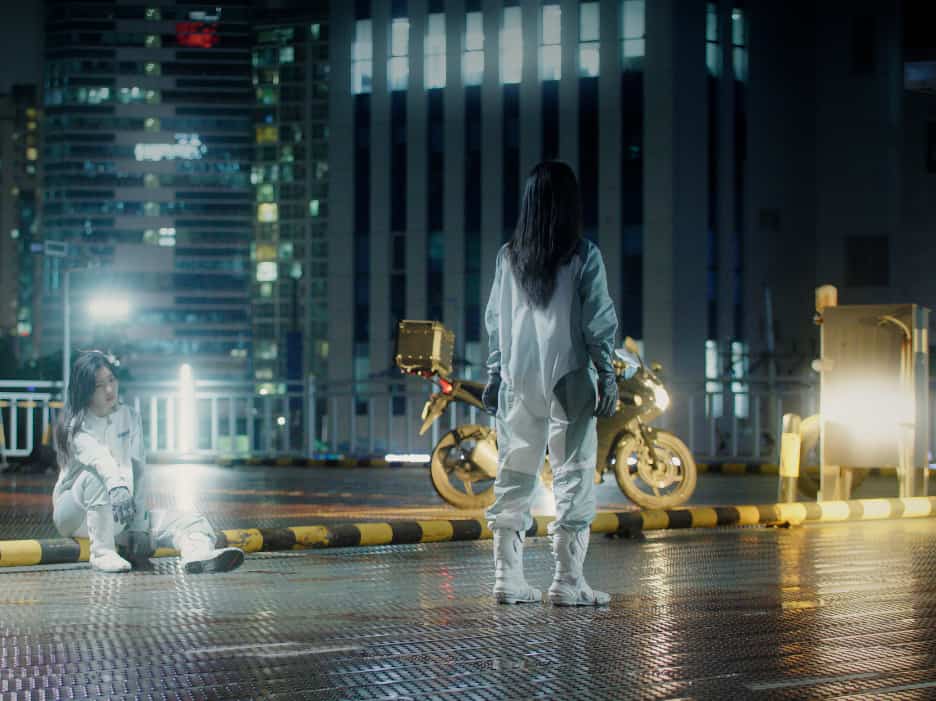
Ayoung Kim, Delivery Dancer’s Sphere, 2022
Film
K-Now: Korean Video Art Today
Maria Walsh
I found myself empathising with the plight of Ayoung Kim’s protagonist, Ernst Mo, a delivery motorcyclist who incessantly whizzes through Seoul in obeisance to the Dancemaster algorithm that dictates and measures her performance in this competitive gig economy.
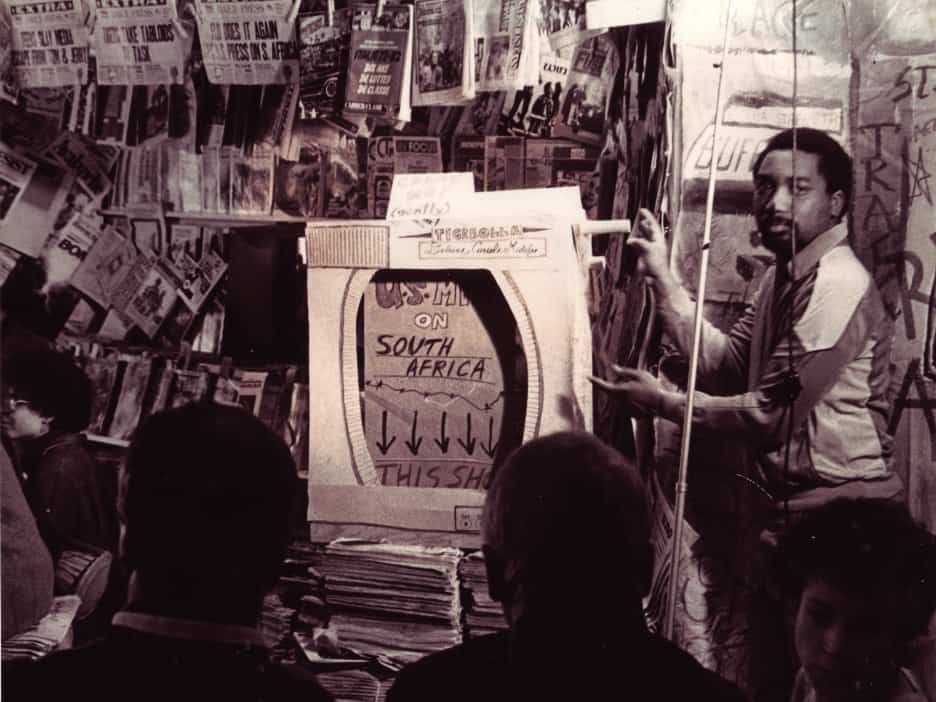
Flo Kennedy Reads US Press on South Africa: The Hair in the Milk, 1985, Paper Tiger Television production
Film
Paper Tiger Television: It’s 8.30. Do you know where your brains are?
Oliver Dixon
With each critical gesture, the paper tigers of the culture industry were crumpled and the corporate imperatives underlying their glossy surfaces were exposed by this public-access television show’s guest performers.
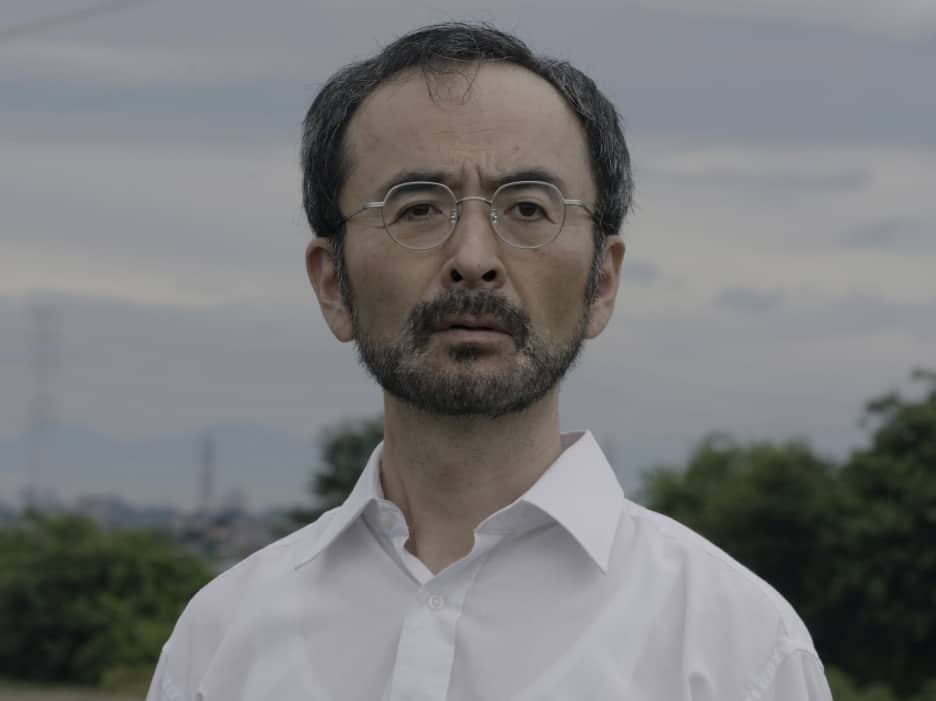
Masao Adachi, Escape, 2025
Film
Masao Adachi: Escape
Arta Barzanji
Masao Adachi’s film stages his own biography as a restless dialogue between past and present: between the young militant who believed in armed struggle, spending decades on the run living under an assumed name, and the ageing man who has outlived it.
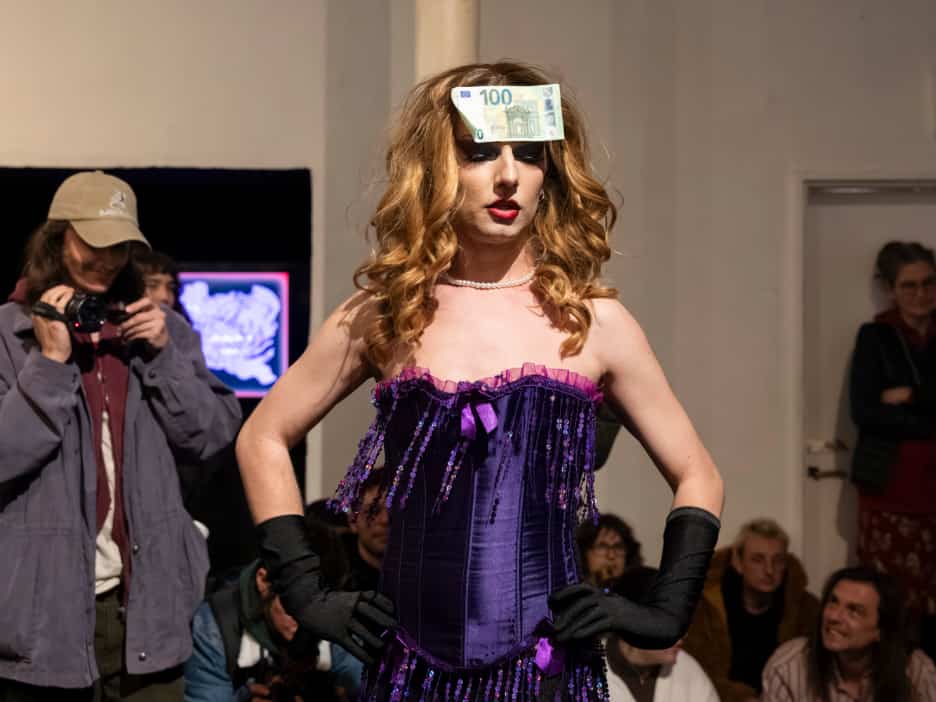
Laza Simeunović performs at Alkatraz Gallery, Metelkova
Reports
Letter from Ljubljana
Juliet Jacques
The cabaret is an interpretation of the death dance currently playing out between liberals and fascists across numerous western democracies since the collapse of socialism, in which the far right sets the terms of debate and liberals alienate their supporters by ‘compromising’ with the fascists, who then come to power and slash the state and persecute minorities, before the liberals return, lock in the far-right gains and the cycle starts again.
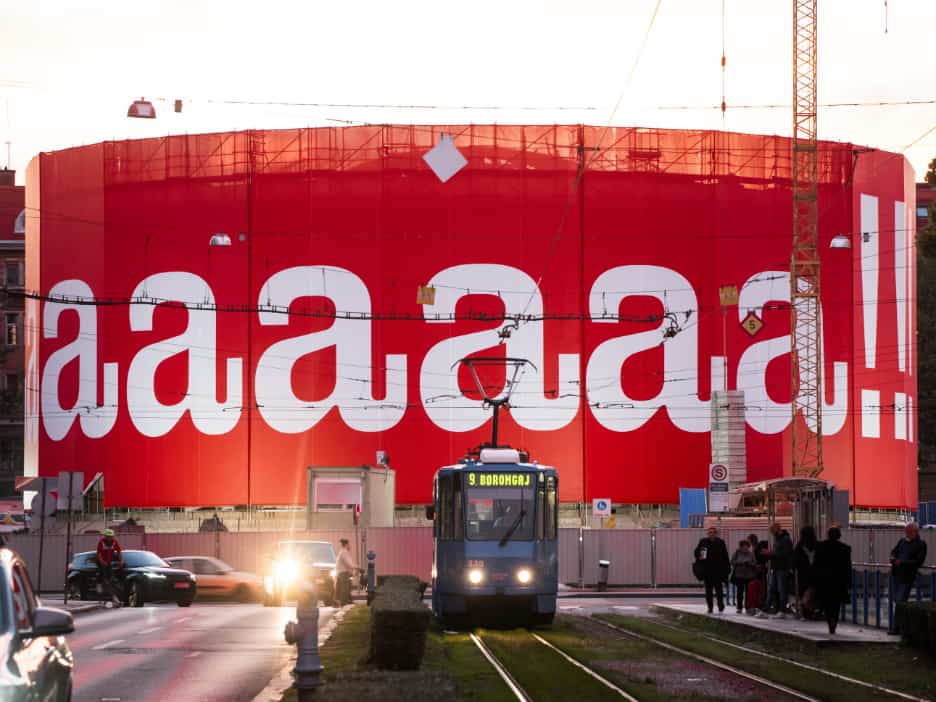
Nora Turato, Aaaaaaaaaaaaaaa!!!, 2025
Reports
Letter from Zagreb
Nevenka Sarcevic
Until recently, the building was framed by a site-specific installation by Nora Turato, titled Aaaaaaaaaaaaaaa!!!, which had bold white letters on a bright red background framing the scaffolding of the rotunda. Every day at noon, an accompanying soundtrack was played, echoing the cry spelled out in the text.
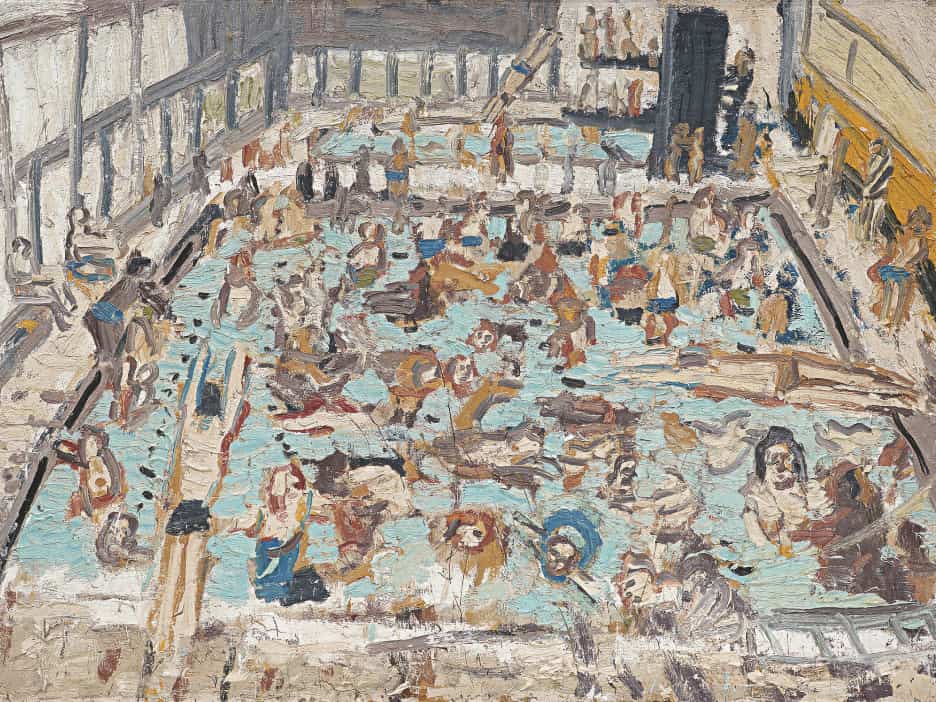
Leon Kossoff, Children’s Swimming Pool, 11 o’clock Saturday Morning, August, 1969, estimate £600,000–800,000 sold for £5.2m
Salerooms
London Plays it Safe
Colin Gleadell
As at Sotheby’s, the play-it-safe mode was also adopted at Christie’s which chose to focus on historically proven work rather than more adventurous young contemporaries, where the market has been soft.
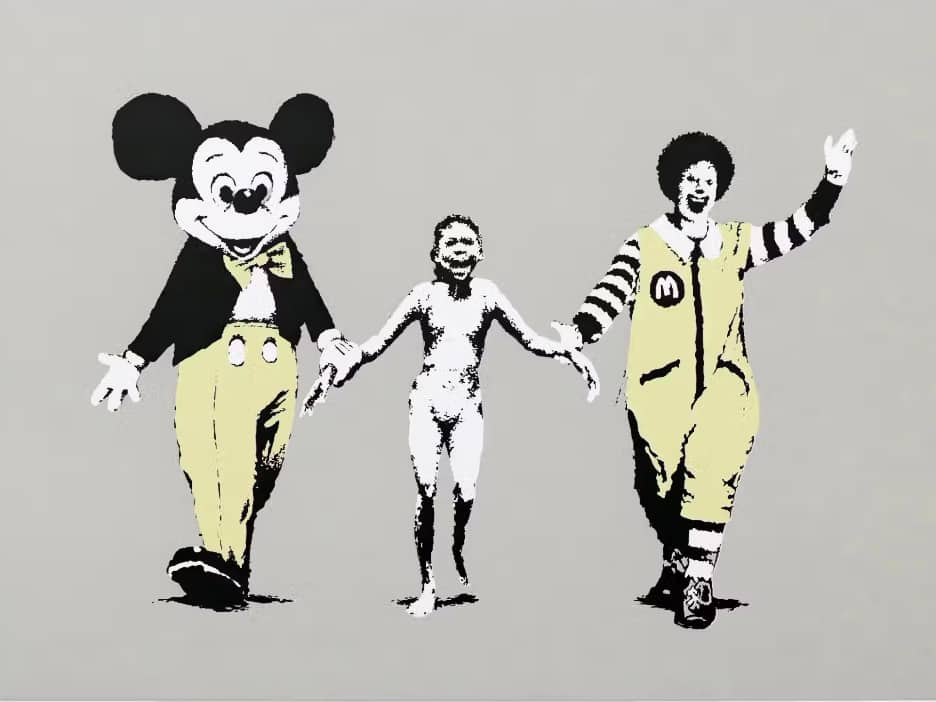
Banksy, Napalm (Can’t Beat the Feeling), 2004, allegedly sold to Ant and Dec for an inflated fee
Artlaw
Friends Like These
Henry Lydiate
The ruling that TV celebrities Ant and Dec secured in court, which revealed the transactions of their art adviser, reinforces the legal invalidity of the well-known custom and practice, commonly asserted by art world dealers, that the identity of a private buyer or owner of an artwork is not revealed.








Peveril Garden Studios
140 Great Dover Street
London SE1 4GW
United Kingdom
Email info@artmonthly.co.uk