Art Monthly 496
May 2026
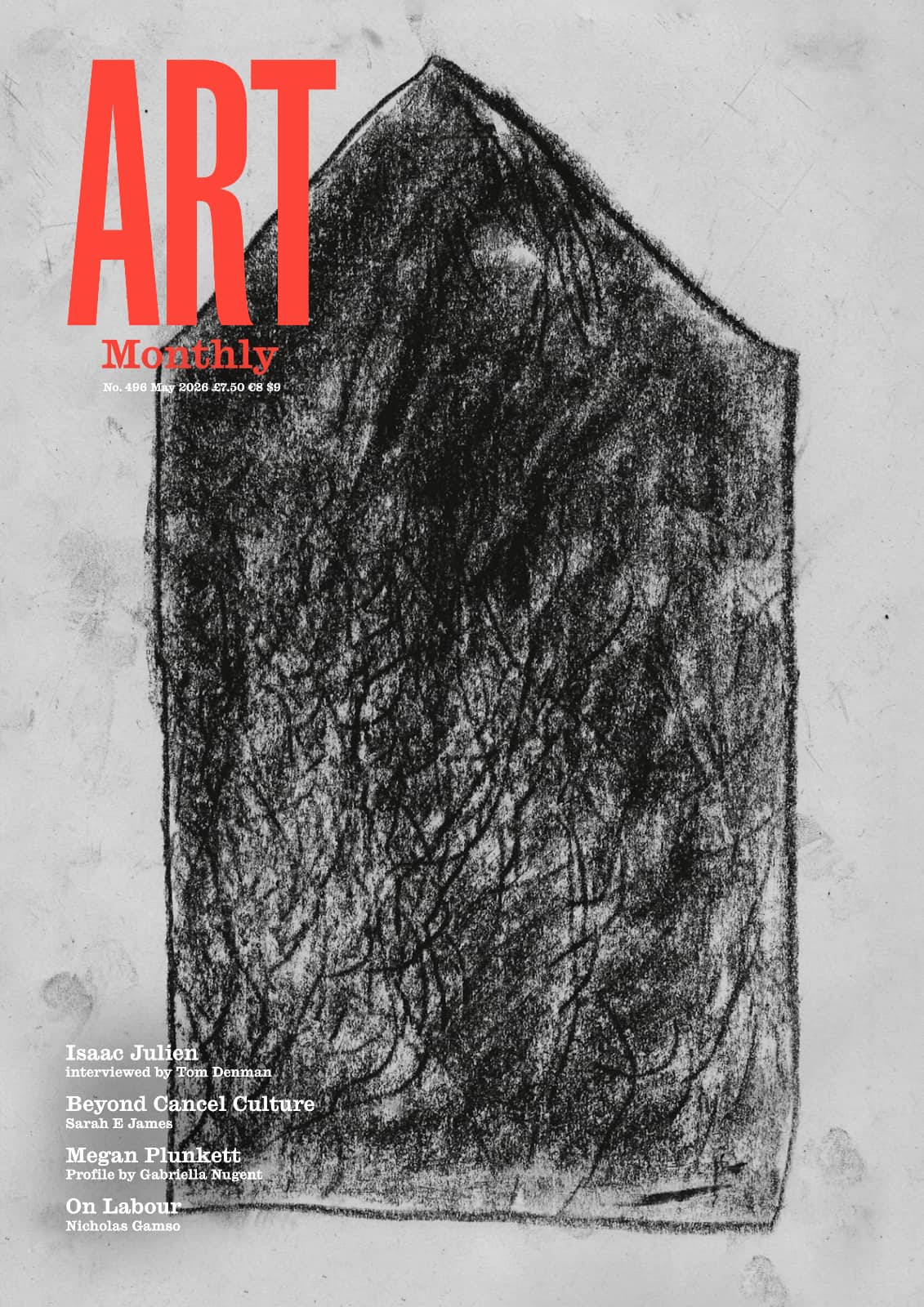
Isaac Julien
interviewed by Tom Denman
Beyond Cancel Culture
Sarah E James
Megan Plunkett
Profile by Gabriella Nugent
On Labour
Nicholas Gamso
Buy Now – select:
Want to read this right now?
Get instant access to the entire back catalogue via Exact Editions from only £8.99!
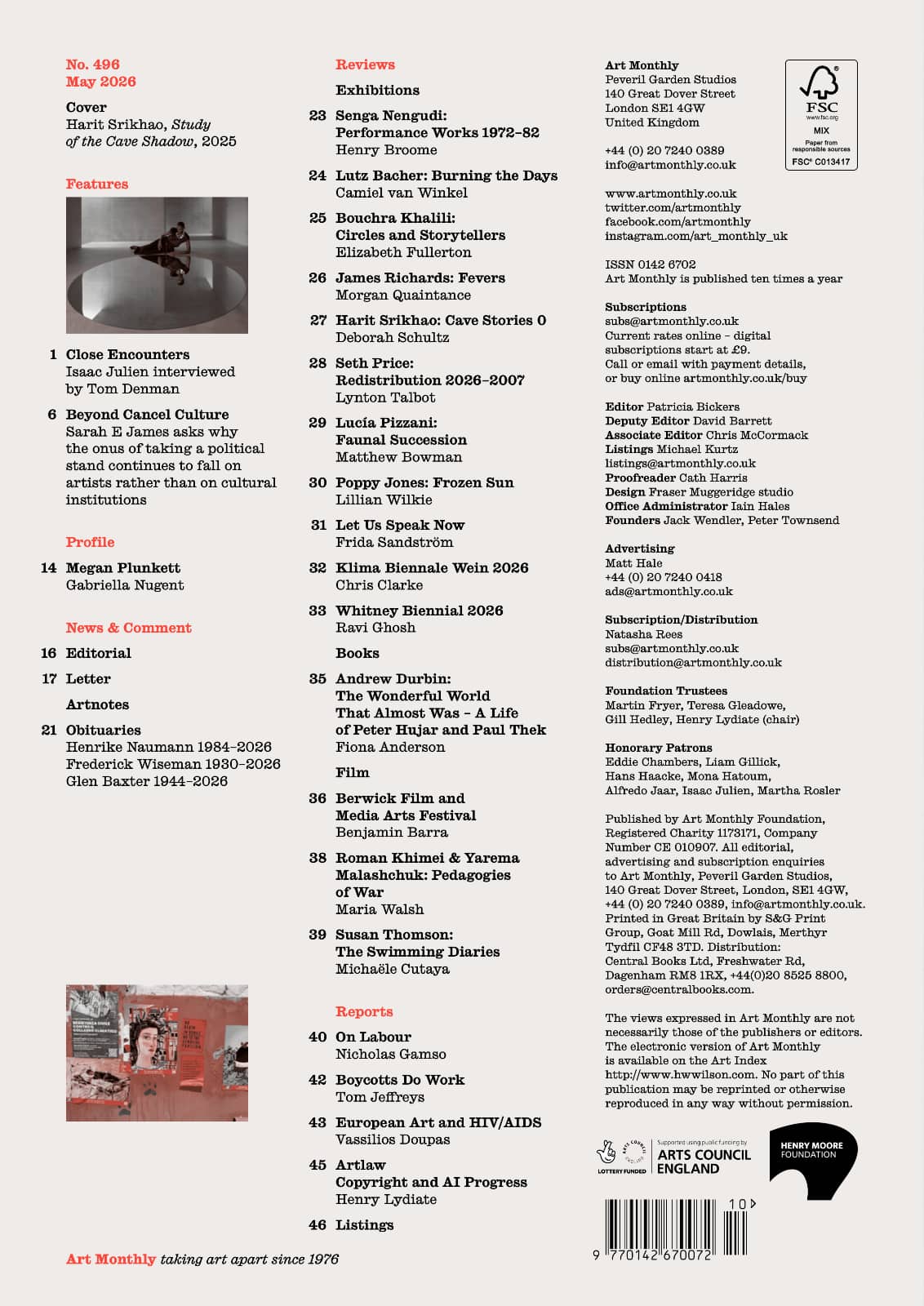
Contents
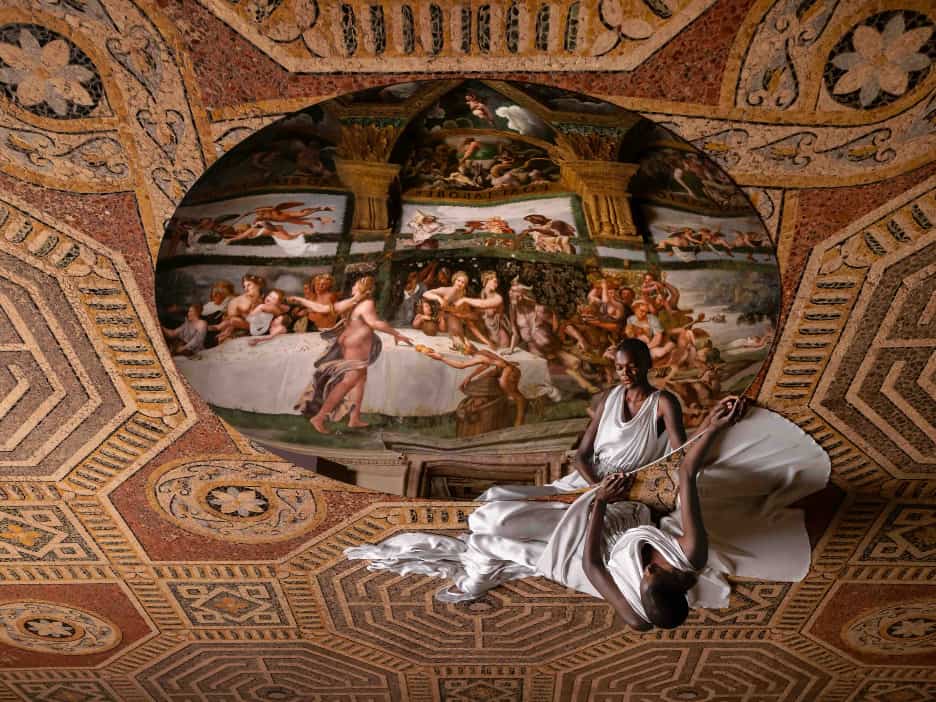
Isaac Julien, Metamorphosis I (All That Changes You. Metamorphosis), 2025
Interview
Close Encounters
Isaac Julien interviewed by Tom Denman
I think one of the problems of today is a tendency to crystallise meaning when it comes to images of power, in how they are constructed and interpreted, whereas I am seeking to trouble such images.
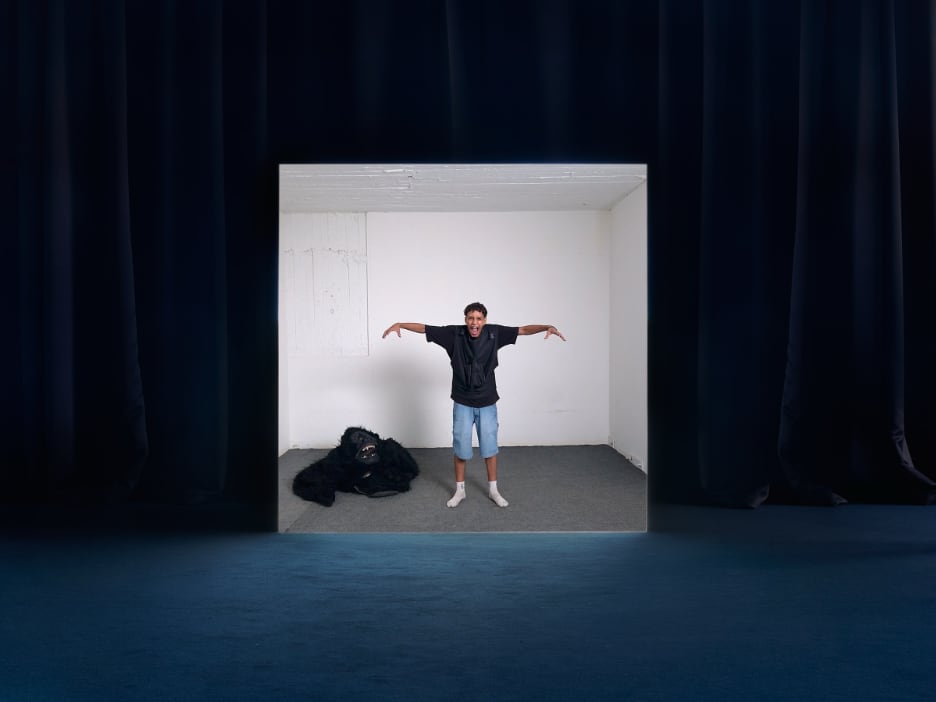
Hassan Khan, Little Castles, 2025
Feature
Beyond Cancel Culture
Sarah E James asks why the onus of taking a political stand continues to fall on artists rather than on cultural institutions
Hassan Khan is unambivalent when he outlines what he sees as art’s critical role in our current times of genocide: ‘To make the taboo visible in a way that is uncensorable is for me at this moment one of the most important political acts art can do.’
 |
From the Back Catalogue |

Megan Plunkett, Special Friend 14, 2018
Profile
Megan Plunkett
Gabriella Nugent
Megan Plunkett interrogates our relationship, and that of photography, with objects: she works with props, as well as found objects, consumer detritus and film industry replicas, to circumvent established systems of ownership and desire.
Editorial
So WAD?
The 15th of April was officially, according to UNESCO, World Art Day, though it passed with little fanfare here in the UK – symbolic of a general neglect of the visual arts.
Long before the cost-of-living crisis in the UK morphed into the international permacrisis that we are currently living through, the arts were already in a parlous state.
Letter
Responding to the BAS10 Announcement
Morgan Quaintance is dismayed that the ‘British Art Show’ has become a single curator’s thematic exercise rather than the survey show it was founded as in 1979.
Artnotes
War Crimes
Artist Ali Cherry has filed a war crimes complaint over the Israeli airstrike that killed his parents; the National Audit Office paints a bleak picture of the finances of the UK’s national museums and galleries; a newly revealed survey shows the impact on staff morale of dodgy museum sponsorships; Goldsmiths announces yet more cut backs triggering a campus occupation by students in revolt; plus the latest on galleries, people, prizes and more.
Obituaries
Henrike Naumann 1984–2026
Bob Dickinson
Frederick Wiseman 1930–2026
Arta Barzanji
Glen Baxter 1944–2026
David Barrett
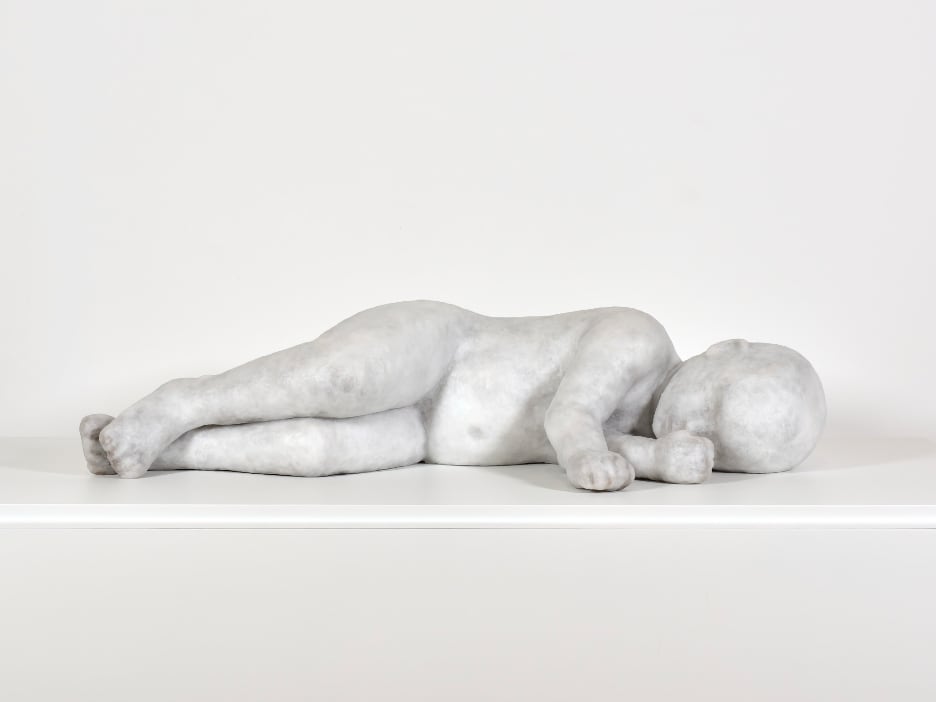
Andrea Fraser, Untitled (Object) IV, 2024, ‘Whitney Biennial’, Whitney Museum, New York
Exhibitions
Senga Nengudi: Performance Works 1972–1982
Whitechapel, London
Henry Broome
Lutz Bacher: Burning the Days
WIELS, Brussels
Camiel van Winkel
Bouchra Khalili: Circles and Storytellers
Mosaic Rooms, London
Elizabeth Fullerton
James Richards: Fevers
Sylvia Kouvali, London
Morgan Quaintance
Harit Srikhao: Cave Stories 0
YDP, London
Deborah Schultz
Seth Price: Redistribution 2026–2007
Sadie Coles HQ, London
Lynton Talbot
Lucía Pizzani: Faunal Succession
Focal Point Gallery, Southend-on-Sea
Matthew Bowman
Poppy Jones: Frozen Sun
Towner, Eastbourne
Lillian Wilkie
Let Us Speak Now
Heirloom – center for art and archives, Copenhagen
Frida Sandström
Klima Biennale Wien 2026
various venues, Vienna
Chris Clarke
Whitney Biennial 2026
Whitney Museum, New York
Ravi Ghosh
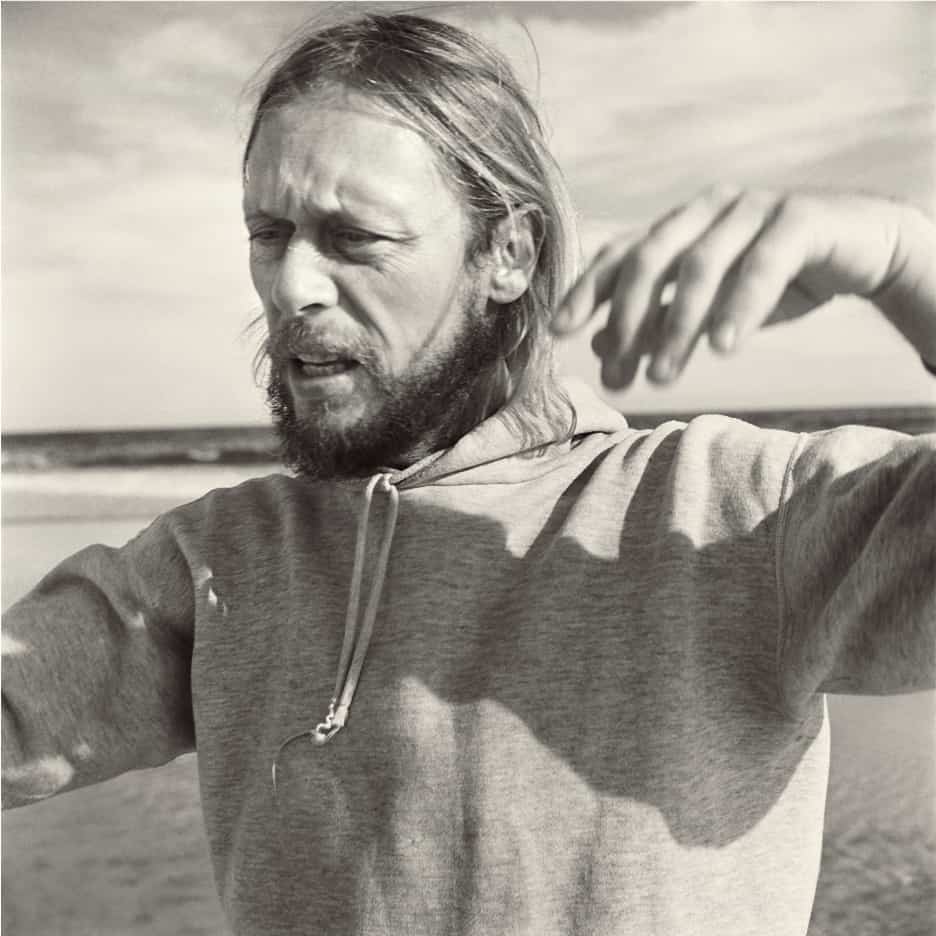
Peter Hujar, Paul Thek (In Hooded Sweatshirt), 1975
Books
Andrew Durbin: The Wonderful World That Almost Was – A Life of Peter Hujar and Paul Thek
Fiona Anderson
The narrative Andrew Durbin presents here is, instead, one of renewal, of the challenges and pleasures of an artistic life and of these artists’ desire and need for freedom and creative agency.
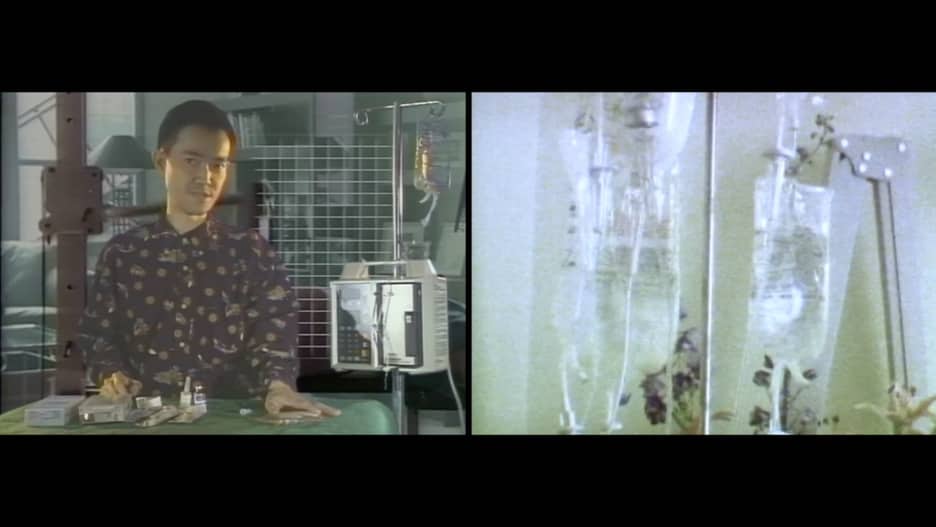
Lesley Loksi Chan, Lloyd Wong, Unfinished, 2025
Film
Berwick Film and Media Arts Festival
Benjamin Barra
Lesley Loksi Chan brought to life a box of old tapes that record long-lost footage of the artist Lloyd Wong and which explore his experiences of living with HIV, the work paying respect to his deep-felt anger about his impending death.
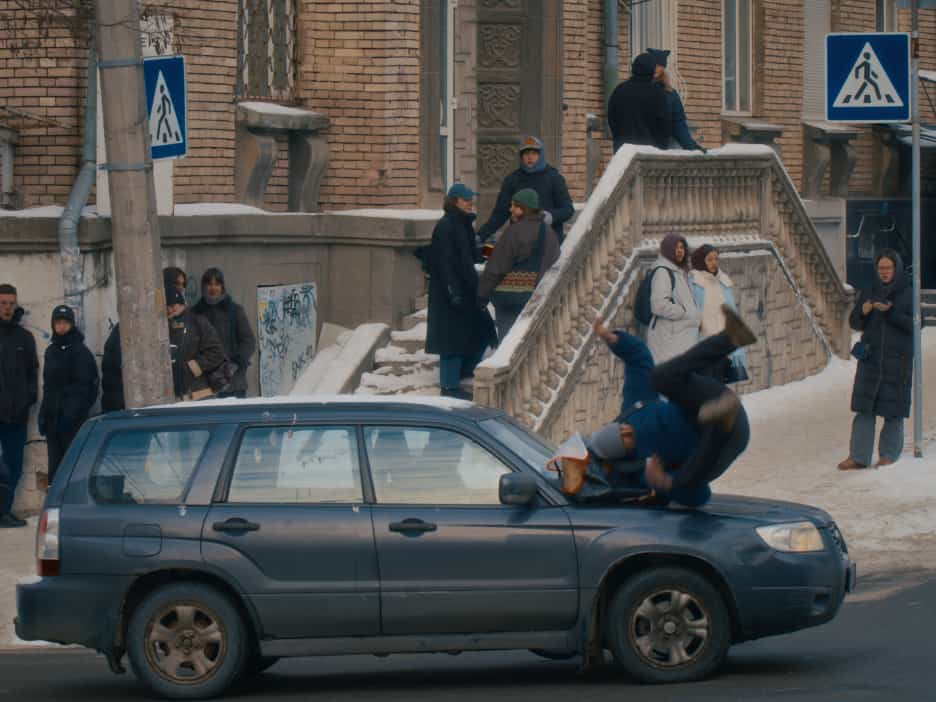
Roman Khimei & Yarema Malashchuk, We Didn’t Start This War, 2026
Film
Roman Khimei & Yarema Malashchuk: Pedagogies of War
Maria Walsh
Ukrainian artists Roman Khimei & Yarema Malashchuk offer a corrective lens to the spectacle of war. Their film installations create the time and space to contemplate the affects surrounding war in an aesthetic call-to-arms that gets under the skin rather than remaining at the level of information.
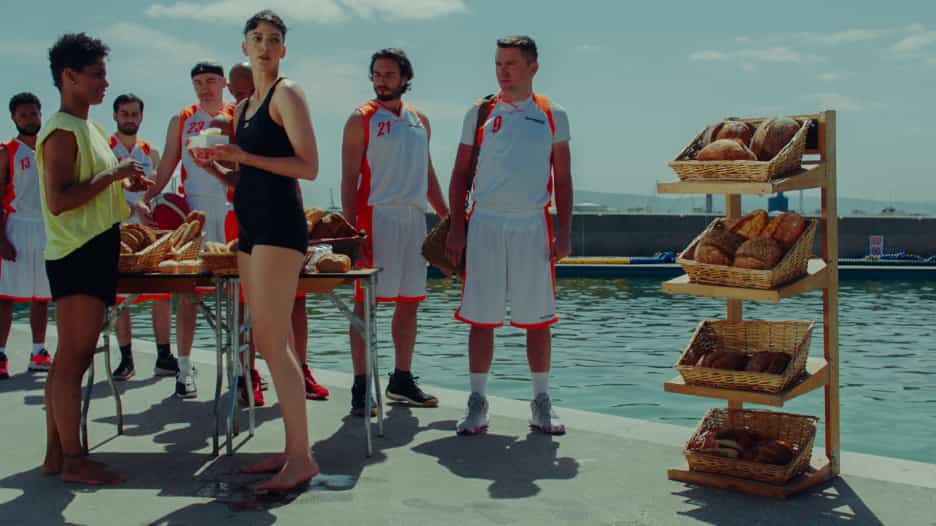
Susan Thomson, The Swimming Diaries, 2024
Film
Susan Thomson: The Swimming Diaries
Michaële Cutaya
The film is composed of a series of original dance performances interspersed with extracts from personal archive videos. Each sequence has its own cinematographic identity, reflecting the different emotional states the narrator is going through.
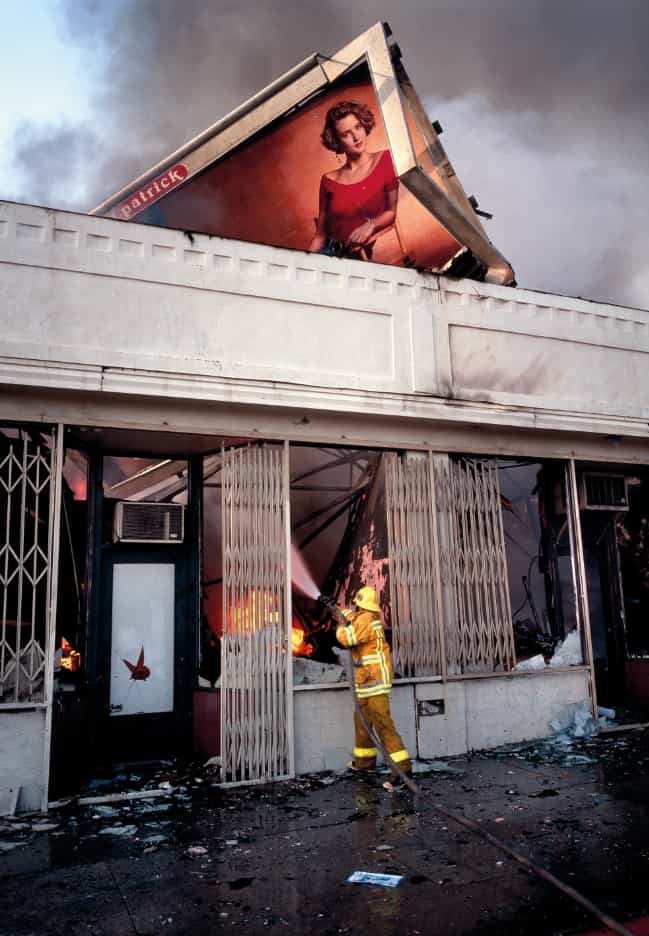
Allan Sekula, Koreatown, Los Angeles, April 1992, 1992
Reports
On Labour
Nicholas Gamso
The themes of the Wattis Institute’s ‘Labour’ exhibition has special significance here in San Francisco, a former countercultural bastion which is now synonymous with tech-world workaholism and with very poor people living in tents in roadside encampments.
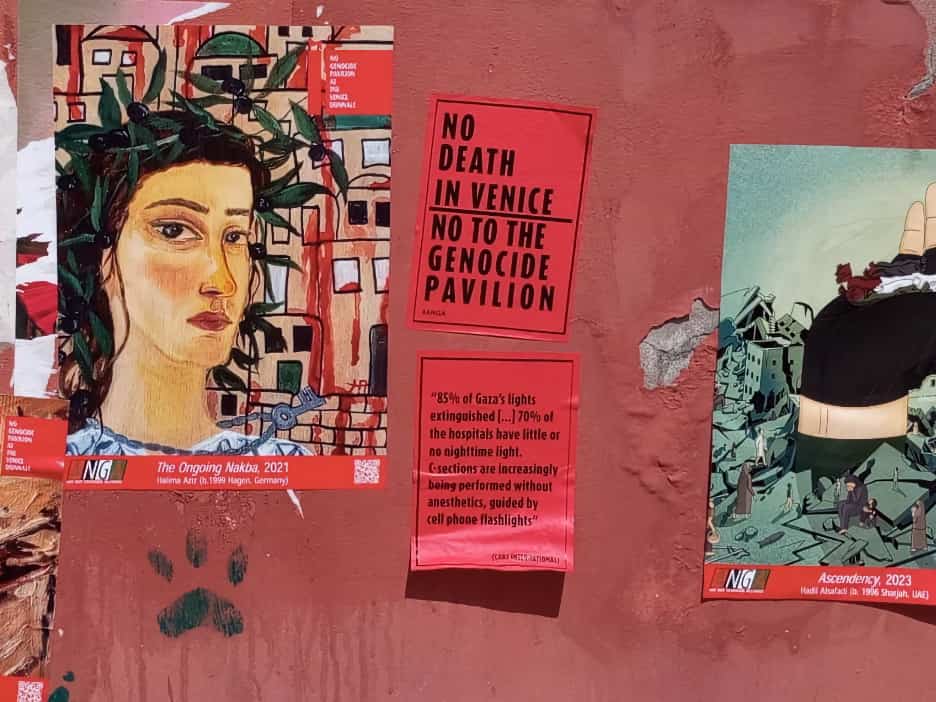
ANGA’s flyposting of ‘No To The Genocide Pavilion’ and Palestinian art in the streets of Venice, 2024
Reports
Boycotts Do Work
Tom Jeffreys
Over the past two and a half years, it has been precariously placed cultural workers, not institutions, who have organised together for collective liberation. The less the current system offers you, the less you have to lose from speaking out.
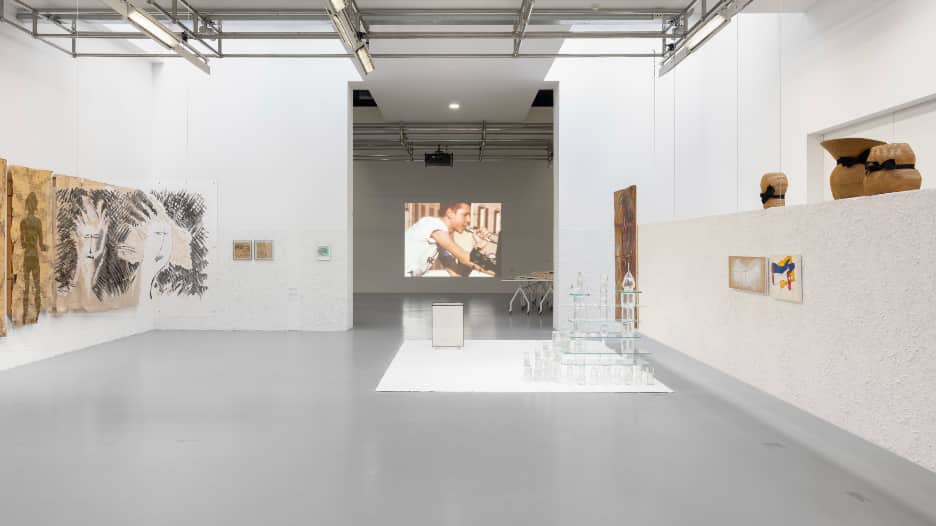
‘Vivono: Art and Feelings, HIV-AIDS in Italy. 1982–1996’, installation view, Centro Pecci, Prato
Reports
European Art and HIV/AIDS
Vassilios Doupas
The moral framing of the AIDS epidemic in southern Europe, which equated it with deviance and something to be marginalised, posed a threat to heteronormative structures. ‘Vivono’, a group exhibition of Italian artists affected by the HIV/AIDS crisis aimed to disrupt a long and pervasive silence.
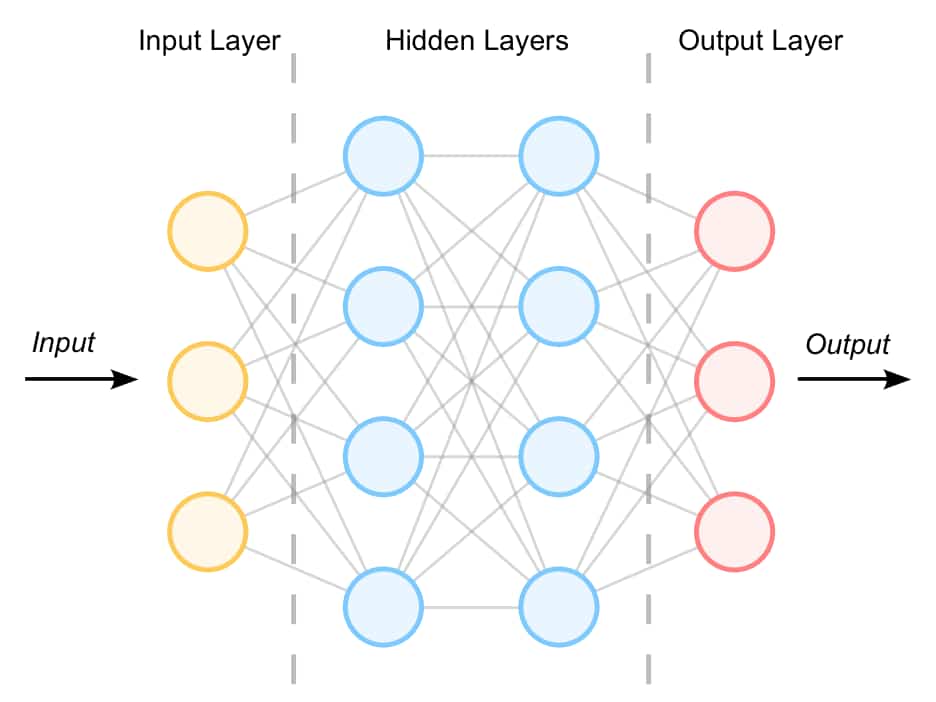
UK government simplified representation of an AI neural network
Artlaw
Copyright and AI Progress
Henry Lydiate
The Copyright, Designs and Patents Act’s computer-generated provisions were enacted four decades ago, when computer technology was rudimentary. Computer-generated works were challenging and costly in the 1980s, but AI has since developed significantly, and can now produce outputs in large quantities without the same challenge or cost.






Peveril Garden Studios
140 Great Dover Street
London SE1 4GW
United Kingdom
Email info@artmonthly.co.uk