
Film
Roman Khimei & Yarema Malashchuk: Pedagogies of War
Maria Walsh on low-key artwork from the front line
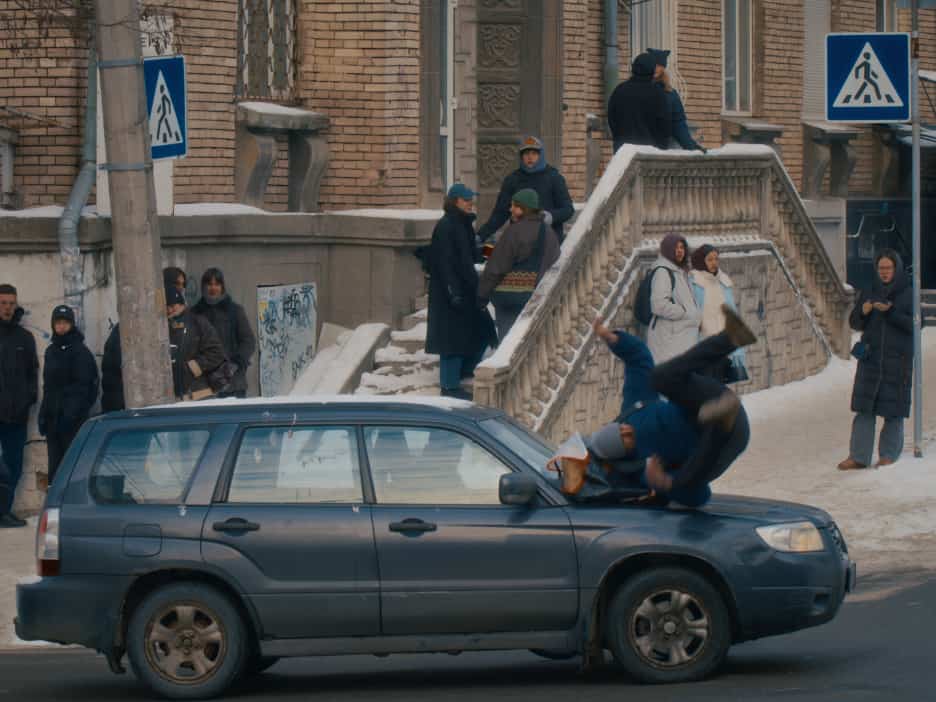
Roman Khimei & Yarema Malashchuk, We Didn’t Start This War, 2026
Recently, at a group exhibition, I was unexpectedly confronted by a video clip of a soldier with his face blown off. I did not linger, not because of horror or outrage, but because I did not want to participate in looking at sensationalised or ‘shocking’ images of war, the cumulative effects of which can numb us to the reality of violence. Ukrainian artists Roman Khimei & Yarema Malashchuk’s ‘Pedagogies of War’, curated by Chus Martínez and organised in collaboration with TBA21, offers a corrective lens to the spectacle of war. Their four film installations – episodic documentary narratives fused with improvisation – create the time and space to contemplate the affects surrounding war in an aesthetic call-to-arms that gets under the skin rather than remaining at the level of information.
In The Wanderer, 2022, shown on five LED screens of variable sizes arranged on a deep rust-coloured wall, the artists enact the positions of fallen Russian soldiers in Ukraine’s forested Carpathian Mountains. There is no sound. Caspar David Friedrich’s painting Wanderer Above a Sea of Fog, c1817, is a reference for the work, yet the sublime nature of heroism is deflated by the duo’s deliberately pathetic approximations to dead soldiers. What does it mean for Khimei and Malashchuk, who live in Kyiv, to mimic their dead ‘enemy’? Is this an act of empathy or mockery? Or does it more generally expose the terrible contrast between state diktats and the wasted lives of those who act in accordance with them; over a million Russian soldiers have already been killed in this war.
The ‘fog of war’ is how Martínez situates the exhibition’s aesthetics. She attributes the term to Carl von Clausewitz’s 1832 treatise On War, in which he contrasts the state of uncertainty and chaos of actual war with absolute war, which aims at complete destruction of the enemy. As a motif, the ‘fog of war’ implies the endless waiting and suspended states of being that unite those on the frontline with those at home and those displaced by conflict. In the two-channel Open World, 2025, an LED video monitor shows an exiled Ukrainian teenager at his computer controlling from a distance (he is in Warsaw) a remote military-grade robotic dog, replete with two-way microphone and camera, to explore his home in Ukraine. We see what he sees projected cinematically on a large screen behind, while also watching his ‘gamer-style’ interaction on the monitor. While the ‘dog’ cannot shake off its identity as part of the military-industrial complex, it nonetheless becomes a faux-therapeutic means of reassuring the boy that his home is still intact, the technology reuniting him, albeit from an unsatisfying distance, with his mother and his pets. The discomfiting boundary-crossing between good and evil is accentuated when, on one of its rounds, the ‘dog’ runs along the beach with a young girl who gleefully accepts it as if it were an actual animal. As Harun Farocki addresses in his video installation Serious Games, virtual gaming technology is both a tool for pre-enacting war and for its post-therapeutic treatment; a pedagogy we are unwittingly being trained in daily, as is clear from the ease with which the youngsters adapt to the weaponised ‘dog’.
Children are also the subject of You Shouldn’t Have to See This, 2024, a six-channel installation of five screens propped on the floor – one screen shows an image on both sides. The wall text tells us that these are some of the ‘returned’ children of the over 20,000 kidnapped by Russian soldiers at the beginning of the invasion of Ukraine. Yet, even without this information, an uneasiness arises as we watch them sleeping unawares. One feels like an intruder but, at the same time, a displaced sense of responsibility towards them contradicts this feeling. It is a relief when they momentarily awake and can return the gaze – but this respite is short-lived as they fall back into their ostensibly peaceful narcosis, which may be a protection against trauma or an unleashing of nightmares.
The three-screen We Didn’t Start This War, 2026, a commission by TBA21, is installed at the end of the same space, but the gallery lighting and colour scheme creates the illusion of a secluded space for each work. The work further recalls Khimei & Malashchuk’s films of the past ten years, which observe everyday life in post-Soviet Ukrainian society viewed through a filter of improvised documentary. Here, the seeming ordinariness of everyday life relates to the ‘fog of war’ theme, each screen portraying an aspect of an ice-covered street in which people wait, pass by or collect a hot drink from an open hatch. (It has been Ukraine’s coldest winter for 16 years with some places reaching -20C.) For most of its 5m 43s duration, you look and wait like the people standing purposelessly outside an official building in the centre screen. All at once, three simultaneous irruptions occur, one on each screen: a man slips off an icy ledge, his fall disappearing him from the screen; a delivery bike collides with a car with most of the drama happening off-screen; and another man, wrapped in blankets who appears to be ‘sleeping’ on a deck chair, suddenly jolts forward and spits out his drink. After the ‘event’, everything continues as ‘normal’.
Through the work’s downbeat theatricality, the sense of being under siege emerges – the emptiness of time, the air of imminent threat, the necessity of gallows humour. Rather than pulling at the viewer’s heart strings, ‘Pedagogies of War’ is an invitation to inhabit in solidarity a ‘foggy’ time, a rhythm that can easily be broken. A break that in fiction occasions another cycle of waiting but which, in reality, can be fatal.
Roman Khimei & Yarema Malashchuk’s ‘Pedagogies of War’, Museo Nacional Thyssen-Bornemisza, Madrid, 3 March to 21 June 2026.
Maria Walsh is a writer based in London and Cork. She is reader in artists’ moving image at University of the Arts, London.
First published in Art Monthly 496: May 2026.









Peveril Garden Studios
140 Great Dover Street
London SE1 4GW
United Kingdom
Email info@artmonthly.co.uk