Artlaw Retrospective
Artist’s Contracts
Henry Lydiate on the value of artist’s contracts
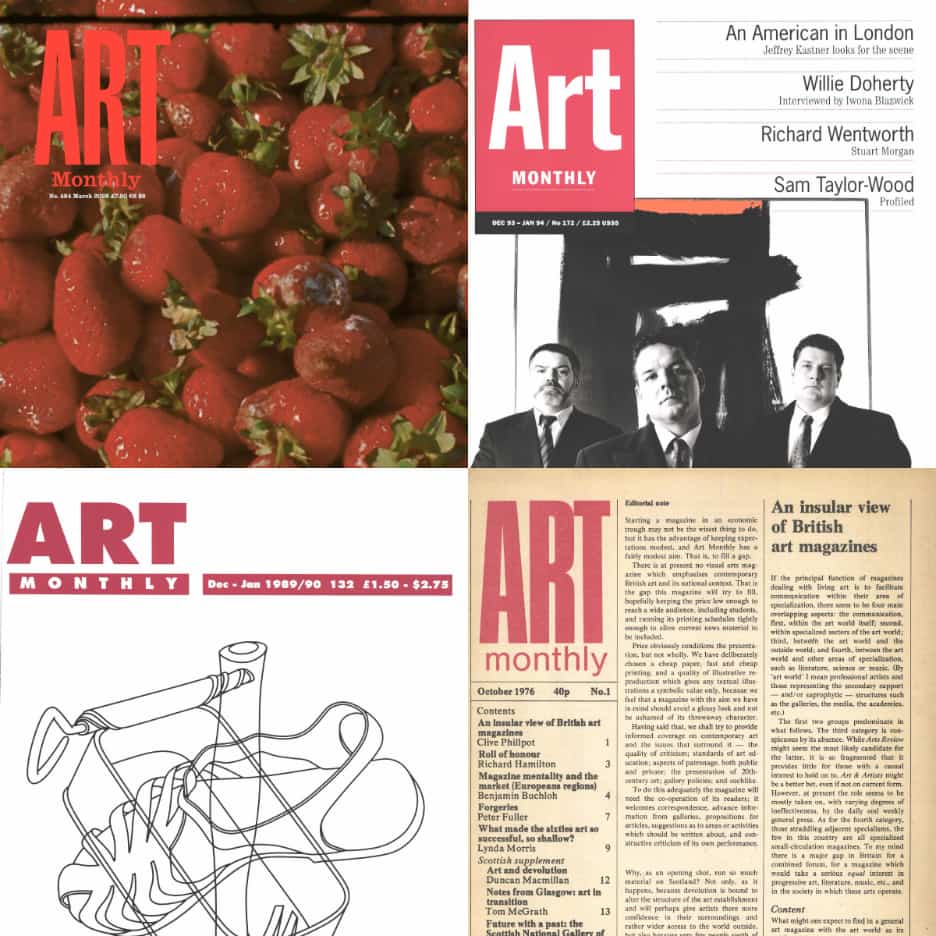
Art Monthly cover designs 1976–2026
‘All in all, the creative act is not performed by the artist alone; the spectator brings the work in contact with the external world by deciphering and interpreting its inner qualification and thus adds his contribution to the creative act. This becomes even more obvious when posterity gives a final verdict and sometimes rehabilitates forgotten artists.’ – Marcel Duchamp, 1957.
Marcel Duchamp’s insights still chime with the fact that most artists have little or no bargaining power, especially when dealing with the greater power and wealth and influence of cultural and market ‘gatekeepers’ worldwide. Private and public collectors and patrons and commissioners, plus art market professionals, continue to determine – collectively and individually – the cultural and market values of artworks, even after death.
By the 1970s, Andy Warhol had famously married fine art with commerce, of which he proudly and controversially noted: ‘Being good in business is the most fascinating kind of art. Making money is art and working is art and good business is the best art.’ Warhol was not taught business skills at art college in the 1940s, but serendipitously discovered and uniquely applied them via his mid-20th-century Manhattan studio known as ‘the Factory’. Today’s artists are unlikely to be as fortunate, especially when facing art business challenges as lone practitioners. Being solo means that to survive, perhaps thrive, artists ideally need to acquire and deploy appropriate skills to secure necessary transactions with gatekeepers. They especially need to exercise sound use of suitable legal and business tools as naturally as a painter uses a brush.
Five decades ago, in the pre-internet era, there were many contemporary art worlds located in geographically disparate territories. They connected with each other, from time to time, as a loose network of cultural institutions and marketplaces. Whether viewed separately or as a whole, they were often criticised for lacking internationally harmonised standards regulating relations between artists and gatekeepers. In particular, art marketplaces were stereotypically characterised as being opaque, private, cash-based and legally informal; these came to be likened to North America’s 19th-century Wild West: self-built societies without law enforcement, where only the fittest survived.
This was the contemporary art landscape Artlaw began to address in 1976, when the most pressing issue was widespread use of the verbal ‘gentleman’s agreement’, often sealed only with a handshake. Especially in Anglo-American jurisdictions, parties relied solely on their personal integrity, and wrongly believed them to be merely informal and non-legally binding understandings. Then, and now, fewer than half the countries worldwide follow the Anglo-American common law approach to contract formation, namely: that a formally signed written instrument is not generally required to create a legally binding and enforceable contract for most business transactions.
An additional related complication is still the notable absence of common standards, customs and practices operating throughout the contemporary art world. In response to repeated calls from artists and gatekeepers and their lawyers, Artlaw drafted illustrative forms of agreement for the most common art transactions. Initially proving to be helpful, use of these examples soon became counterproductive: too many were mistakenly believed to be prescriptive models and were used unthinkingly, without making adjustments for the uniqueness of the artwork and surrounding circumstances. Instead, a different approach was adopted, whereby broad frameworks were suggested that would then be customised by parties to meet their specific requirements and idiosyncrasies. These frames of reference did prove helpful, and have been regularly updated to incorporate experience of new and better art business practices.
Over the next five decades, there was a marked reduction in reliance on verbal-only art business agreements by artists and gatekeepers, and a corresponding increase in use of documentation, for two principal reasons: the patchwork of separate contemporary art worlds developed into today’s global ecosystem, in which most countries adopt a Franco-style civil law approach to contract creation, generally requiring some form of documentary evidence for validity; and, from the 1990s, the internet revolution tiggered growth of international digital commerce. The most frequent art and artist’s transactions Artlaw has continuously addressed are: studio sales, new artwork commissions, artist/dealer representation and, most recently, digital applications.
Future legal and business problems arise when artists sell directly to buyers, but fail to agree and document key matters at the point of first studio sales. Some artists rely on an erroneous belief that they have an automatic legal right of buy-back, even where there is no recorded agreement to do so; but, to date, no countries have legislated to give artists such an automatic right, in which case there needs to be a written sale condition recording a buyer’s undertaking to give the artist (and/or their estate) first option to rebuy the artwork in future at a fair market value.
Physical artwork deteriorates over time, and it is good professional practice for artists to always provide separate written guidance for an artwork’s care and maintenance, including: storage in sound environmental conditions; instructions for safe transportation, assembly/disassembly and display; and operation of any physical components, equipment, machinery or computer software. Omission of such matters leaves artists and first buyers without agreement on ways to address future problems, and exposes artwork to risks of being neglected or treated inappropriately.
Film/video artworks are usually sold by transferring to the buyer full ownership of the physical material or digital file, but many sales agreements do not also clarify buyers’ showing rights to third parties. To avoid future disputes, showing rights – especially to public audiences – should ideally be discussed and agreed before the sale and then included in written terms and conditions, as they are normally included in comprehensive written acquisition contracts by public-facing institutional collectors.
Dematerialisation of contemporary art activity has increased significantly since the 1970s, resulting in many different performance practices. Each work is unique and requires bespoke legal and business arrangements for exposition and/or acquisition. Where works are manifest as instructions for execution, written agreements ensure the artist’s directions and conditions for performance are respected and adhered to, and that only artist-authorised personnel may perform. Additional terms and conditions may require that ownership is transferred exclusively to a collector, and/or to a performance location, meaning that the artist undertakes not to sell re-enactment rights to others.
For successful realisation of a commission, an important starting point is the establishment of a bond of trust between artist and commissioner, which is best embodied in a written agreement reflecting the inevitably unique nature of the work and its creation. Such a contract need not be regarded as a legalistic straightjacket, but as a jointly constructed aide-mémoire and project management checklist to guide the parties through their respective responsibilities and rights during the commission process. There is no exemplary one-size-fits-all commission model.
A key challenge is often the tension between artists being confident they will be paid for delivering professional artistic skill and labour; and commissioners having rights of rejection. This dichotomy may be reconciled through provisions agreed along the lines of: specifying an overall project timescale, with staging points for artists receiving interim payments for work done and expenditure made (and contingent provisions for slippages and/or variations); and, at each stage, commissioners having opportunities to view, make constructive suggestions, approve progress to the next stage, or terminate the remainder of the commission.
Artists and commissioners should anticipate, discuss and make appropriate written provisions for an artwork’s ownership, installation and possible future modification and/or relocation. For example, clarification of: who will be the owner of the completed work after delivery; installation, especially if site-specific; and whether the artist’s transfer of ownership is on condition that if the work is planned to be changed or relocated, the artist will be consulted.
A landmark case in point concerned Richard Serra’s Tilted Arc, 1981: a large steel sculpture commissioned by the US General Services Administration (GSA) and sited in Federal Plaza, New York City. Several years later the GSA unilaterally decided to remove it. Serra strongly objected, and filed a lawsuit claiming the sculpture was site-specific and that removal would destroy its artistic integrity. His lawsuit failed, and the sculpture was removed in 1989. US federal law did not then, but since 1991 does, give US artists legal rights to prevent any intentional distortion, mutilation or other modification that would be prejudicial to the artist’s honour or reputation, and to prevent any destruction of a work.
In Central and Eastern Europe and Russia, artists and dealers did not rush into each other’s arms following the collapse of communist regimes in the 1990s and their subsequent development of capitalist economies. Artists in these countries are mostly reluctant to engage dealers as their representatives, preferring to sell new work themselves or consign them to auction houses. In these ways, artists seek to guard against what they see as the unacceptable risks of dealers influencing the content and form of their work in order to be more marketable, and of paying up to 50% commission fees to dealers (whereas auction houses typically charge sellers consignment fees of less than 10% of the hammer price). A conventional artist/dealer agreement is rare in such countries.
In India and South-East Asia, newfound wealth has stimulated buying of contemporary art, resales of which have achieved profitable returns. Such new art markets have yet to establish customary trading norms for artists and art market professionals – including artist/dealer representation agreements. This situation is similar in other growing contemporary art markets, such as Greater China, Latin America and parts of Africa.
Conversely, artist/dealer business frameworks in Western Europe and North America have been long established. They traditionally require dealers to actively promote their artists through exhibitions, brokering first sales and commissions, and sharing the proceeds (often, though not always, equally). Artists may appoint more than one dealer to represent them, in one or more territories or worldwide. Dealers rarely represent a single artist (except perhaps at the start of their dealing careers) and most represent only a handful of artists. There is no ideal model for artist/dealer representation deals, and no customary art industry standards or rules – each representation agreement is unique.
Successful artist/dealer relationships are often likened to a marriage, the success of which need not be founded on the initial legal joining in wedlock, but on sustained mutual trust. The artist trusts that the dealer believes in the work and can achieve sales at the right price; the artist relies on the dealer’s greater knowledge and experience of the art world. The dealer trusts that the artist is professionally committed to producing quality work for sales and critical recognition; that the dealer’s business and artistic advice will be welcomed by the artist; and that the representation will be long term, giving the dealer time to develop the artist’s market and cultural standing. Challenges and conflicts inevitably arise, and written agreements should ideally provide methods for resolving rubbing points and disputes – perhaps via third-party mediation.
Artists and dealers often worry about how to end their business deals. Sound solutions may be provided, along lines of: either party may terminate, by serving written notice giving a specified period for outstanding mutual (and any third party) rights and obligations being fulfilled. Such a notice provision may also apply on the artist’s death or the dealer’s insolvency/bankruptcy.
Secondary sales of contemporary art increased exponentially after the global economic downturn of 2009. Latest authoritative research shows that post-war and contemporary art resales account for around half the global spend on all types of art and antiquities. Reasons for such unprecedented high levels of buying are not yet clear, but a consensus is emerging among art market professionals that one significant factor affects contemporary art sales performance: online selling.
When selling online, customer satisfaction is a principal concern. Sound considerations include having effective systems in place for: secure online payment; timely delivery/collection; packaging; insurance for delivery/transit; protection of customer’s personal data; dissatisfied customer returns and refund of payment; and fair terms and conditions written in plain language. A fundamental matter is how best to authenticate work, preferably by providing something that can be passed on with the work when ownership is transferred (by subsequent resale, loan, gift or bequest).
Throughout art history, work was customarily authenticated by the artist’s personal signature on physical works. In the contemporary art era, an artist’s inscription on finished work has become less common, especially if made using non-traditional materials such as multi- and mixed-media; and it has become normal practice for first buyers to require an artist-signed authenticity certificate to be provided at the same time as the physical work is transferred.
The fitness for purpose of authenticity certificates in the resale market is now becoming problematic. Many post-war artists’ works were first sold before certificates were developed and used. Some artists have died, and certificates signed by their heirs and successors are often not accepted in resale markets. Many living artists refuse to certify, or demand a significant fee for doing so. There are no global industry standards for such certificates, and no monitoring or enforcement mechanisms. Use is purely voluntary and inconsistent, and fake or forged certificates have begun to emerge in art marketplaces. Digital technology, however, may offer alternative solutions to authenticity problems.
Blockchain technologies are being used by a growing number of artists and online sales platforms, predominantly in the US. Advocates of blockchain-supported digital sales contracts see them as a unique, secure, transparent mode of proving an artwork’s authenticity, and provenance of title to first and subsequent ownership. In many countries, such so-called ‘smart’contracts may not currently be legally recognised, and therefore not be binding on buyers or enforceable by artists. Some jurisdictions have enacted legislation recognising and regulating smart contracts, but most countries worldwide have yet to do so. Blockchain-supported transactions, and their successful operation, ideally require universal jurisdictional recognition.
In 2021, blockchain-supported sales of artworks minted as NFTs flooded the contemporary art market. There are two main types: artworks born-digital and minted by the original digital artist; and physical artworks digitally reproduced and minted by anyone with access to them. Art lawyers have warned would-be art NFT buyers to interrogate the written terms and conditions of sale on selling platforms before purchasing, and have highlighted the added risk of buyers’ digital wallets being hacked to steal their acquisitions by citing the caveat: ‘If it can be digitised, it can be hacked.’
Myths and misunderstandings about artists’ intellectual property rights are common among first buyers, especially purchasers of art NFTs, many of whom erroneously believe they are buying not only an artwork but also the right to reproduce or otherwise merchandise copies. It is good practice for artists to record in first sales agreements ‘for the avoidance of doubt’ provisions along lines of: the artist owns and retains copyright and all other intellectual property rights; and the buyer needs the artist’s prior written consent for any reproduction or other merchandising of copies of the artwork (or versions of it) in any dimensions and mediums (mechanical or digital).
Digital technological innovations are likely to drive a changed and improved future of the contemporary art ecosystem. Business ideas are currently being developed to create unique tamperproof ways of tracking work from the artist’s hands into possession of subsequent owners. Such ideas not only offer solutions to authentication problems but also bring further benefits to first and subsequent buyers, including: simplifying collection management; improving security systems; and providing comprehensive and accurate recording of ownership provenance. Other researchers and developers believe that technology using radio frequency identification could offer further improvements: electromagnetic fields automatically identify and track tags or chips attached to objects; and tags contain electronically stored information about the artwork.
Whether artists embrace such new applications is unlikely to depend on their willingness to take responsibility for providing accurate data about their works, but may be determined by the financial costs of doing so. And it is a melancholy truth that the majority of artists are poor.
Henry Lydiate is an art lawyer and adviser to www.artquest.org.uk.
First published March 2026.
Art Monthly celebrates its 50th anniversary and 500th issue in October 2026. Henry Lydiate marks the magazine’s 50th year by reviewing his Artlaw column since its first publication in 1976. Throughout 2026, one broad subject is explored each month, noting significant events and issues, and commenting on key changes and developments to date.










Peveril Garden Studios
140 Great Dover Street
London SE1 4GW
United Kingdom
Email info@artmonthly.co.uk