Artlaw Retrospective
Artist’s Moral Rights
Henry Lydiate on the development of artist’s moral rights
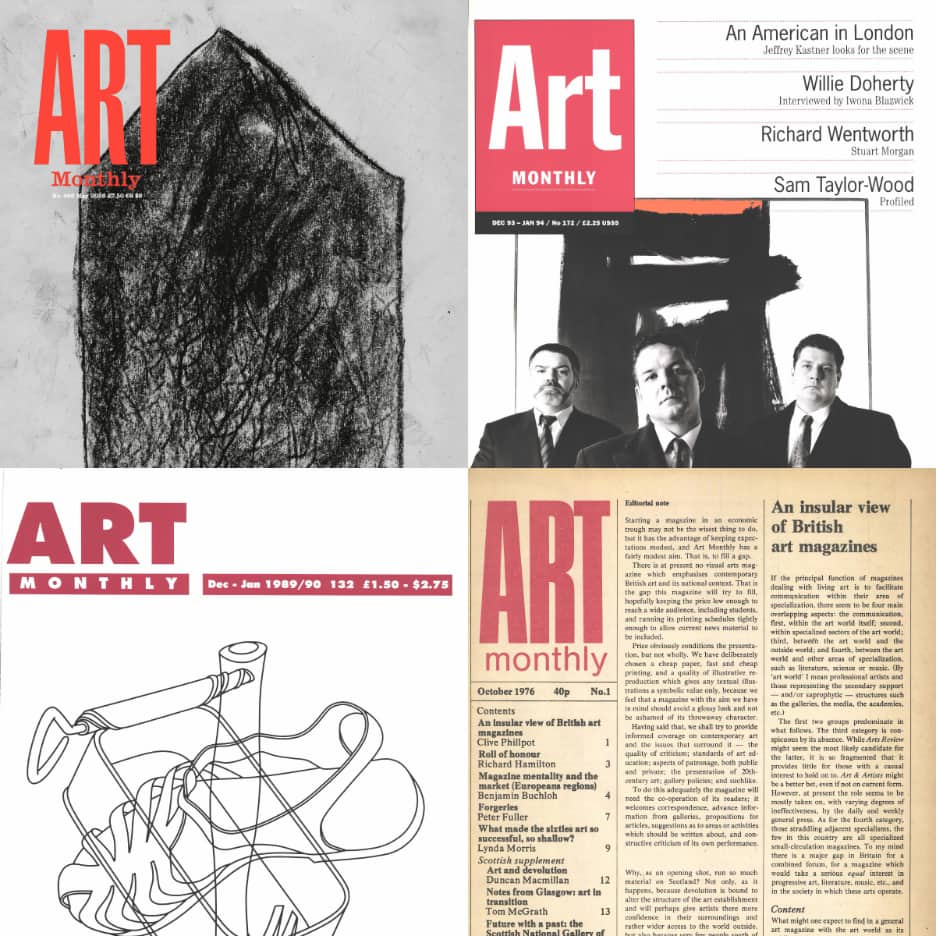
Art Monthly cover designs 1976–2026
When the first Artlaw column was published in October 1976, the UK Copyright Act 1956 needed rationalisation and modernisation. During the next decade, Artlaw not only explained the current law of artist’s copyright, but also contributed to debates for reform, responded to the UK government’s fitful consultations, lobbied parliamentarians and, especially, advocated the enactment of additional personal moral rights for all authors – including artists – of their copyright-protected works.
Moral rights had never been included in UK copyright legislation, since first enacted in 1710 and through many revisions during ensuing centuries, and were not in the 1956 Act. Instead, UK courts safeguarded the equivalent of author’s moral rights through judgments in individual cases. The earliest authoritative judicial decision was made in 1769, when Lord Chief Justice Mansfield ruled that authors should be protected against specific activities that they had not authorised:
‘It is just, that an author should reap the pecuniary profits of his own ingenuity and labour. It is just, that another should not use his name, without his consent. It is fit, that he should judge when to publish, or whether he will ever publish. It is fit he should not only choose the time, but the manner of publication; how many; what volume; what print. It is fit, he should choose to whose care he will entrust the accuracy and correctness of the impression; to whose honesty he will confide, not to foist in additions.’
Apart from an author’s right to ‘reap the pecuniary profits’ (copyright), Mansfield’s descriptions of further restrictions mirror today’s specific statutory author’s moral rights of attribution, divulgation, integrity, and retraction. Over succeeding centuries, UK judges developed forms of protection for authors against abuses of their works and reputations, which became embedded into ‘common law’ as claims for wrongs now recognised as: passing off (unregistered trademark violation); defamation of character; slander of goods; and contract breaches. These ‘judge-made laws’ were repeatedly relied upon, by successive UK governments, to avoid fixing authors’ moral rights in copyright legislation.
In 1886, the UK was a leading country influential in framing the first international treaty covering author’s rights: The Berne Convention for the Protection of Literary and Artistic Works (Berne). At the peak of the Second Industrial Revolution – heralding the dawn of the ‘age of mechanical reproduction’ – countries faced the same two fundamental copyright problems, which Berne successfully addressed: national copyright laws would no longer be inconsistent with each other, and would henceforth be amended by Berne member countries to conform to common standards; and those consistent national authors’ copyrights would be recognised by every Berne country – thereby making them enforceable throughout the signature countries of the ‘Berne Union’.
In 1908, Berne introduced further innovations, notably: copyright protection would be automatic when a work was created, and would therefore be free from compliance with any formalities; and would endure for at least the life of the author and 50 years thereafter.
In 1928, moral rights were first incorporated into Berne, the latest revised text of which reads: ‘(1) Independent of the author’s economic rights, and even after the transfer of the said rights, the author shall have the right to claim authorship of the work and to object to any distortion, modification of, or other derogatory action in relation to the said work, which would be prejudicial to the author’s honour or reputation. (2) The rights granted to the author in accordance with the preceding paragraph shall, after his death, be maintained, at least until the expiry of the economic rights, and shall be exercisable by the persons or institutions authorized by the legislation of the country where protection is claimed. (3) The means of redress for safeguarding the rights granted by this Article shall be governed by the legislation of the country where protection is claimed.’
Berne therefore requires signatory countries to enact into national legislation at least two moral rights: to be identified as author of a copyright work (the attribution right); and to object to derogatory treatment of a copyright work (the integrity right). To date, all save a score of countries worldwide are Berne signatories, and most have enacted the two minimum moral rights – notable latecomers being the UK via its landmark Copyright, Designs and Patents Act 1988 (CDPA), and the US in 1990.
On 1 August 1989 the CDPA was implemented, radically improving copyright law: arcane provisions were repealed, and replaced by a more logical and consistent new framework to protect original artistic, dramatic, literary, and musical works. The CDPA has been amended many times over the past four decades, and is the current copyright framework for artists and their works. ‘Artistic works’ are expressly copyright-protected, and are divided into three broad categories: first, works made in specified traditional forms irrespective of the ‘artistic quality’ of the image/object (namely, graphic works, photographs including holograms, sculpture or collage); second, works of ‘artistic craftsmanship’ not created as one of the traditional forms, but only if they have ‘artistic merit’; third, works of architecture being a building or model for such. Significantly, in a set of landmark provisions, the CDPA also enacted into UK law for the first time Berne’s two minimum moral rights – and added several more.
The attribution right, to be identified as sole or joint author, is exercisable when a copyright-protected artistic work is exhibited in public, published commercially, or a visual image of it is communicated or shown to the public. Unlike copyright, the right does not arise automatically, but has to be ‘asserted’ in order to be enforceable. Assertion must be made ‘without delay’: the mode of identification should ideally be included as a term in written contracts for, say: commissioning new work, licensing reproductions, consigning to agents and dealers for exhibition and sale, or to exhibition-only venues.
Assertion may best be made generally, before a work leaves the artist’s possession, by securing identification on or near the work itself, a frame, mount, plinth, or other ‘thing’ to which it is attached. Once asserted, the right endures for the same length as copyright in the work; and is inalienable, so can never be assigned or otherwise be transferred (but can be consented to, or waived/set aside in writing); but cannot be asserted by employee-artists. The right applies to works made on/after 1 August 1989; and those made before 1 August 1989, if the artist was alive at that date.
The integrity right, of a sole or joint author to object to derogatory treatment, is exercisable if a copyright-protected artistic work is changed (altered, adapted, added to, or deleted from) in a way that distorts or mutilates the work, or is in some other way prejudicial to the honour or reputation of the artist. The right arises automatically, and covers situations where a derogatorily treated work is: exhibited in public or published commercially; an image of it is communicated or shown to the public; or a work or copy is possessed or dealt with in the course of business by anyone who knows or has reason to believe has been subjected to such derogatory treatment.
The integrity right cannot be enforced in certain situations, and the more significant are when a work is: created by an employee-artist; has been modified to comply with a law or avoid the commission of an offence, such as indecency, obscenity, and public disorder; made specifically to illustrate a newspaper, magazine or encyclopaedia; or is wholly computer-generated. As with the assertion right, the integrity right endures for the same length as copyright and is inalienable; it applies to works made on/after 1 August 1989; and before if the artist was alive at that date.
False attribution of sole or joint authorship is a form of moral right not required by Berne, first enacted in 1862 by the UK’s Fine Arts Copyright Act, and continues in the CDPA. It arises automatically, when anyone is identified (expressly or implicitly) as author of any artistic work (whether or not copyright-protected) they did not make; and is infringed by committing any of the following acts with a falsely attributed work: exhibiting to the public; issuing or exhibiting copies to the public; displaying to the public associated material containing such false attribution; and possessing or dealing in the course of business with such a work or copy, knowing or having reason to believe it contains a false attribution. The right is typically enforced when artists have an established cultural or market status, and they or their heirs wish to prevent the circulation of fakes being passed off as genuine. It endures for a person’s life plus 20 years thereafter, and is inalienable.
There is a further false attribution infringement: dealing in the course of business with a work or copy that has been altered after the artist parted with possession of it, as being the unaltered work of the artist. This is an important right of artists and their heirs to intervene if, for example, unauthorised conservation and restoration issues arise; or when giving prior approval for the quality of reproductions they licence. The right is exercisable irrespective of whether such alteration amounts to derogatory treatment.
A new photographic ‘privacy right’ is introduced as a form of moral right. When photographs are commissioned for private or domestic purposes, sole or joint commissioners are given an automatic right to prohibit the commissioned images being exhibited, communicated to the public, or copies being issued to the public. The right only applies to commissioned photographs taken on/after 1 August 1989; it lasts for the same length as copyright in the commissioned photographs, so may be enforced by commissioners’ heirs, and is inalienable.
Since 1989, Artlaw has explained the operation of the CDPA, and tracked changes affecting artists. Notably, on 1 January 1996, the length of copyright was generally extended from 50 to 70 years after the artist’s death for works made on/after that date, and for works made by artists who died between 1 January 1956 and 31 December 1995. This extension applies to the length of moral rights of attribution and integrity, if the artist was alive on 1 August 1989; and of the privacy right in commissioned photographs, but only if taken on/after 1 August 1989.
Most artists are unable to afford the cost of legal advice and assistance, if needed to enforce their rights. In a minority of countries worldwide, lawyers are required by their governing professional bodies to provide an annual minimum quota of pro bono client service-hours. In most countries, including the UK, lawyers are not obliged to provide free legal services, but many traditionally choose to do so. In the US, there is a longstanding network of ‘lawyers for the arts’ providing low or no cost legal services; which is, perhaps, why Artlaw has mostly reported US-based artist’s moral rights infringement lawsuits.
In 2004, US artist Chapman Kelley’s suit included a claim for violation of his moral right of integrity, alleging mutilation of his site-specific artwork in Chicago’s lakeside Grant Park: Chicago Wildflower Works, 1984. A non-commissioned piece, the planting/installation of which Kelley initially financed and maintained for 20 years, it comprised 66,000sqft of wildflowers. The Chicago park authority bulldozed half the wildflowers and planted trees. In 2008, the trial court ruled against Kelley’s site-specific integrity violation claim. Kelley appealed and, in 2011, the appeal court decided that ‘site-specific art, like any other type of art, can be defaced or damaged’.
In 2010, a US court ruled that an artist’s moral right of integrity may be violated by public exhibition of an unfinished artwork. The lawsuit was between Swiss artist Christoph Büchel and Massachusetts Museum of Contemporary Art. The museum had commissioned Büchel to create a massive installation, Training Ground for Democracy, in its vast exhibition space. During 2006, Büchel began the installation, but stopped working at the end of the year because of his unresolved dispute with the museum over funding. To overcome the impasse, the museum decided to show the incomplete installation, and Büchel filed suit to prevent the museum doing so. In 2007, the trial court favoured the museum, ruling that moral rights applied only to completed works. Büchel appealed, and won a ruling that ‘Moral rights protect the personality and creative energy that an artist contributes to his or her work … That convergence between artist and artwork does not await the final brushstroke or the placement of the last element in a complex installation’.
In 2013, British artist Peter Doig was sued in the US by a purchaser of a painting, authorship of which Doig had repeatedly refused to acknowledge. The purchaser needed Doig’s authentication for potential resale purposes, and claimed a declaratory court judgment attributing the painting to Doig. The trial court ruled that Doig ‘did not paint’ the disputed work, and ordered the unsuccessful claimant and his lawyer to pay Doig’s legal fees of $2.5m, saying that the claim was ‘factually meritless and frivolous’. However, the case was not decided on the basis of Doig’s moral right ‘to prevent the use of his or her name as the author of any work of visual art which he or she did not create’: US statutory moral rights were not enacted until 1 June 1990, but only for artworks created on/after that date – and the disputed work was painted in 1976. It was decided on whether Doig’s refusal to authenticate wrongly interfered with the buyer’s ‘prospective economic advantage’.
In 2018, a landmark US lawsuit concerned the destruction of street art. A group of 21 artists sued a real estate developer who, for over 20 years, had permitted them to spray-paint artwork on the outside walls of his 200,000sqft warehouse in New York City. In 2013, the developer whitewashed the walls of the entire building overnight, without notifying the artists, who claimed violation of their moral rights. US moral rights law includes the right ‘to prevent any destruction of a work of recognised stature, and any intentional or grossly negligent destruction of that work is a violation of that right’. The trial court decided in the artists’ favour, and awarded them $6.75m in damages. The developer failed in his appeal to a higher court; and, in 2020, was denied a further final appeal by the US Supreme Court. This was the first time street art was legally recognised as ‘work of recognised stature’ worthy of protection under US moral rights law.
Moral rights may nevertheless be exercised by artists, especially the right to assert or deny attribution of authorship, without professional legal advice and assistance. For example, in 2018, Banksy not only officially authenticated the auction sale at Sotheby’s of a stencilled work on paper, Girl With Balloon, 2006, but also re-titled it Love Is In the Bin, 2018, immediately following the work’s infamous partial shredding, at the moment when Sotheby’s auctioneer hammered it down to the highest bidder; and further re-titled the 2018 work as Girl Without Balloon, 2021, when it was resold at Sotheby’s in 2021. In other words, Banksy thrice asserted his moral right of attribution to give essentially the same physical object three different titles – often regarded as three different artworks. Conversely, Banksy’s Pest Control Office recently denied official authentication of his street artwork, Valentine’s Day Mascara, 2023 (which had been removed from its location and was being marketed for sale); and explained that Banksy’s street works ‘are not created to be sold, are site-specific, and are gifts to local communities’.
Governments worldwide are currently struggling to keep pace with the impact of artificial intelligence (AI). Successive UK governments have been reviewing AI matters since 2017, and the latest government report was published in March 2026: Copyright and Artificial Intelligence. The government decided against immediate legislative changes to copyright and related moral rights law, and opted to maintain the status quo while gathering more evidence. The report concludes that there is no current consensus on balancing AI innovation with author’s rights: the government requires further monitoring and consideration of international developments, including lawsuits currently in train. Artlaw will continue contributing to consultations and debates on these matters, tracking and reporting them.
Henry Lydiate is an art lawyer and adviser to www.artquest.org.uk.
First published May 2026.
Art Monthly celebrates its 50th anniversary and 500th issue in October 2026. Henry Lydiate marks the magazine’s 50th year by reviewing his Artlaw column since its first publication in 1976. Throughout 2026, one broad subject is explored each month, noting significant events and issues, and commenting on key changes and developments to date.








Peveril Garden Studios
140 Great Dover Street
London SE1 4GW
United Kingdom
Email info@artmonthly.co.uk