
Feature
Back in the USSR
Sarah E James on the unwritten story of Eastern Bloc conceptualism
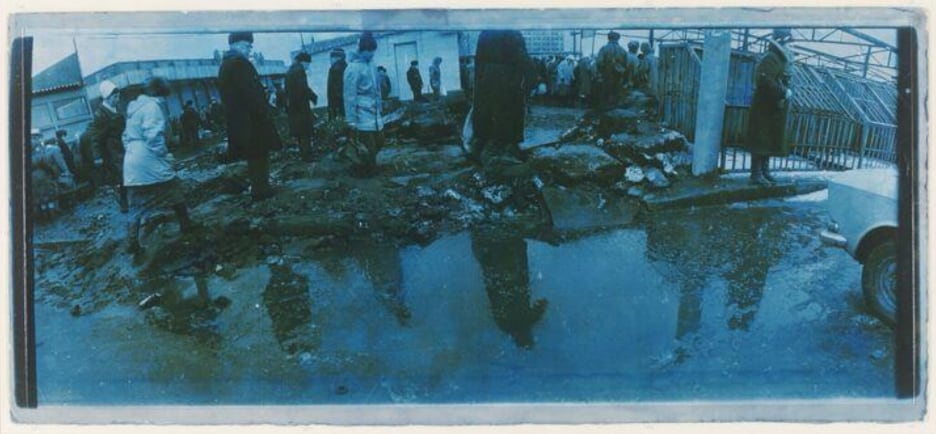
Boris Mikhailov, Untitled from ‘At Dusk’, 1996
In Rosalind Krauss’s conspicuous postmodern critique of modernism, formulated in the early 80s, she located the one constant ideology of vanguardist discourse in the dogma of originality. In the story of postmodern art production now associated with the October critics, and one further cemented in their huge recent publication – more a new testament than a manifesto – Krauss claims that behind the creed of Modernism’s originality, it is the copy that consistently lurks below the surface, as its repressed other. Further, it is Modernism’s hegemony of the visual that is understood as having refused language and, hence, the inherent self-reflexivity that might have splintered its own mythology. It is only in the works which exemplify Krauss’s American conceptualism that the copy finds ecstatic liberation in an art that incorporates both photography and language, celebrating the copy’s repetitive form and dismantling Modernism’s many myths.
It has now become somewhat passé to critique this postmodern critique, and that is not an argument that needs re-rehearsing here. The main complaints against this Postmodernism have been found in its construction of a very homogeneous American – and thus Greenbergian – Modernism. So Postmodernism becomes a product of the American positivism and formalism that preceded it. Yet there is another way to displace this narrative from within the postmodern moment itself. If the unfurling of the postmodern project accelerated in the 70s and came to its peak in the 80s, within these decades an entirely different art historical narrative was unfolding in the Soviet Union and the Eastern Bloc. Putting Krauss’s text back into its historical and American context reminds us that this ‘critical postmodernism’ was developed in a period before Gorbachev’s perestroika, when Ronald Reagan was president and the Cold War was still in place. The conceptualism unfolding in those artworlds that stood in sharpest antithesis to America played no role in the dominant construction of art’s histories in the 70s or 80s. Yet it is here that the central paradigms of the postmodern project – the copy over original, and language over the visual – can, crucially, be seen as displaying completely different inflections.
Amazingly, the Conceptual Art of the Soviet Union and its satellites (Hungary, the German Democratic Republic, Poland, Romania, etc) still lies outside the majority of art historical narratives, even though the increasingly globalised artworld – hungry for another version of political practice – has begun to exploit the artistic production of these countries. This shift has mostly involved the examination of recent practices in relation to the question of art production and post-communism. The earlier practices that developed in the unofficial artworlds of these socialist states in the 70s and 80s are ignored. It is these parallel histories of conceptualism that still need writing. Even recent anthologies, like Michael Corris’s Conceptual Art: Theory, Myth, and Practice – that sought to broaden our previously narrow approaches to conceptualism and to develop a well-needed historiography of this period – completely neglected the conceptualism of the Eastern Bloc. In the last decade, the exhibitions and publications surrounding the Norton and Nancy Dodge Collection of Nonconformist Soviet art in New Jersey have done much to promote the study of Soviet conceptualism in America. However, that this is something only just beginning to take place is shown by the fact that the exhibition curated by Zdenka Bodovinac, ‘Interrupted Histories’ – held earlier this year at the Museum of Modern Art Ljubljana – was one of the first of its kind to specifically address the histories of this art. Similarly, only recently has the establishment of an appropriate academic forum been undertaken in the United States. The first major conference dedicated to exploring the practices of underground literature and artistic activities in the last decades of the Eastern Bloc took place at the University of Pennsylvania last April. Yet, beyond excavating the histories of Conceptual Art in the former Eastern Bloc, this work also needs to be considered in relation to American postmodern narrative, so as to disrupt its hegemony. Here, I want to try to do just that, considering Soviet conceptualism in terms of three of those postures now paradigmatic of Anglo-American conceptualism and, in turn, the postmodern: the ‘absorption of photography into art’, the ‘linguistic turn’ and the ‘critique of the art object’.
The copy was not the repressed other of Russian Modernism, but became its central philosophy. Although Socialist Realism is now mostly defined as a visual language, its basis was first of all a method of disseminating art: the broadcasting of visual material to the masses. In fact, the unique, ‘handmade’ work of art was even treated as a half-finished product intended for reproduction. The turn to photography in Soviet art was originally underwritten by the communist art project, which was not orientated towards the creation of unique objects, but toward distribution. In this, the avant-garde artists and the state were unanimous. In the reproduction, differences between painting and photography were removed. Like its American counterpart, Soviet conceptualism was largely defined by the absorption of photography into art practices. However, as a result of the already established central cultural position of the copy, radical Moscow conceptualism which developed in the 70s – in exact antithesis to American conceptualism – actually sought to deconstruct the law of mass distribution: of the copy. As Ekaterina Degot argued in her essay ‘The Copy Is the Crime: Unofficial Art and the Appropriation of Official Photography’, it was the idea of the radical but unique art object that became central to this conceptualism’s critique. The Soviet state’s orientation towards mass media was subjected to critique by ‘intimate media’: in artist’s samizdat magazines, newsletters and personal archives, so that the uniqueness of the art object offered a form of political resistance. This emphasis on the unique saw the proliferation of conceptual practices in the 70s and 80s which employed the overpainting of photographs, such as Boris Mikhailov’s snapshots, hand-coloured with aniline dye; Boris Orlov’s intricately repainted collages; Galina Moskaleva’s beautifully stained photograph albums, or Vladimir Kupriyanov’s crumpled series of rephotographed found portraits, which aestheticised and individualised the photographic, emphasising its material and historical nature.
Importantly, the privileging of the copy that such artists reacted against was not simply a result of political oppression, or any abrupt fissure in Krauss’s modernist narrative, but instead can be understood as extending far back into the Russian Avant Garde itself. For Krauss, it is the painted grid that is central to Modernism, and that provides her with the clearest example of the repression of the copy. In tracing the history of the grid, Krauss turns to the monochrome colourfield painters of Modernism, and consequently Malevich plays a central role in her thesis. Conversely, the crisis of the Russian Avant Garde in the 20s meant that photography had ruined painting’s modernist prison long before Krauss’s postmodernists. It was actually Malevich’s disciple, Gustav Klucis, who, in dealing with his suprematist heritage as early as 1919, deconstructed the grid by introducing photographic fragments into Malevich’s square, beginning the avant-gardist exploration of photomontage. Importantly, the inclusion of the photographic did not orchestrate the indexical shift synonymous with its later incorporation in American work, but was underwritten by the iconicity of the medium – the irrepressibly documentary nature of photography – which enabled both a valuable link to the real, and the possibilities of mass collective reception. A similar crisis of the Avant Garde of the West had led to the entrenchment of modernist ideals and the proliferation of the grid. In the Soviet context the paradigm of a visual hegemony deconstructed in an indexical shift is therefore reversed. And the pure indexicality of Modernism’s formalism is already disrupted by the incorporation of iconicity.
The Conceptual Art that developed in the unofficial Soviet artworld in the 70s shared many characteristics with its American equivalent, one of them being the centrality of language. Indeed, the beginning of the use of text in Soviet conceptualism can be seen in Ilya Kabakov’s 1972 work, Ten Characters. However, while American conceptualism ushered in art’s linguistic turn and the promotion of the text, which deconstructed art’s former meanings, within Moscow conceptualism an emphasis on language meant a return to narrative, representational and literary forms. Language was explored as a way to articulate a new-found scepticism towards the possibilities of the individual and the historically significant gesture. However, unlike the endless semiotic deconstruction that coloured intertextuality in the American context, Moscow conceptual artists such as Kabakov understood narrative text materially and visually, in terms of its status as, in Boris Groys’s term, a ‘text-object’. Here, in works like Kabakov’s Where are They? from 1979, text is fully desemanticised, privatised and made into visual motif. This once more related back to the specific experience of Modernism in the Soviet context, and can be understood as conceptualism’s reaction to the earlier dominance in unofficial Russian art in the 1950s of the neomodernist ideal of ‘pure painting’, itself a reaction to the realistic impulses and rigidity of Socialist Realism.
If the absorption of photography into art by American conceptualism was aimed at the critique of the traditional art object and painting’s unique gesture, this was not true in the Soviet context. As Groys has argued, painting had long since deconstructed itself and had turned itself into the standard language of mass culture, fulfilling the same role in the Soviet Union as commercial photography had in the West. So Moscow conceptualism utilised Soviet painting and mass book illustrations in much the same way that Western conceptualism utilised photography. This meant that Soviet conceptualism – and its postmodern critique – was framed in terms of restaging the materialism of the artefact and art object, as opposed to its textual deconstruction. For example, the conceptual photography of Francisco Infante – coloured by his interest in Suprematism, and particulary its space-creating qualities – informed his concept of the ‘artefact’, and thus his materialist conception of photography. The lack of a new hegemony of the text, as championed by American conceptualism, meant that visuality was not rejected: artists explored a visual language for telling stories; for re-literalising art after it had been de-literalised during Modernism. The performances of Rimma Gerlovina and Valeriy Gerlovin used black and white photography as an instrument to visualise verbal metaphors. Meanwhile, the group Collective Actions used photography to make strange the visual field of perception, appearance and light.
This emphasis on visuality also stretches back into Russian Modernism, and can be understood as a result of the much less clearly demarcated boundaries between painting and photography. Unlike photography’s struggle against the dominance of painting that took place in America in the 70s, in the Soviet context a much more confused and dialectical understanding of the relationship between painting and photography evolved. The boundaries between the two media were particularly blurred because both were understood primarily as sites of reproduction, a function which obscured medium specifities. For example, Rodchenko had begun to use an intermediary technique between photography and painting as early as the mid 30s. At this time huge photo-frescoes were also developed which involved direct photographic printing onto stone walls. Meanwhile, photomontage’s iconic style and forms were to reemerge later in painting, graphics and drawing. This slippery post-medium condition of art, so different to Krauss’s formulation, was also seen in the 70s, when many ‘art’ photographs were exhibited as high-art ‘paintings’, glued onto pieces of thick cardboard. And it was these half-photograph, half-painting collaged pictures that inspired a generation of Moscow conceptual artists, including Kabakov, Eric Bulatov, Oleg Vassiliev and Mikhailov. Similar values can be seen emerging in the conceptual practices of the other Eastern Bloc countries where, after all, comparable frameworks were provided by the backdrop of Socialist Realism and the development of unofficial artistic cultures.
In American postmodernism, conceptualism (and especially its incorporation of the photograph) is understood in terms of a strategy manifestly derived from Duchamp’s readymade. However, that Krauss is well aware of other moments of Modernism that do not fit so neatly into her postmodern narrative is demonstrated by the fact that she frames her approach to the copy with Walter Benjamin’s canonical 1935 essay on reproducibility. In so doing, she alludes to the modern discourses that did not repress, but celebrated the copy. Benjamin’s essay itself was derived, as Krauss’s colleague Benjamin Buchloh has stressed, from a text that predated it by more than ten years. This was a Soviet thesis by one of Alexander Rodchenko’s colleagues, Varvara Stepanova. It is such moments of transformation within the modernist paradigm that have great implications for the postmodern experiences in Soviet art, the former Eastern Bloc, and Europe more generally. The problem with Krauss’s narrative of conceptualism and Postmodernism is not that it is limited to the American context, but that it has become the oft-applied paradigm for all postmodern production. If we are to critique the critical vanguard of October, their failure lies in not announcing this paradigm more explicitly as an American postmodernism. In defining it so, the need to turn to the construction of conceptualism’s other postmodern narratives is made clearer. It is here, in the unwritten story of these conceptualisms – on the other side of the Iron Curtain – that we find the possibility of a much more differentiated understanding of art’s histories after Modernism. Crucially, it is in these neglected narratives that the expression of a Postmodernism which is not limited to those terms set by the cultural logic of late capitalism can be found.
Sarah E James is a writer and art historian.
First published in Art Monthly 302: Dec-Jan 06-07.










Peveril Garden Studios
140 Great Dover Street
London SE1 4GW
United Kingdom
Email info@artmonthly.co.uk