Feature
Conspiracy
Anna Dezeuze asks whether artists might counter alt-right conspiracy theories
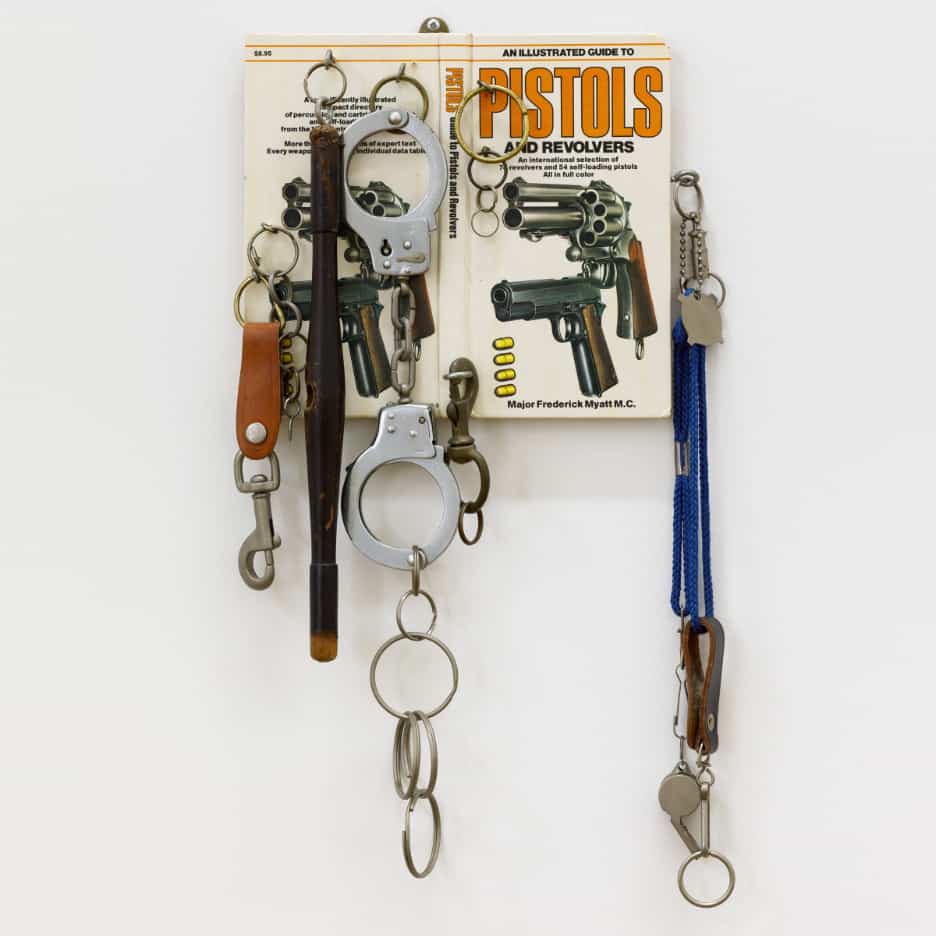
Cady Noland, Percussion and Cartridge Revolvers, 1984
Anna Dezeuze asks whether it is possible, in an era in which politics and social media are dominated by alt-right conspiracy theories, to turn the tide in a positive direction.
Do you remember when conspiracies used to be fun? ‘The truth is out there’, we used to joke, with reference to the X-Files television series (1993–2002). We enjoyed sprawling books and films – such as Don DeLillo’s 1998 Underworld, Paul Thomas Anderson’s 1999 Magnolia, Iñárritu’s 2000 Amores Perros – in which polyphonic plot lines would intersect in a mix of the epic and the mundane, paranoia and randomness. It was all about connecting the dots, finding the invisible knots between apparently unrelated entities. A hypnotically droning voice in a 2006 video work by Lars Laumann laboriously expounded, track by track and with the help of numerous film clips and trivia, a conspiracy theory found on the internet that supposedly demonstrated how Morrissey had predicted Princess Diana’s death in The Smith’s 1986 album The Queen is Dead. In a 2014 video, Laure Prouvost’s trademark whisper promised to instruct us on How to make money religiously by deciphering an incongruous montage of found and filmed images, words, facts and fiction. Prouvost’s vocabulary evoked both the constant solicitations of web and media advertising, and the worn-out clichés of the spy and detective genres that have been suffused, since their joint birth in the 19th century, by a form of social paranoia. Indeed, as sociologist Luc Boltanski showed in his 2012 analysis of Enigmas and Plots, both genres emerged at a specific historical junction in which modern nation states sought to establish an everyday normality that would be predictable, legible and stable. The flows of capital that were already threatening this official project at the time have been relentlessly eroding the authority of democracy and nation states ever since. This is why Frederic Jameson would describe conspiracy theory in 1988 as ‘a degraded figure of the logic of total capital, a desperate attempt to represent the latter’s system’.
As Peter Knight argued in his 2000 book Conspiracy Culture: American Paranoia from the Kennedy Assassination to The X-Files, however, the conspiracy theories that were thriving as never before at the turn of the 21st century appeared to be significantly different from the long tradition that preceded them. Whereas previous conspiracy theories tended to bolster ‘moral certainties’ through bad old ‘single-issue’ scapegoating, by the millennium Knight had observed ‘a more fluid and contradictory rhetoric of paranoia’.
It is precisely this fluid and contradictory space, I would suggest, that allowed contemporary works to mine the ‘degraded’ conspiratorial for new forms of humour and poetry. The voice-over device used by both Laumann and Prouvost figured as a recurrent feature of other works that I associated with conspiracy at the time. In a 2008 filmed lecture delivered in faltering English, Patricia Esquivias tries to convince us of the similarities between 16th-century monarch King Philip II of Spain and pop singer Julio Iglesias by propping cuttings and postcards against her laptop screen and using elaborate diagrams to support her argument. In Camille Henrot’s memorable Grosse Fatigue, 2013, it is the spoken-word voice-over that beautifully weaves together a history of the origins of the world from a dizzying proliferation of objects and images accumulated by the artist during her research residency at the Smithsonian Institution, through both encounters with objects and people, and long hours spent trawling the museum’s online catalogue and using common internet search engines.
‘In the contemporary context of the endless dissemination of information, where over-communication and over-saturation must constantly be navigated,’ reflected Henrot at the time, ‘efforts to gather and structure knowledge in a totalised worldview resemble an … artistic project’, with ‘subjectivity and imperfection inevitably creeping in.’ Such reflections on the construction of knowledge resonated, simultaneously, with debates surrounding the figure of the artist-as-researcher (in the context of practice-based PhDs) and with practices delving into the ‘over-saturation’ of images and information in the age of the internet. Out of both these drives seemed to emerge a new kind of ‘artist-iconographer’, as Garance Chabert and Aurélien Mole called it in 2009. Arranging constellations of images of different natures, origins and periods, such artists seemed more concerned with the intervals between them than with the images themselves, ie with those invisible knots that connect them together.
The grandfather of such image-based projects was of course art historian Aby Warburg, whose unfinished Atlas Mnemosyne, started in 1924, became a key reference to many artists and curators in the first 15 years of our century. The appeal of the Atlas lay partly in Warburg’s combination of research and intuition, his belief in the power of images to communicate symbolic meanings across various contexts, and his potentially infinite material rearrangements of images that invite viewers to grasp what connects them. Photographs of Warburg’s pinned images on their black-fabric backgrounds bring to mind the opening windows on Henrot’s desktop in Grosse Fatigue as much as the detective’s evidence board.
These contemporary artists’ meandering dérives through this brave new internet world of images made me think of André Breton’s 1937 reflections on the ways in which we wander every day through a forêt d’indices – a forest of signs or clues. It is because we are limited by a narrowly rational understanding of the world, he explained, that we fail to read these clues. Furthermore, if we try to decipher reality without the right (surrealist) tools, we risk being overwhelmed by a délire d’interprétation, an interpretative delirium – the very term used by psychiatry at the time to describe paranoia. In contrast to Breton, Salvador Dalí celebrated this interpretative delirium by inventing, in 1930, what he called the ‘paranoiac-critical method’. The appeal of paranoia for Dalí lay in the systematic, coherent and irrefutable logic of the narratives that the paranoiac subject endlessly constructs with the apparently unrelated clues scattered around Breton’s forest of signs. Dalí embraced paranoia as a motor to concoct delirious interpretations and crackpot conspiracy theories: often humorous and provocative, they affirmed a desire to investigate reality – like that of the detective or the researcher – while at the same time undermining their authority by emphasising the potentially infinite and profoundly biased nature of such projects. In the first two decades of the 21st century, contemporary practices seemed to be exploring this fault line between Breton’s desire to find secret meanings and Dalí’s paranoiac delirium. The material grain of human voice-overs in the above-mentioned works by Henrot, Prouvost, Esquivias or Laumann betrayed the fragile subjectivity of stories cobbled together out of fragments; this playfulness spoke of an optimistic belief in the pedagogical potential of constructing legibly fictitious conspiracies, and in the promise of imbuing images with new meaning by questioning their materiality and circulation.
This, broadly speaking, is what I was arguing in a conference paper that I gave in New York in February 2017, but, as I was speaking, this perspective suddenly felt eerily out of touch, and the works under discussion already seemed to belong to another era. With Donald Trump’s inauguration as president a month earlier, it seemed that conspiracy, and its particular modes of constructing stories from reality, had officially moved from the margins to the centre. Rather than a space for speculation, humour and reverie, the ‘fluid and contradictory rhetoric’ of conspiracy had become a battlefield. Did this new shift, which reflected the global changes in politics and economics that still resonate today, mark the end of conspiratorial aesthetics altogether?
This very turn in ‘aesthetic and intellectual affinities between recent art and conspiracy’ is what AM contributor Larne Abse Gogarty addresses in her new book What We Do is Secret: Contemporary Art and the Antinomies of Conspiracy. The author’s own wake-up call literally occurred in the middle of the night following the UK general election in December 2019, when she lay awake thinking ‘about how nationalism and racism and impoverishment had suffocated everything that felt momentarily possible’ – and about ‘the kind of conspiracy we might need’ to counter this situation. Crucially, this involved pitting two different kinds of conspiracy against each other: a kind of clandestine ‘conspiracy as criminal act and militancy’ that could, perhaps, defeat the other kind of conspiracy, or ‘political plot’, which presents a static vision of history as a tautology through which domination is constantly affirmed under various, though ever wilier, guises.
Unpacking the implications of Jameson’s above-mentioned statement, for example, Abse Gogarty underlines the hierarchical nature of the domination that it sets up between the intellectual, who can grasp ‘the logic of total capital’, and the ‘poor person’ – as Jameson literally described him or her – who is ‘desperate’ to understand it by elaborating ‘degraded’ conspiracy theories. In her introduction, Abse Gogarty draws on a number of gender and race-based critiques to demonstrate how this hierarchy establishes a close complicity between, on the one hand, a supposedly superior way of understanding the world and constructing knowledge and, on the other hand, the ways in which such tools are used for the political domination and economic impoverishment of others. What if, instead, the narrative drive, subjective associations, personal experiences, naming of names and specific events – all privileged by conspiracies – were as valid as the theories, systems and abstractions elaborated by intellectuals and capitalists? Rather than replacing the latter with the former, however, Abse Gogarty seeks ‘to carve out a position that retains an abstract concept of capitalist totality alongside one that pays attention to how this is experienced, subjectively, by individuals and communities’. Instead of dismissing conspiracies as signs of ‘stupidity’, she wants to read them as bearing the scars of ‘wounded thought’. In the same way, she argues, conspiratorial artworks can bear witness to the ‘unfree existence’ that they are simultaneously trying to escape by imagining new spaces and narrative modes.
The expression ‘unfree existence’ is borrowed from David Lloyd, and it is nothing less than ‘the racial regime of aesthetics’ as a whole, analysed in his book of the same title, that is at stake here. Given Abse Gogarty’s attraction to the conspiratorial, it may be no coincidence that her ambitious reflections on the underpinnings and history of such abstractions as aesthetics or the sublime are easier to follow when they are grounded more precisely in case studies and personal reflections. Her first chapter, for instance, offers excellent insights into the politics of ‘post-internet’ art – a category first delineated in 2008 but already declared useless in 2015 by critics such as Morgan Quaintance (‘Right Shift’, AM387). Abse Gogarty agrees with Quaintance that the 2016 Berlin Biennale curated by the DIS collective sounded post-internet art’s death knell, and that it was never so much a movement as a ‘style’. Interestingly, this chapter situates the political stakes of this ‘style’ in relation to a most dramatic episode in post-internet art’s brief history: the controversy, that Abse Gogarty first discussed in the pages of this magazine at the time (‘The Art Right’, AM405), surrounding London-based LD50 gallery’s hosting of an ‘alt-right’ exhibition and conference in 2016 and 2017.
In case you were wondering, as I certainly was, what a post-internet ‘alt-right’ exhibition in an art gallery might look like, the author provides a few pointers. On the one hand, the exhibition offered a platform for explicit contents such as tweets by so-called alt-right personalities ‘printed on acrylic’ and mass shooter Elliot Rodger’s video manifesto ranting against the women who rejected him. (Less explicit perhaps was the exhibition’s title, ‘71822666’, which referred to a thread on the notorious 4chan online imageboard predicting Trump’s election victory.) On the other hand, a combination of candles, flowers, altars, crystals and a ‘robotic sculpture’ bore affinities with an ‘aesthetics of the far right … conjuring the arcane and the futuristic simultaneously’. This kind of aesthetics, according to the author, finds its counterpart in global post-internet practices with no known far-right affiliations. Furthermore, such ironic modes of address, widely mobilised by the ‘alt-right’ on social media, also turn out to be typical of a brand of post-internet art which Abse Gogarty terms ‘flat-unmediated-aspirational-nihilism’. A useful comparison is suggested between the invitation to ‘71822666’ and posters advertising the 2016 Berlin Biennale by Babak Radboy and Roe Ethridge reproduced later in the chapter. The former, according to the author, consisted of ‘a photograph of pop star Taylor Swift’ (an icon of ‘alt-right’ groups at the time) ‘with a quote by Adolf Hitler’ and the logos of two neo-Nazi organisations. The latter, included in the Berlin Biennale’s self-described ‘marketing campaign’, displayed what seems to be an image of a woman in an electric wheelchair alongside a question: ‘Why should fascists have all the fun?’ For Abse Gogarty, the irony of this post-internet ‘flat-unmediated-aspirational-nihilist strain’ enacts a violent ‘dissolution of meaning’, which ushers in ‘a dissolution of history and the erasure of any specifics to the exploitation, domination, and violence that structure our world’. The second strain, which she terms ‘excessive-particularising-metamorphic’, remained obscured in this Biennale; it was embodied in a single work by Ryan Trecartin and Lizzie Fitch, which differs from the smooth, seamless, floating aesthetic of the first strain by foregrounding cheapness, discomfort and the endlessly awkward ‘forms of relationality’ generated in a space ‘dominated by capital’. Whereas the first strain operates as a form of ‘conspiracy as political plot’, the second is ‘tied’ to Abse Gogarty’s preferred model of the artwork as ‘criminal act’.
The case studies in chapters Two and Three, which involve more in-depth analyses of artists’ works, offer yet another contrasting pair reflecting the author’s binary model of conspiracy. Trevor Paglen’s practice typifies what Abse Gogarty describes as a brand of ‘legibly political art’ (also typical according to her of works by Hito Steyerl and Forensic Architecture) that purports to lift the veil on hidden data to help viewers understand and protect themselves against abuses of power. Paglen’s work often hinges on the relation between seemingly innocuous photographs and their highly specific titles that inform us of the subjects’ role in various covert state-surveillance operations. For example, a C-print of an ordinary New York beach is juxtaposed with a mixed-media collage of pictures and data on a navigational chart in a 2015 diptych titled NSA-Tapped Fiber Optic Cable Landing Site, Mastic Beach, New York, United States. For Abse Gogarty, this shores up the opposition between a ‘sublime’ (because unknowable and ‘unrepresentable’) hidden reality and the Jamesonian figure of the intellectual/artist who will bring an enlightening transparency, such as the heroic Edward Snowden, whose archives Paglen quoted directly in this diptych’s collage.
In contrast, Abse Gogarty argues, the works of Cady Noland in the 1990s refused such a ‘magisterial view’ by stressing a kind of ‘invasive proximity’ that undermines any claim of higher moral or scientific authority. Instead of presenting information in a didactic manner, Noland’s work ‘arrests materials and images’, ‘prompting a mode of looking that is suspicious’ – just like the conspiracies deemed criminal by the state. Noland’s ‘chain-link fence sculptures’, Abse Gogarty demonstrates, invite viewers to sense the authoritarian system in contemporary North America wherein fences protecting inner-city schools eerily look just like fences keeping prisoners in jail, spelling out a dark plot connecting education to incarceration. When analysing another series of Noland’s, which uses images of Patty Hearst and the far-left Symbionese Liberation Army (SLA), Abse Gogarty traces a history of revolutionary thought and figures who have sought to break the enclosures of such everyday repression. Most interesting in my eyes are the ways Noland explores, according to Abse Gogarty, the ways in which the ‘political imaginary’ that such images conjure varied according to their contexts. For example, according to the author, Noland’s use in her 1991 SLA Group Shot with Floating Head of a still from Paul Shrader’s ‘dreadful’ 1988 film Patty Hearst, rather than the original group portrait, reflected a widespread neoliberal demonisation of the 1960s protests. At the same time, Noland cut out the head of the SLA leader at the centre of the group’s hydra-symbol, thus leaving a space to be occupied by past revolutionary figures such as Cinqué, the black hero of the 1839 Amistad mutiny whose name was adopted by SLA leader Donald DeFreeze in a desire to position himself as heir to a ‘legacy of Hydra-like resistance’.
The last chapter centring on Ima-Abasi Okon’s 2019 exhibition at Chisenhale Gallery (Profile AM428) is the one where the author experiments with a more subjective form of experiential writing and lets herself be guided by her sensations in the installation. As air-conditioning units circulate a distorted song, as cutglass lamps filled with Courvoisier and palm oil diffuse a ‘sticky orange light’, as absent bodies are convoked by a combination of ultrasound gel, insulin, morphine and the artist’s mother’s gold jewellery placed on the ceiling, a suspended space of shared pleasure and imagination opens up in the text. Abse Gogarty reminds us that the etymology of conspirare means ‘to breathe together’; this kind of conspiratorial space, she intimates, is precisely what is needed in a context in which all attempts at resistance are being ‘suffocated’.
Okon’s installation, and Abse Gogarty’s repeated references to fiction, poetry, and music such as jazz and R&B throughout the book, point to a trend that I have been observing more generally. Instead of the techniques of montage and Warburgian constellations accompanied by delirious voice-overs, typical of the conspiratorial aesthetics discussed earlier in this article, artists seem to have since turned to enigmatic fragments, drawn from science fiction or the increasingly global socio-political histories of lesser-known fields such as popular music or botany. These fragments invite us to decipher them, in a kind of ‘request’, to borrow one of Abse Gogarty’s terms, ‘of a commitment without any promise of what that commitment might deliver’. Significantly, such clandestine manoeuvres stay clear of the logic of paranoiac storytelling favoured by the earlier practices mentioned above – perhaps because it mimicked too closely the systems and authority that it sought to undermine. Rather than the solitary lecturer, researcher, iconographer or detective staring at their ‘crazy walls’, an artist such as Okon seems more akin to a storyteller inviting us to partake in the breathing, spontaneous sociability of the fable. I might miss the light-hearted humour of the previous yarns, but it’s not all glum.
Anna Dezeuze is an art historian.
First published in Art Monthly 471: November 2023.






Peveril Garden Studios
140 Great Dover Street
London SE1 4GW
United Kingdom
Email info@artmonthly.co.uk