Artlaw Retrospective
Art After Death
Henry Lydiate on the legal wrangles over artists’ estates
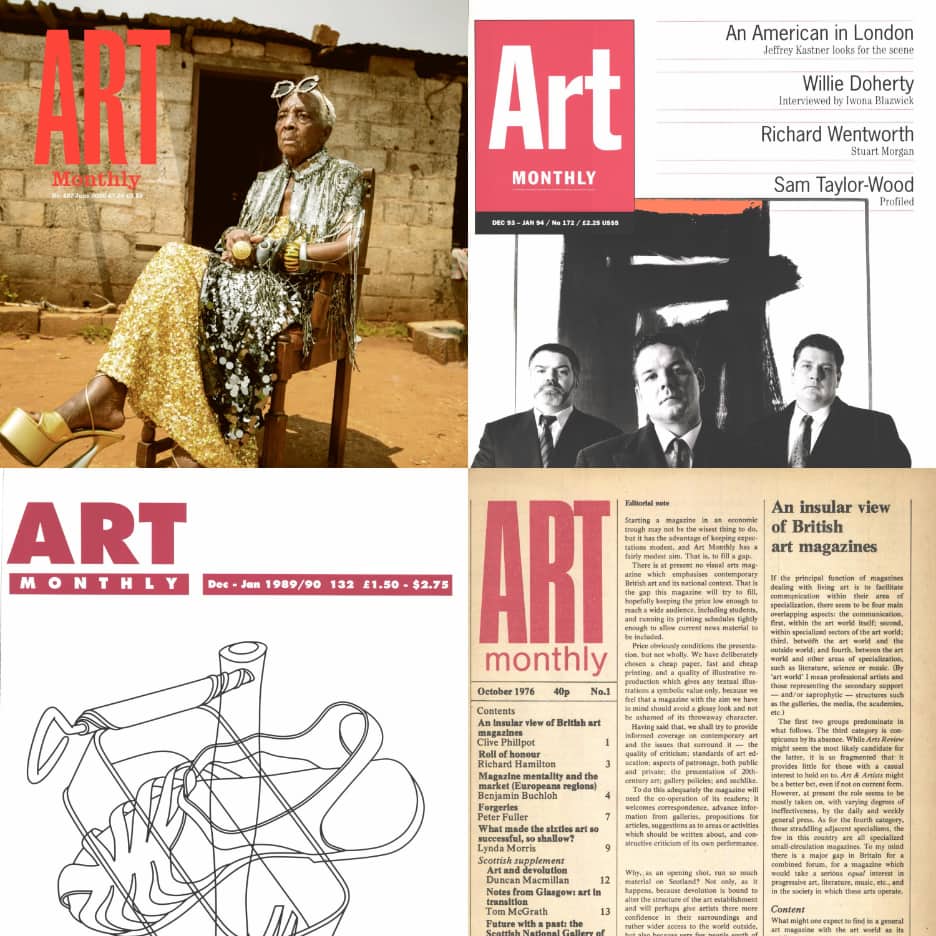
Art Monthly cover designs 1976–2026
When Artlaw’s first column was published in October 1976, interest in art after death had already been stimulated through discussion with artists about Marcel Duchamp’s life and work, and especially by the surprising posthumous revelation, within a year of his death in 1968, of his secretly made artwork: Étant donnés: 1° la chute d'eau / 2° le gaz d'éclairage, 1946–66. The origination and post-mortem completion of this final work is a remarkable example of an artist meticulously planning for posterity.
Artlaw’s intellectual engagement with Étant donnés turned towards legal consideration of art after death early in 1976, when the result of the Rothko Estate lawsuit was briefly reported from the US. This was evidently a landmark case that demanded thorough investigation. Consequently, Artlaw visited the US and interviewed artists and attorneys, including the assistant attorney general for New York State, who had pursued the Rothko litigation. Research and analysis, and key takeaways for artists, were reported extensively in Art Monthly’s fifth issue.
In February 1970, Mark Rothko was found dead in his Manhattan studio. He had overdosed on barbiturates and cut an artery in his right arm with a razor blade. There was no suicide note. He was 66. In 1968, Rothko had made a Will: his widow was left money and their town house containing 44 of his paintings; his Seagram artworks were given to London’s Tate; and the rest, his ‘residuary estate’, was bequeathed to the Mark Rothko Foundation (MKF), a charity he established shortly before his death ‘to provide financial grants and assistance to artists’.
The Will’s executors were Bernard Reis, Theodores Stamos and Morton Levine. Their duty was to distribute the estate. Rothko’s stock of 798 paintings in his residuary estate was worth more than half the entire estate, but the Will did not specify precisely what should happen to them. In May 1970, the executors concluded two agreements: the sale of 100 paintings; and a 12-year consignment of the other 698. Both contracts were with Rothko’s New York City dealer, the Marlborough Gallery.
In July 1970, Rothko’s widow contested the Will, claiming that the residuary estate, especially the 798 paintings, belonged to her and not MKF. Her claim was based on New York State’s inheritance laws, which did not allow more than half the total value of an estate to be left to charity. The court granted her claim, ruling that the bequest to MKF was legally invalid, entitling the widow to inherit the residuary estate as Rothko’s next-of-kin. A month later, the widow died and her now orphaned children – Kate, 19, and Christopher, 6 – inherited the residuary estate as her next-of-kin. The children asked the executors for paintings instead of money.
In June 1971, the children learned about the executors’ two agreements with Marlborough, filed a suit against them, and were immediately granted a court injunction ordering Marlborough not to dispose of the contested paintings. The children wanted the agreements set aside, artworks returned, and the executors removed: they alleged that the executors had wrongly sold the paintings to Marlborough, and at such low prices as to be a fraud on Rothko’s estate.
In December1975, the court set aside the two agreements. The executors were found to have acted in breach of their duty of loyalty to the estate, by making agreements they knew to be unfair; and Marlborough was found to have knowingly induced and participated in such disloyalty. The sale of 100 paintings was unfair, because they were shortly resold by Marlborough for six to ten times the price it paid for them.
Reis and Stamos were found to have had conflicts of interest. Reis was an executor of the Will, with a duty to obtain terms most advantageous to the estate in its dealings with Marlborough; while, at the same time, he was the accountant and salaried director-secretary-treasurer of Marlborough, with a duty to bargain for the gallery in opposition to the estate. Stamos’s conflict was because he was an artist then negotiating with Marlborough for an exclusive agency contract, so it was to Stamos’s advantage ‘to curry favour with Marlborough’, which he did knowing of Reis’s conflicted position. Reis and Stamos were removed as executors and, together with Marlborough, were ordered to pay the estate the current value of 140 paintings already resold, including $9.2m for appreciation.
Levine was also removed as executor because he had acted not disloyally but improvidently and negligently. He was aware of Reis’s and Stamos’s conflicts of interest and, despite this knowledge, he ‘docilely lent his approval to a deal of which he was distrustful’. Because of his absence of self-interest or bad faith, he was ordered to pay the estate only the actual value of the paintings sold, including a lower measure of damages for appreciation, $6.4m.
Marlborough had knowledge of the executors’ breaches of loyalty to the estate. The gallery was financially penalised in the same way as Reis and Stamos, and ordered to return the 658 unsold paintings to the estate. Frank Lloyd and his family were the sole owners/beneficiaries of Marlborough, whose business transactions he alone controlled and directed. He had colluded with Marlborough to facilitate the sales of the estate’s paintings in violation of the court’s injunction not to do so: for that contempt of court, he and Marlborough were jointly fined $3.3m.
Marlborough appealed those court decisions through higher courts until 1977, when the New York Court of Appeals finally affirmed the original court orders to return the unsold works and pay the financial penalties. The paintings were successfully repatriated to the estate by 1979. A final confidential settlement in 1986 ended the 15-year dispute, resulting in about half the estate’s works (then valued at $50m) being returned to Rothko’s children.
After reporting the Rothko wrangle, Artlaw covered further legal disputes over the estates of high-profile artists, notably: Henry Moore, Andy Warhol, Francis Bacon, Robert Rauschenberg, Christo and Jeanne-Claude. In 1977, Henry Moore contacted Artlaw to discuss his art after death. He was 79, and not only a leading artist of the post-war era, but also one of the most financially successful. That year, with advice and help from specialist art and tax lawyers, Moore and his daughter established two separate interrelated entities, which continue to operate today.
The Henry Moore Foundation (HMF) is a UK limited liability company and registered charity. HMF’s mission is to preserve Moore’s legacy by supporting sculptors and creating exhibitions; and to encourage public appreciation of the visual arts, particularly sculpture, through exhibitions, research and support for innovative projects. Because of legal trading restrictions on registered charities, a commercial arm of HMF was also established, as a separate UK company: it paid Moore a salary until his death in 1986, owns and deals with his works, and remits trading profits to HMF. Initially named Raymond Spencer Limited, after Moore’s father, the company was later renamed HMF Enterprises Limited.
In 1987, Andy Warhol died, aged 58, following an apparently routine gallbladder operation. In 1982, Warhol had made a Will, appointing as principal executor Frederick Hughes, his business manager since 1968. The Will directed the bulk of the estate to be used to establish a non-profit foundation, with trustees being Warhol’s brother John, his Factory Manager Vincent Fremont, and Hughes. The putative foundation’s assets comprised 4,118 paintings, 5,103 drawings, 19,086 prints, 66,512 photographs; a large portfolio of real estate; and cupboards overflowing with antiques and junk Warhol had collected for years. There was not enough cash to establish and operate the willed foundation.
In 1988, the trustees authorised a ten-day sale, at Sotheby’s New York, of over 10,000 pieces of ‘Warhol Clutter’ and personal effects (including wigs), fetching $25.3m. With this capital, The Andy Warhol Foundation for the Visual Arts (AWF) was established ‘to foster innovative artistic expression and the creative process … focused primarily on supporting work of a challenging and often experimental nature’. AWF did not market the sale of any bequeathed Warhol works until 2013, when it agreed a long-term and gradual sales strategy with Christie’s New York.
In 1992, Francis Bacon died, aged 82. Months before death, Bacon executed a Will leaving his entire estate, then valued at £11m, to his companion John Edwards. The Will named Edwards as co-executor with three others: a director of Bacon’s dealer (Marlborough Fine Art, again), Bacon’s doctor, and the chairman of Global Asset Management (who later declined to serve). For six years, Edwards disputed with Marlborough the nature and extent of Bacon’s business relations with the dealership since 1958.
In 1998, Edwards requested Brian Clarke, an artist friend of Bacon, to replace him as executor. London’s High Court made Clarke sole executor, removed the co-executors and, significantly, severed all ties between Bacon’s estate and Marlborough. There was clearly a conflict of interest between the duty of the initial co-executors to maximise the value of Bacon’s estate, and the duty of Marlborough’s director to act in the best interests of the gallery. It would have been unfair, to Marlborough and the estate, for the director to continue to act in both capacities.
In 1999, Marlborough was sued by Clarke, pursuing his duty as executor to protect the interests of Bacon’s estate. The suit accused the gallery of undervaluing paintings, wrongfully exploiting the artist, and concealing works following the estate’s severance from Marlborough in 1998. Marlborough resisted the claims.
In 2002, with trial hearing dates set for three months later that year, the suit was settled out of court. Had the suit been tried, the case would have investigated – in open court – alleged ‘extraordinary anomalies’ in how Marlborough handled Bacon’s affairs during the 40 years it represented him. Artlaw had provided expert evidence for the court on customs and practices, ethical and legal relations, between artists and dealers since the 1970s.
In 2008, Robert Rauschenberg died at his home in Florida, aged 82. In 1990, he had established the Robert Rauschenberg Foundation (RRF) to ‘foster the legacy of Rauschenberg’s life, work, and philosophy that art can change the world’ through supporting artists, initiatives and institutions that ‘embody the same fearlessness, innovation, and multidisciplinary approach that Rauschenberg exemplified in both his art and philanthropic endeavours’.
In 1994, Rauschenberg established another legal entity, the Robert Rauschenberg Revocable Trust (RRRT) to conserve and manage his estate in the years immediately following his death, and eventually to hand it over to RRF. Rauschenberg named three longstanding associates as trustees to oversee RRRT’s work: his accountant, his artist-assistant (who was also executor of his Will), and his business partner in a print workshop and publishing company. Accordingly, Rauschenberg’s last Will bequeathed the bulk of his estate to RRRT.
In 2011, a legal dispute arose between RRRT and RRF over the fees payable to RRRT trustees for their work since 2008. Together, the trustees claimed $60m as a ‘reasonable’ sum; RRF disagreed and argued that they were entitled to only $375,000. The trustees filed suit in a Florida Probate Court.
US and UK laws have similar provisions governing payment for the work of trustees (and executors of wills and administrators or personal representatives of those who die Will-less). A trust’s foundation document can expressly forbid trustee remuneration, or allow it and specify the amount of payment, or (as is more usual and was done in RRRT’s case) allow remuneration by stating that trustees are entitled to ‘a reasonable fee for their services’.
In 2014, the court decided what was ‘reasonable’ remuneration for the work of RRRT trustees, giving illuminating and instructive reasoning. Immediately after Rauschenberg’s death, the trustees ‘planned, advertised, and managed several exhibitions and memorials’. At the same time, they ‘developed a strategic plan to withdraw Rauschenberg’s art from the market, in order to prevent a decline in value from speculators or collectors flooding the market with his art’, which included immediately contacting all galleries holding art on consignment and directing it to be returned. Appropriate insurance cover was secured for all estate assets, which were moved to a suitable warehouse for safekeeping, conserving, inventorying and appraising. Christie’s was appointed to conduct a formal market appraisal. All artwork was reviewed ‘to determine which pieces should remain in the Foundation’s permanent collection’.
The trustees also dealt with litigation over Rauschenberg’s intellectual property rights, and managed authentication requests. When ‘the time was right to re-introduce the art on the market’, trustees managed ‘placement of art in museums and galleries for exhibitions’. A range of dealers was interviewed, and Gagosian Gallery was appointed to represent the estate worldwide. During the four or so years after Rauschenberg’s death, the trustees effectively ‘curated, set prices, negotiated with the galleries and museums, and were involved in all aspects of each exhibition’.
The market value of the estate’s assets had more than tripled since the artist’s death, from around $605m to $2.1bn. The complexity of the estate, and the trustees’ legal duty to act in the best interests of the eventual beneficiary RRF, had presented substantial management challenges and risks for the trustees. The court judged that RRRT’s trustees had done ‘an exemplary job’. Having already been paid $8m by RRRT for their work over four years, the trustees were awarded a further $16.6m, making their ‘reasonable fee’ a total of $24.6m.
Until 2013, there had been a marked absence of notable publications or services focusing on art after death. Around this time, there began a noticeable growth in representation, by art market professionals, of the estates of artists who had recently died. These business relationships required long-term investment of agents’ and dealers’ resources before achieving profitable returns from sales, and is perhaps why so-called mega-galleries led this new – now well-established – niche sector in the contemporary art landscape.
Alongside these art market developments, other initiatives focused on artists’ estates. Whether from the perspective of living artists planning for posterity, or of heirs and successors inheriting artistic estate management responsibilities, both share the same or very similar needs for specialist information, knowledge and skills. In 2013, the UK’s Royal Academy published The Artist’s Legacy: estate planning in the visual arts. In 2014, the US-based Joan Mitchell Foundation (JMF) published an Estate Planning Workbook for Visual Artists. In 2015, the UK-based Art360 Foundation was established as an independent charitable entity ‘to meet the urgent needs of many visual artists and estates who need practical support and advice about managing their archives and legacies at a time of austere cuts to the arts’.
In 2016, the Germany-based Institute for Artists’ Estates was established as a research and management consultancy, together with its companion publication: The Artist’s Estate handbook for artists, executors and heirs. In 2018, JMF published a Workbook for Attorneys & Executors, exploring wills and trusts, how to establish artist-endowed foundations, plus insights from artists about their own practices and views about legacy.
By 2019, Hauser & Wirth represented several high-end artist’s estates and foundations, and hosted an event launching a new publication exploring key issues on art after death: Artist, Authorship & Legacy: A Reader. This unique collection of essays was commissioned and edited by Artlaw associate Daniel McClean, a leading international art lawyer and independent contemporary art curator. The reader examines the ‘construction and iteration of the artist-author both during the lifetime of the artist and beyond’.
In 2021, a 14-day live stream from Paris showed the Arc de Triomphe entirely wrapped in silver-blue fabric and red rope. This installation was conceived by US-based artists Christo and Jeanne-Claude in the 1960s, which they developed and financed, but were unable to execute before their deaths in 2020 and 2010 respectively. From the outset of their practice, the duo developed the art of self-financing their projects. Jeanne-Claude said: ‘The only way to work in total freedom is to pay for it. When you accept outside money, someone wants to tell you what to do. So we fund each of our projects with our own money – through sales of Christo’s preparatory drawings, collages and early works. But we never know if they will sell fast enough to meet the expenses.’
In 1969, the artists added a business dimension to their practice by establishing a separate legal entity, the CVJ Corporation. ‘My Marxist education clearly helped me in using the resources of capitalism for my own ends,’ noted Christo, Jeanne-Claude adding: ‘But the reason for founding the corporation was mainly practical. For us it is very important to have a cash flow. We can pay for the early engineering studies for our projects because those bills come in sporadically. But when we start to hire workers to install the project, we have to meet the payroll every Friday. We can’t count on art sales to come in on time.’
CVJ owns most of the artists’ preparatory project artwork, safeguarded in several storehouses, mainly in Switzerland. Christo was blunt about the collection’s purpose: ‘When CVJ Corporation negotiates a credit line with a bank, these works of art serve as collateral. So they enable us to pay for our projects.’ In the decade following Jeanne-Claude’s death, Christo made sound business and financial plans to wrap the Arc De Triomphe – without him being hands-on. ‘I never thought it would ever happen,’ Christo admitted, ‘But I want you to know that many of these projects can be built without me. Everything is already written.’ CVJ operated beyond Christo’s death in 2020, and was instrumental in realising and managing the Paris project in 2021.
Continuing to manage the artists’ legacy and posthumous projects, CVJ oversees their studio, archives, and sales of Christo’s preparatory drawings to fund ongoing and future activities; and coordinates international documentation exhibitions, such as the Wrapped Reichstag exhibit in Berlin (running through 2035) and recent retrospectives in Germany and the US. CVJ is effectively the commercial arm of the Christo and Jeanne-Claude Foundation, which was established by the artists as a non-profit entity to manage their estate, promote their artistic legacy and vast private archives, and provide extensive documentation on both realised and unrealised projects. The Foundation loans work for exhibitions, and has made significant donations to major institutions, recently giving 14 artworks to two museums in Paris.
In 1955, Duchamp made a telling comment on legacy, in a recorded interview expressing interest in ‘a future public, rather than the immediate one that gives you success and everything. Instead of that, I would rather wait for a public that will come 50 years – a hundred years – after my death.’
Henry Lydiate is an art lawyer and adviser to www.artquest.org.uk.
First published June 2026.
Art Monthly celebrates its 50th anniversary and 500th issue in October 2026. Henry Lydiate marks the magazine’s 50th year by reviewing his Artlaw column since its first publication in 1976. Throughout 2026, one broad subject is explored each month, noting significant events and issues, and commenting on key changes and developments to date.









Peveril Garden Studios
140 Great Dover Street
London SE1 4GW
United Kingdom
Email info@artmonthly.co.uk