Performance
Colectivo Acciones de Arte: Radical Democracy
Juan José Santos on the activist art collective’s actions under Chile’s Pinochet dictatorship
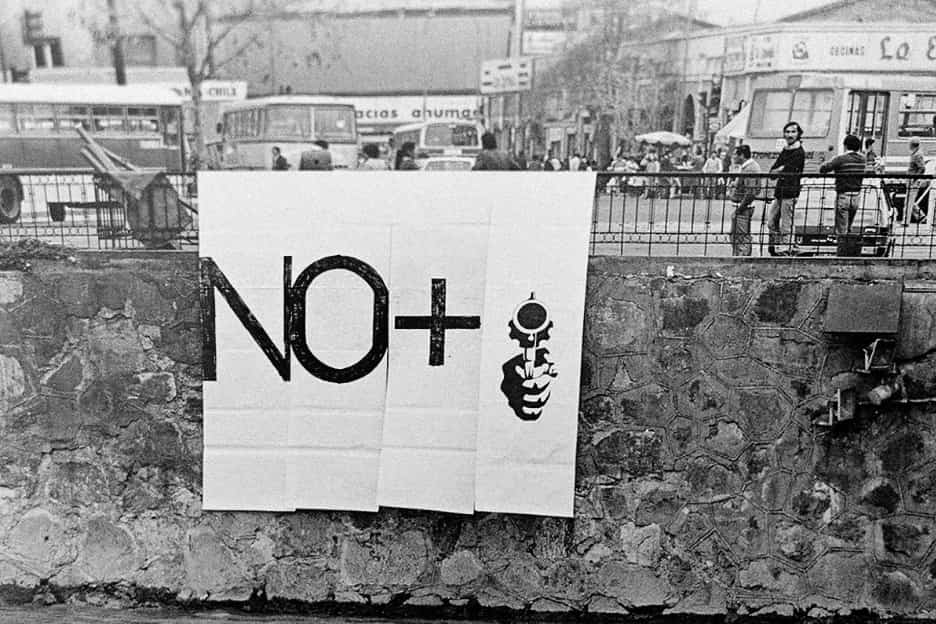
Colectivo Acciones de Arte, NO+, 1983
The Colectivo Acciones de Arte (CADA), formed by artists Juan Castillo and Lotty Rosenfeld, writers Diamela Eltit and Raúl Zurita, and sociologist Fernando Balcells, was active in Chile between 1979 and 1985, carrying out art actions planned for public spaces, factories or to be ‘inserted’ into mainstream media. They never worked with an art institution, a fact they made clear on several occasions, for example regarding the work Oh South America! Mental Spaces, Physical Spaces, 1981, they stated that ‘we say no to [...] assemblages created in white illuminated, amnesic galleries’. Similarly, in the 1982 publication Rupture. Art Document, they warned against the idealist notion of a work of art that can only ‘belong to the museum’ when it ‘expels each and every trace of contingency’. These institutions, including the National Museum of Fine Arts, lived under siege during the Pinochet dictatorship and were subject to blatant control and censorship. CADA’s work channelled their animosity towards this cultural hijacking. That is why the group’s well-coordinated and planned actions, ephemeral in nature, took place outside the museum. In this sense, the current retrospective of their career, ‘Radical Democracy’ at MASP, raises a pertinent question: can something that resisted entry into a museum be retrospectively musealised?
In many senses, MASP has become a kind of memorial space for the nine actions made by the collective. Yet, despite these inherent associations, this comprehensive and rigorous survey, spearheaded by curator André Mesquita, overturns such historical or political flattening and instead offers vital insights into the collective’s processes. The exhibition brings together several display panels, original documents, photographs and video recordings, along with enlarged images and a recreation of the installation To Avoid Starving in Art, 1979, in which 40 boxes of milk are placed inside an acrylic display case while a speaker broadcasts a speech that cries out against violence and hunger. Crucially, the attraction of CADA’s work lies not in its aesthetic appeal but in its political and poetic capacity and contingency - something the collective proclaimed as anti-museum. Thanks to this thorough investigation, even non-Chilean viewers are able to understand the implications of each action and, thus, works such as Para no morir de hambre en el arte, 1979, Inversión de escena, 1979, ¡Ay Sudamérica!, 1981, or NO+, 1983, remain powerful entreaties against all forms of political oppression.
Several original letters detail how the collective convinced Chile’s aeronautical authorities and municipal officials that their planned action - dropping 400,000 leaflets over Santiago from six small planes - was an innocent work of ecological art. But neither the paper bombardment nor the message in the leaflets, which encouraged the expansion of creative spaces, was innocent: ‘We are artists, but every person who works to expand, even mentally, their living spaces is an artist.’ It was a call for freedom for citizens in a country under strict censorship. What makes this action such a powerful and committed work is that it took place under a military regime that seized power in a coup d’état during which the army launched an air attack on the presidential palace.
A further step in this demand for citizens to embrace their role as artists was the NO+ action, which consisted of plastering and painting the city walls with the phrase ‘NO+’, encouraging people to freely complete it. Words like ‘dictatorship’, ‘fear’ and ‘deaths’ were spontaneously added to the equation. Citizens became co-authors of the work, and it is precisely this flexibility, this capacity for adaptation, that has made it a central element in demonstrations to this day. In Inversión de escena, the counter-institutional intent is emphasised by covering the entrance of the Chilean National Museum of Fine Arts with an enormous white sheet: ‘the city is the museum offered to itself in the contemplation of its shortcomings’, CADA wrote in a manifesto about this work.
If we reverse the perspective and look outwards - beyond the museum and its local audience - what is revealed is how the documentation of these actions, here presented in such an invigorating way in an institutional framework, becomes an essential component in revisiting these works. This set of courageous and thought-provoking actions, which conceived of the citizen as an ally, ‘an art that creates and expands the intellectual spaces that organise the memory and historical development of a people’, as CADA stated, is an interpretation that prompts more than one reflection on how contemporary society engages in the public sphere today.
‘Colectivo Acciones de Arte: Radical Democracy’, MASP, São Paulo, 7 April to 2 August 2026.
Juan José Santos is an art critic and curator living in São Paulo.
First published in Art Monthly 498: Jul-Aug 2026.








Peveril Garden Studios
140 Great Dover Street
London SE1 4GW
United Kingdom
Email info@artmonthly.co.uk