Review
61st Venice Biennale: In Minor Keys
Chris Clarke encounters a Biennale rocked by conflict and loss
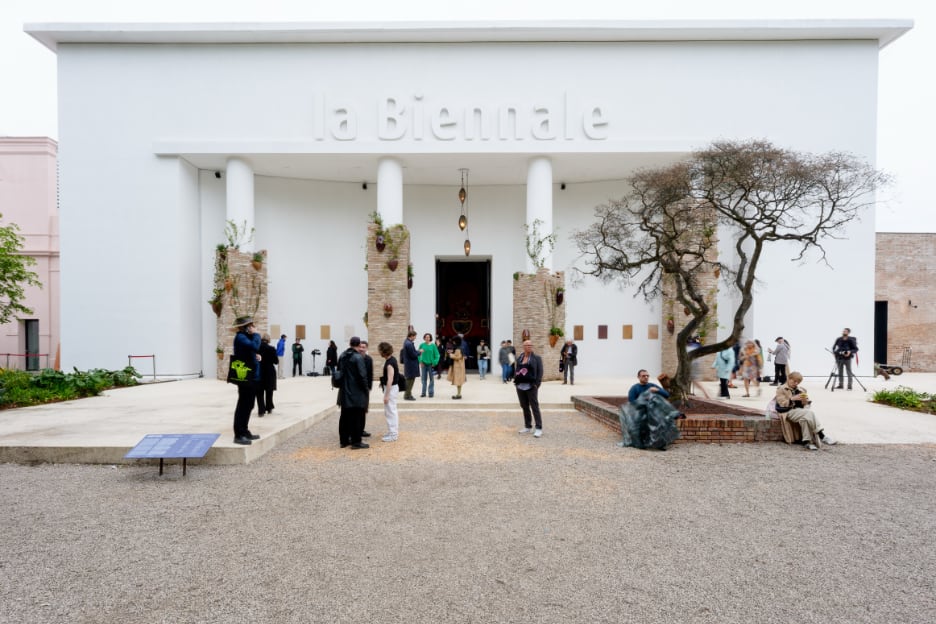
Otobong Nkanga, Soft Offerings to Silenced Voices and to All Who Have Turned to Dust, 2026
There is nothing normal about this Venice Biennale. Heavily armed carabinieri patrol the garden grounds while mass protests remonstrate against the inclusion of Israel and Russia. South Africa censors and then shutters their national pavilion (although Gabrielle Goliath’s stunning Elegy installation has found a new home in a 17th-century church). The International Jury resigns over the participation of countries accused of war crimes. Posters and placards are everywhere: ‘NO ARTWASHING GENOCIDE’, ‘Palestine is the Future of the World’, ‘Curated by Putin, dead bodies included’. Meanwhile, the German artist Henrike Naumann and also Koyo Kouoh, the curator of the international group exhibition ‘In Minor Keys’, are tragically absent, both having died from sudden, untimely illnesses. Could any art biennale meet such a moment?
In a brief but tantalising text, Kouoh proposes something quite removed from current events, with the minor keys representing both the emotive lower frequencies that underpin a musical score and ‘an archipelago of oases’, a chain of scattered enclaves and safe havens. These dual interpretations of the term share an affinity for the subdued, the secluded, for deeper tones and distant shores, and for what Édouard Glissant once described as ‘the subterranean convergence of our histories’. The exhibition thus promises to be a site of collective composition, a polyphony of intersecting lines and layers. In reality, however, ‘In Minor Keys’ is rudderless, simultaneously underdeveloped and overstuffed, and unable to bring its different strands together cogently. Given the unenviable task facing the curatorial team, designated as La Squadra di Koyo, this was probably inevitable: there is a persistent uncertainty as to what the exhibition would have, could have, been. Instead, it second guesses itself, vacillating between determined positions, and catering to varying, and irreconcilable, expectations of how Kouoh would have finished the job.
For example, the ‘shrines’ to the late artists Beverly Buchanan and Issa Samb, the two lodestars of ‘In Minor Keys’, are practically undifferentiated from the displays of other artists here. Only the wall texts and quantity of works indicate any outsized influence. Buchanan’s presence is especially striking, the display presenting her wide-ranging practice that encompassed earthworks, paintings, drawings and sculptures. In Untitled (Spirit Jar), c2000, a tin can is barnacled with bottle caps, a crumpled licence plate, hair ties and plastic beads, a reliquary of everyday, discarded objects that recalls the ‘memory jugs’ of African-American folk traditions. These bits of scrap material also adorn her replicas of shacks and houses, constructed from wooden slats, shingles, nails and twine. Names are scrawled along their siding - ‘TILLEY’, ‘JENKINS’, ‘BOWMAN’ - like a litany of previous occupants, neighbours, families. The objects are both joyous and elegiac, enclosing intergenerational histories within their miniature walls. And yet the impact is diminished by their proximity to one of the exhibition’s sour notes: María Magdalena Campos-Pons’s vast, eight-panel portrait Anatomy of the Magnolia Tree for Koyo Kouoh and Toni Morrison, 2026. The memorial, which includes glass and resin floral sculptures and a largely inaudible soundscape by Kamaal Malak, is mawkish, overwrought and entirely at odds with the exhibition’s premise.
At other points, artworks jostle awkwardly against each other. In the Corderie of the Arsenale, Ranti Bam’s Black Ifa 1-5, 2025-26, comprises a ring of lopsided, stoneware vessels perched on wooden stools. They appear on the verge of collapse, folding into themselves, bursting at the seams: the cracked surfaces are achieved by firing unglazed clay beyond its prescribed temperature. Her receptacles, named after the Yoruba system of divination, suggest votive offerings, totems and conduits, and demarcate an interior space of quiet contemplation. They are, unfortunately, overshadowed by the looming presence of Carrie Schneider’s First Living Woman, 2026, a suspended one-kilometre ‘jumbo roll’ of photographic paper depicting an eight-second sequence from Chris Marker’s 1962 film La Jetée. While there is a clever formal correspondence between the creases and curls of the two installations, their juxtaposition is too jarring: vivid chromogenic colour clashes against subtle, sombre tones, maximalist excess overpowers refined simplicity. The reverie is disrupted; the spell has been broken.
Where works are given room to breathe, one gets a better sense of what Kouoh envisaged. Khaled Sabsabi’s khalil, 2026, encircles the viewer within an orbit of fluid colours, symbols and sounds. Projections of inchoate, abstract forms float across painted canvas, navigating eddies and crosscurrents then momentarily coalescing before diverging along separate paths. Titled after the Arabic word for a close friend, the installation evokes a sense of collective kinship and transient connections, derived in part from the Lebanon-born artist’s own forced migration as a child. Its inclusion in ‘In Minor Keys’ also stems from an invitation by Kouoh after Creative Australia decided to cancel Sabsabi’s national representation - ostensibly because of an earlier work’s depiction of the late Hezbollah leader Hassan Nasrallah (Artnotes AM484); the artist was subsequently reinstated (Artnotes AM489) and is now exhibiting across two venues. Closing the Corderie is Torkwase Dyson’s installation Tougaloo, 2026, which is both monumental and intimate: her curved, architectonic slabs of graphite and acrylic, containing cavities of irregular glass chunks, tower over the viewer. Vertical shards jut out and balance precipitously from sloping charcoal-grey quadrants. The title, which refers to the former plantation and Historically Black College in Mississippi which Dyson attended, derives from the Choctaw word for ‘between two streams’ and, in their placement along parallel rows, the work beckons one forward, weaving from one arc to another. They resist any single vantage point and realign the atmosphere. In Wangechi Mutu’s installation of earth, crystals, sculptures of hovering animals and pregnant human forms, and a revolving broom that sweeps coffee grounds into concentric circles, an animated film voices the primordial mother of the Kikuyu people. The silhouette of Mount Kenya or Kirinyaga awakens from her slumber, stretches and turns over, and narrates her betrayal by subsequent generations ‘of their longest, most important relationship. A relationship that connected everyone to everyone else on the planet and each one to who they are’. It is a creation myth and a call for a return to a symbiotic co-existence with nature.
Fittingly, it is the outdoor spaces that best exemplify Kouoh’s invocation of ‘the persistent signals of earth and life’. Otobong Nkanga (Interview AM478) has encased the exterior columns of the Giardini’s Central Pavilion with locally produced bricks, ceramic pots, climbing vines and translucent ovoids of Murano glass, while the partially submerged scarlet heads of Alice Maher’s Les Filles d’Ouranos, 1996/2025, peer out from the waters of the Arsenale’s Gaggiandre in the shipyard. The goddesses are watching, waiting for their imminent return to terrestrial soil. In an arched alcove, overlooking the canal and far from the congestion of artworks and audiences, Tsai Ming-Liang’s film Sand, 2018, portrays a solitary Buddhist monk as he slowly, steadfastly traverses a deserted landscape. He moves with extreme stillness, concentrating on every muscular contraction and shift in weight, as he crosses a beach lined with the remnants of makeshift encampments, driftwood and flotsam. A tangle of tree trunks with interlocking branches, channels and culverts. And, finally, a cement chamber, seemingly devoid of human activity. There is a sudden clamour of angry yelling and rumbling machinery, off-screen and unintelligible, and the monk’s demeanour imperceptibly wavers. He almost falters, freezes in place, before deciding to advance anyway.
There is a similar unresolved tension between the muted, minor keys and the tumultuous cacophony that underscores the 61st Venice Biennale. In musical composition, the two are inextricable, often drawing on the same shared pitches and generating an expressive range through their relationship to one another. The minor modes temper the bombastic triumphalism of the major keys, imbuing the piece with ambiguity, ambivalence and instability. While others scream and shout, they assert themselves softly, surreptitiously, in sotto voce. Yet, amid the fury and noise, they can all too easily be drowned out.
61st Venice Biennale: ‘In Minor Keys’, 9 May to 22 November 2026
Chris Clarke is a curator and writer based in Vienna.
First published in Art Monthly 497: June 2026.







Peveril Garden Studios
140 Great Dover Street
London SE1 4GW
United Kingdom
Email info@artmonthly.co.uk