Artlaw Retrospective
Censorship
Henry Lydiate on the repression of art over the decades
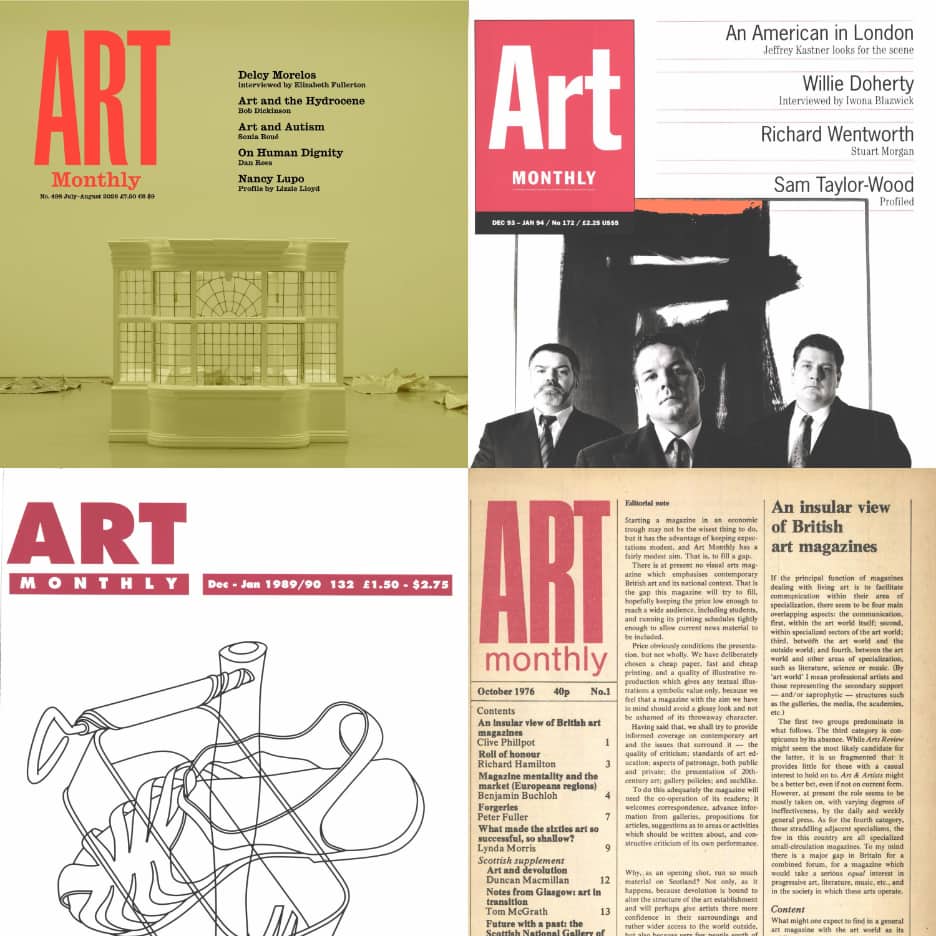
Art Monthly cover designs 1976–2026
When Artlaw’s first column was published in October 1976, interest in censorship of art and artists had already been stimulated through discussion with artists about Marcel Duchamp’s life and work, and especially censorship of his work Fountain: a readymade standard porcelain urinal on the side of which he inscribed his pseudonym ‘R. Mutt 1917’.
In 1917, Duchamp served on the board of the newly formed New York City-based Society of Independent Artists, founded with a democratic charter stating that no artwork would be censored, judged or rejected. To test these values, in response to the society’s open invitation to any artist who paid the entry fee of one dollar, Duchamp sent Fountain for the society’s first exhibition. The board rejected the piece as ‘vulgar’, ‘immoral’ and ‘plagiarism’, and hid it from public view during the show. Duchamp resigned from the board in protest, saying that the supposed institutional ‘freedom’ was a ‘facade for conventional, conservative tastes’.
Artlaw’s intellectual engagement with the censorship of Fountain turned towards legal consideration of suppression and persecution of art and artists barely a year after the death of General Francisco Franco in 1975. Fascist dictator of Spain since 1939, Franco was supported by likeminded fellow despots: Benito Mussolini in Fascist Italy to 1943, and Adolf Hitler in Nazi Germany to 1945: all three mandated gross state-censorship of art and artists under their repressive regimes, echoes of which still resounded in the 1970s and for decades beyond.
Similarly, under dictator Joseph Stalin, censorship continued in the USSR long after his death in 1953: not as a result of his policy of existential terror since the 1930s, but of regulated ideological conformity. While the ‘Khrushchev Thaw’, from 1953 to 1964, allowed a temporary relaxation of repression and the emergence of ‘unofficial’ art, the state maintained strict control over official publishing, exhibitions and media. From 1964 to 1982, in the Leonid Brezhnev era, the atmosphere became more conservative: artistic controls were tightened again to prioritise political stability, marking a return to stricter censorship.
By 1978, the first dozen or so issues of Art Monthly had somehow been circulating ‘underground’ in countries behind the USSR’s Iron Curtain, and had stimulated some ‘official’ artists based there to invite Artlaw to visit them. When there, Artlaw was assigned an official interpreter-cum-minder to attend formal functions as an ‘honoured guest’, openly to discuss the contemporary art ecosystem in the West; covertly and minder-less, however, Artlaw was to witness firsthand Soviet-style repression of artists and explore ways and means of smuggling their ‘unofficial’ works – and/or the artists themselves – into the West.
Artists in the USSR, and satellite states it controlled in Eastern Europe, were being forced to belong to professional unions to access materials, studio space, commissions and teaching posts. Membership was contingent on adhering to official standards. Some artists and intellectuals, who had opposed state cultural policy, were declared insane and committed to psychiatric prison facilities. Artlaw advised and assisted artists with clandestine export of their works, and developed lifelong bonds of trust with some seeking creative freedom and personal safety in the West – including the Romania-exiled dissident artist Paul Neagu, who settled in the UK. It was unsafe to reveal these activities in Art Monthly.
Artlaw mostly focused on censorship in the West, until the fall of the Berlin Wall in 1989, dissolution of the USSR and its metamorphosis as the Russian Federation in the 1990s, Vladimir Putin’s rise to power from 1999, and China’s formal engagement with global trading and cultural markets in 2001. Western democracies typically have liberal laws for material that may at first sight depict proscribed content, but which may have a ‘reasonable excuse’ or ‘legitimate reason’ justifying public exposition.
Since 1791, the First Amendment to the US Constitution guarantees freedom of speech, including visual artworks. International human rights frameworks were developed in the shadow of the Second World War. The Universal Declaration of Human Rights, proclaimed by the United Nations General Assembly in 1948, directly inspired the European Convention for the Protection of Human Rights and Fundamental Freedoms in 1950 (ECHR), to which only two countries in Europe do not accede: Belarus and Russia. ECHR gives artists the legal right to freedom of expression, even for artistic works that ‘offend, shock, or disturb’ if they foster ‘creativity, critical thinking, and public debate’.
In 1981, legislation was enacted for England, Wales and Scotland that was aimed at striking a fair balance between freedom of expression and public protection. The Indecent Displays (Control) Act (IDCA) is still in force today; but not in Northern Ireland, which has its own separate legal framework regarding public decency and obscene publications. The IDCA is simply drawn: it is a criminal offence to display ‘indecent matter’ to the public, and offenders face two years imprisonment and/or an unlimited fine. Courts decide whether material is indecent according to ‘recognised standards of propriety’.
However, IDCA has an exemption: if a warning notice is clearly displayed on the exhibition premises, which patrons must pass by and see, forbidding entry to those under 18 years of age and explaining that material is on view that may be indecent; and if such notice makes it clear that payment for entry is specifically to view indecent material (a provision designed to legitimise licensed sex shops). Significantly, a further exemption applies to indecent displays specifically ‘in an art gallery or museum and visible only from within’, thus allowing such institutions to decide the appropriateness of public exposition. Yet, despite IDCA’s exemptions, censorship of artwork from public viewing need not necessarily involve legal proceedings or threat of them. It often occurs through the exercise of influence or control, directly and indirectly, over exhibiting venues – even though the reason given for censorship may be couched in legal language to give credibility to insistence on removal or withdrawal of works.
In 1984, there was an attempted censorship of the ‘Power Plays’ exhibition at Hull City Council’s Ferens Art Gallery. The show, which had a feminist focus, comprised works by artists Sue Coe, Jacqueline Morreau and Marisa Rueda. At the exhibition’s preview, a city councillor ordered a Coe work to be removed from the exhibition because it was, apparently, too ‘disturbing’: it depicted the gang rape of a woman on a pool table. The Council’s Cultural Services Committee met and initially supported the work’s removal. However, after considering representations from Coe’s art lawyers, who cited the IDCA and the views of the gallery’s curators, the work was reinstated in the exhibition.
In 1988, months before fine art photographer Robert Mapplethorpe’s death, the US National Endowment for the Arts contributed funding to a major retrospective of his work, ‘The Perfect Moment’, which included the artist’s ‘X Portfolio’ of explicit sexual photographs. This touring show triggered what became known as the decade-long ‘culture wars’ in the US.
In 1990, anti-pornography campaigners in Cincinnati were instrumental in the indictment of the Contemporary Arts Centre (CAC) and its director for showing ‘The Perfect Moment’. This was the first time a public-facing institution in the US had faced criminal charges for the art displayed. The prosecution failed to convince the jury that Mapplethorpe's photographs lacked artistic merit, and the CAC and its director were acquitted. The censorship trial brought more attention to Mapplethorpe’s work than it would perhaps otherwise have received: over 80,000 people visited the show.
In 1996, a Mapplethorpe retrospective at London’s Hayward Gallery raised similar issues, when the show’s curators themselves excised two works from public viewing: Rosie, 1976, showing a three-year-old girl in a dress, without underwear, sitting legs astride a bench, with part of her genitalia visible; and Marty and Hank, 1982, an interracial scene of two men having oral sex. The gallery consulted the Metropolitan Police Vice Squad about these works before deciding to exclude them. The tabloid press had a field day over the exclusion of Rosie, despite the work never having been excluded from the show elsewhere during its world tour up to that date and notwithstanding that Rosie herself, 23 at the time of the exhibition, said she loved the picture and displayed it in the restaurant she managed in Notting Hill.
In 1998, Mapplethorpe’s Certain People: A Book of Portraits (published in 1985, including Rosie and Marty and Hank) was seized by England’s West Midlands Police Service – or rather a copy owned by the Library of the University of Central England (UCE). A criminal prosecution was averted for possession of an ‘obscene’ publication when the Crown Prosecution Service decided it was ‘not in the public interest’ to pursue a case against UCE’s principal, who had steadfastly refused to accept that the book be withdrawn from the library.
In 2000, Art Monthly received a copy of a letter from the Department of Corrections in Tallahassee, Florida. It had been sent to a prisoner, advising him of his right to appeal against the prison’s impounding his copy of Art Monthly because of alleged violation of the Department of Corrections Rule Chapter 33-501.401, citing three regulations.
First, ‘it contains visual material which is dangerously inflammatory in that it advocates or encourages riot, insurrection, disruption of the institution, violation of department or institution rules, the violation of which would present a serious threat to the security, order or rehabilitative objectives of the institution or safety of any person’. Second, ‘it pictorially depicts sexual conduct: (1) actual or simulated sexual intercourse (2) sexual bestiality (3) masturbation (4) sadomasochistic abuse (5) actual contact with a person’s clothed or unclothed genitals, pubic area, buttocks, or, if such person is a female, breast (6) any act or conduct which constitutes sexual battery or simulates that sexual battery is being or will be committed’. Third, ‘it presents nudity or a lewd display of the genitals in such a way as to create the appearance that sexual conduct is imminent’.
The column explored this letter and censorship issues involved and arising, including a brief response: ‘Dear Prisoner 035178. You will have wondered why you failed to receive your April copy of Art Monthly (#235), which was posted to you as usual last month. It was received at the prison on April 20, but was impounded by the authorities. We would be very interested to hear from you about whether you have appealed against this decision, what the outcome was, and whether we can be of any assistance. Art Monthly would also be interested to hear from any other prisoners, whether they are detained in the US, UK or elsewhere, who experienced similar difficulties in receiving their April copy of Art Monthly.’
In 2001, a Metropolitan Police Inspector called on the Saatchi Gallery in North London, ordered the removal of two artworks and a publication related to the exhibition ‘I Am A Camera’, and threatened prosecution for failure to comply. The police said they were acting on complaints received from members of the public, who had seen the exhibition. Prosecution would be for contravention of the Protection of Children Act 1978 (PCA), still in force, which outlaws the taking, showing or possession of indecent photographs of children. The gallery refused to comply, and the matter was referred to the director of public prosecutions (DPP), whose consent is required to initiate a PCA prosecution.
The offending artworks were photographs by the artist Tierney Gearon: a series of 15 snapshots of family holidays included her two children, aged six and four, naked or partly naked playing on the beach; and one of her son urinating in the snow. The images were not ‘indecent’ according to Charles Saatchi, from whose personal collection of artworks the exhibition had been drawn; not according to Jenny Blyth, the show’s curator; nor according to their lawyer, Geoffrey Robertson, QC, who sent to the DPP his written opinion that there were no sexual overtones, and therefore no elements of indecency, in the ‘innocent nakedness’ portrayed.
Conversely, the weekly tabloid newspaper, News of the World, viewed the artworks as ‘a revolting exhibition of perversion under the guise of art’. Readers’ letters in that newspaper, and others, variously complained that the children in question were too young to give informed consent to their images being used, that the children’s trust had been betrayed and that copies of the photographs in question should never have been published in newspapers under the hypocritical guise of editorial condemnation.
Other media recalled how, in the 1960s, the then arts minister Jennie Lee had written to the home secretary complaining about the raid on the Robert Fraser Gallery in London for showing what police regarded as obscene work by Jim Dine; and similarly, in relation to the raid on London’s Victoria and Albert Museum concerning allegedly ‘obscene’ graphic works by Aubrey Beardsley. A Guardian newspaper leader, under the caption ‘Off the Wall’, concluded that ‘the police must leave these pictures alone’. Lord Chris Smith, then the UK’s culture minister, wrote about the incident, saying ‘there is a need to strike a balance between protection of children and the right to freedom of expression’.
The PCA provides a defence for possession of indecent photographs of children, which has been held by the Court of Appeal to include ‘academic research’. Accordingly, exposition in a legitimate art gallery, where it is only likely to be seen by people genuinely interested in art, could be a defence. In Gearon’s case, the police were evidently acting in good faith, seeking to enforce a law aimed at protecting children, but were not best equipped to distinguish indecent content from art. Doubtless taking into account such views, especially advanced in Robertson’s written opinion, the DPP announced that there would be no prosecution of the Saatchi Gallery or Gearon. (Rumours later circulated that the show had not been drawing many visitors and that the members of the public who complained to the police were in fact tabloid reporters who had been tipped off, without the artist’s knowledge, about the show’s content by media-savvy people connected to the gallery, resulting in a sensational story for the journalists and increased publicity for the gallery’s collection – but a damaging ordeal for the artist.)
In 2011, Pussy Riot was formed in Moscow: a punk feminist protest and performance art collective of a dozen artists who challenged politics in Russia. Pussy Riot staged unauthorised, provocative performances in public places, filmed as music videos and posted online. The group’s lyrical themes include feminism, LGBTQ+ rights, and criticism of President Vladimir Putin’s policies and his links to leaders of the Russian Orthodox Church.
In 2012, Pussy Riot performed Punk Prayer inside Moscow’s Cathedral of Christ the Saviour, which was condemned as a sacrilegious act by the Russian Orthodox Church. Three group members were arrested, tried, convicted and sentenced to two years in a penal colony for ‘hooliganism motivated by religious hatred’. One member’s immediate prison sentence was later suspended on appeal. The trial and sentences attracted considerable attention and criticism worldwide by many prominent artists and performers, particularly in the West, and by human rights groups, including Amnesty International, which designated the women as prisoners of conscience.
As Pussy Riot subsequently continued to perform, Russian authorities used anti-extremism laws to ban and remove several of the group’s videos from the internet, repression that was later condemned by the ECHR as a violation of freedom of expression. Russia’s censorship developed into a total outlawing of the collective within the federation, and was intensified by criminalising anyone’s intentional online searches for Pussy Riot’s content: Russian citizens could face fines for accessing their material, even without sharing it. A Moscow court officially designated Pussy Riot as an ‘extremist and terrorist organisation’, banning all its activities in Russian territory, and many of its members fled the country. Under this designation, any public endorsement of their work, including liking a post or owning their symbols (such as their iconic balaclavas), carries the threat of a prison sentence. Pussy Riot continues its activism exclusively outside Russia.
In 2015, a new series of guides was published dealing with complex issues of how legal frameworks impact on artistic freedom: they explored counter terrorism, public order, child protection, race and religion, and obscene publications. Badged as Art and the Law, the guides were jointly published by Index on Censorship, an independent UK-registered charitable organisation that promotes and defends artists’ rights internationally, and Vivarta, a UK-based digital media news lab and advocate in conflict zones and repressive states.
In 2021, Don’t Delete Art (DDA) published digital guidelines and tips to help artists mitigate and/or avoid online censorship. DDA, a New York City-based coalition of organisations campaigning to end ‘the censorship of artistic expression’, was formed after hundreds of artists’ online images had been censored by Facebook, Instagram, Tumblr and YouTube. DDA is dedicated to fighting against ‘digital gatekeepers controlling the world’s largest social-media platforms that have enormous power to determine what content can freely circulate and what should be banned or pushed into the digital margins’.
DDA contends that artists’ content is removed by platforms because of overly restrictive and sometimes unclear online community guidelines, and that – unbeknown to users – material vaguely defined as objectionable is made to disappear from search and/or explore functions and hashtags. DDA argues that such censorship ‘has a dire effect on the work of emerging artists, those living in repressive regimes and, in general, on all who have no museum or gallery representation’: work can be erroneously removed and whole accounts deleted with thousands of followers lost. Since there is often no possibility of appeal, an artist can feel powerless and therefore opt to censor themselves instead of risking capricious punishment from the platform owner. DDA encourages artists to share their online censorship experiences via the interactive database of censorship incidents at the National Coalition Against Censorship’s crowdsourced Censorpedia (wiki.ncac.org).
In 2023, Ai Weiwei publicly criticised Israel–Hamas hostilities, which resulted in the cancellation of his upcoming exhibition by London’s Lisson Gallery. Following the eruption of that conflict on 7 October 2023, the gallery was evidently offended by a tweet Ai had posted,: ‘The sense of guilt around the persecution of the Jewish people has been, at times, transferred to offset the Arab world. Financially, culturally, and in terms of media influence, the Jewish community has had a significant presence in the United States. The annual $3bn aid package to Israel has, for decades, been touted as one of the most valuable investments the United States has ever made. This partnership is often described as one of shared destiny.’
In response to Ai’s tweet, Lisson wrote: ‘There is no place for debate that can be characterised as anti-Semitic or Islamophobic at a time when all efforts should be on ending the tragic suffering in Israeli and Palestinian territories, as well as in communities internationally … Ai Weiwei is well-known for his support of freedom of expression and for championing the oppressed, and we deeply respect and value our longstanding relationship with him.’ Nevertheless, the gallery cancelled Ai’s exhibition in November 2023.
Ai subsequently explained to the online arts publication Hyperallergic: ‘The works to be exhibited at Lisson Gallery are inherently political, entwined with contemporary global cultural politics. The irony lies in staging such an exhibition precisely when art is most crucial for expressing alternative perspectives. Yet, self-censorship robs artists of this vital opportunity, a poignant contradiction in a time demanding diverse voices.’ Public arts organisations may also be victims of censorship, from which they may not be immune.
In January 2024, Arts Council England (ACE) published new guidelines for its Relationship Framework with regularly funded clients. The crux of the guidance was that ‘overtly political or activist’ statements might create ‘reputational risk’ and possibly threaten ACE’s awards to them. The new guidance resulted from several clients publicly addressing issues arising from and involved in Israel–Hamas bloodshed. Numerous public outcries against ACE’s warnings were voiced across England’s cultural sector. London-based artist Oreet Ashery posted on Instagram her response to ACE: ‘I am an artist who makes political statements. As ACE threaten regularly funded art organisations that professional associations with those who make “political statements” endangers their reputation and potential funding, we say we will not be silenced. #justiceforpalestine.’
In February 2024, ACE issued a guideline revision: ‘If a risk is identified … make time to consider and discuss the risk, and what it means … Individuals have the right to express their personal views, within the bounds of the law, and organisations should not attempt to constrain those rights. It is, however, good practice for organisations to maintain a clear and up-to-date social media policy that makes explicit the distinction between individuals speaking in a personal capacity, and on behalf of your organisation.’ Art Monthly’s next front cover featured the artwork I am an artist who makes political statements, which Ashery produced to accompany her earlier Instagram statement.
In March 2024, days before voting in the Russian Federation’s presidential elections, many artists’ homes and studios were raided by the Federal Security Service (FSB). The artists were based in cities nationwide, including Moscow, Nizhny Novgorod (‘capital of street art’), St Petersburg, Perm and Yekaterinburg. Phones and computers were seized as officials apparently searched for artists with links to the political activist artist Pyotr Verzilov, according to some who were searched and interrogated. Shortly after the full-scale invasion of Ukraine on 24 February 2022, Verzilov posted on social media his criticism of Russia’s military killings in Ukraine. He was prosecuted, convicted and sentenced in absentia to eight-and-a-half years in a penal colony for spreading ‘false information’.
Notable artists and curators targeted by the raids included: Katrin Nenasheva, a St Petersburg-based psychoactivist and performance artist who often addresses the plight of victims of abuse in psychiatric institutions; Artem Filatov, a Nizhny Novgorod-based street artist, who was named artist of the year at the 2023 edition of the Cosmoscow art fair; Nailya Allahverdieva, director of the Perm Museum of Contemporary Art, a cultural centre in the Urals; Anatoly Osmolovsky, a Moscow-based pioneer of late- and post-Soviet performance art who left Russia following these raids. Russia-watchers say the sweeps were intended to discourage artists, and others, from amplifying political dissent against President Vladimir Putin.
Political scientists and international organisations describe Putin as the de facto leader of Russia since 1999, widely classifying him as a dictator whose regime functions as a highly centralised authoritarian system, characterised by the elimination of political opposition, severe restrictions on civil liberties, and repression of independent media and freedom of expression. While the Russian Federation’s constitution prohibits censorship, Putin uses broad legal powers, economic pressure and administrative control to suppress artistic dissent. He has transformed Russia’s cultural landscape from one of soft censorship to the direct persecution, prosecution and forced exile of artists and other creators deemed ‘disloyal’ to him and his regime. On 17 March 2024, Putin was re-elected by popular vote to his fifth term of office, potentially serving to 2036.
In January 2025, US President Donald Trump was inaugurated for a second term, since when his administration has aggressively reshaped federal arts and cultural policy by removing what it terms ‘improper ideology’ from public institutions. These actions have targeted diversity, equity and inclusion initiatives, specific artistic themes, and the leadership of major cultural agencies: they echo repressive fascist and communist totalitarian censorship regimes over the past hundred years.
During May 2026, three incidents occurred that illustrate 20th and 21st century repression of artists in Russia and China. On 10 May, when artist Gao Zhen marked his 70th birthday in a Chinese prison, hundreds of artists, musicians, writers, human rights advocates and cultural leaders worldwide called for his release, and urged US President Trump to raise Gao’s case directly with China’s President Xi Jinping at their personal summit meeting held days later.
Gao had emigrated to the US in 2022. While in Beijing visiting his family in 2024, he was arrested, 100 of his artworks were seized, and his wife and seven-year-old son were banned from leaving China. Chinese media described Gao as a ‘so-called artist, who caters to Western political agendas through pseudo-art that vilifies and insults revered figures’. He was detained for ‘insulting, defaming, or otherwise infringing on the reputation and honour of heroes and martyrs’ – these were crimes of ‘historic nihilism’ or ‘distorting history’ under new laws enacted in 2018. Gao’s indictment focuses on satirical sculptures and installations he made between 2005 and 2009: notably, Execution of Christ, 2009, a bronze life-size installation of seven unmistakable likenesses of Mao Zedong aiming rifles at a figure of Christ. The firing squad represents a critique of authoritarian power and historical repression of Christianity.
Mao founded the People’s Republic of China (PRC) in 1949, and presided over some of the most traumatic censorship in China’s modern history. He led the governing Chinese Communist Party (CCP), which monopolised artistic creation, replacing traditional and diverse works with USSR-style Socialist Realism: art was required to serve ‘workers, peasants, and soldiers’, focusing on idealised portrayals of daily life and CCP leaders. Artists who criticised the CCP or failed to align with official aesthetic standards, such as using traditional ink painting, were persecuted and forced into ‘re-education’.
From 1966 until Mao’s death in 1976, his Cultural Revolution policy was characterised by the destruction of ‘Four Olds’: ideas, culture, customs, habits. Art was reduced to ‘revolutionary romanticism’ and intense propaganda, artists were often forbidden to create, and many artworks were destroyed. After 1976, censorship relaxed slightly, allowing the introduction of Western techniques and the ‘85 New Wave’ (85NW): a nationwide avant-garde art movement, marking the birth of contemporary Chinese art. Artists rejected Socialist Realism, and instead created experimental, conceptual and western-influenced art to explore new artistic languages and self-expression.
During the 1980s, 85NW flourished, primarily driven by artists born just before or during the Cultural Revolution, including the Gao Brothers, Zhen (born 1956) and Qiang (born 1962), and their friend Ai Weiwei (born 1957). Around 100 self-organised, avant-garde groups staged exhibitions and performances across China: they focused on social reform and freedom of expression, transitioning from strict realism to experimental practice. 85NW laid the foundation for Chinese art of the 1990s and beyond, challenging the traditional state-sanctioned art system, and was part of a larger, broader intellectual movement in the 1980s known as the ‘New Enlightenment’. In 1989, however, the CCP ordered an army massacre of thousands of protesters in Beijing’s Tiananmen Square, after which experimental art was repressed, and many artists worked ‘underground’ or in exile.
By 2003, a contemporary artistic community of over 30 artists, designers and publishers had developed in a de-commissioned 50-year-old military factory complex in Beijing: the 798 Art District, where the Gao Brothers and Ai worked. In 2011, the CCP ordered the closure of the Gaos’ studio, and Ai was arrested and detained for 81 days without charge. Following Ai’s release, his passport was confiscated and only returned after four years, when he was eventually allowed to leave China. In 2015, he emigrated to Germany, then moved to live in the UK and Portugal.
Since 2013, led by President Xi, there has been a significant expansion of art censorship, mass surveillance, and a deterioration in human rights in China. In 2024, repression intensified, especially for critical depictions of Mao, Xi or CCP policies. Artists often self-censor to avoid being monitored, harassed or arrested, and many hold private, word-of-mouth exhibitions to showcase forbidden work. In recent years, international institutions have been pressured to cancel exhibitions of Chinese art critical of the CCP. Dissident artists living abroad report digital harassment and threats to their family members remaining in China, while the enactment of new national security laws in Hong Kong has led to self-censorship by artists and art traders in the island-city.
In March 2026, after two years in prison, Gao Zhen was arraigned in a closed court. His one-day trial concluded without an immediate verdict, pending which he remains in custody. If convicted, he faces a maximum sentence of three years in prison. His brother, Qiang, said that ‘even if a work was made 15 years ago, it can still be turned into a crime if today’s political climate changes’, and that there has been a recent hardening of Beijing’s backlash against perceived dissidence as part of ‘a wider pattern of tightening control’.
The Chinese government has not commented on Gao Zhen’s trial. China-watchers say the CCP is becoming increasingly extreme, policing its citizens transnationally and retroactively, and they describe this period as perhaps the darkest in decades for freedom of expression under the CCP. Others suggest that sliding democratic norms around the world, particularly in the US under President Trump, have led Beijing to believe it can repress more aggressively, without fear of rebuke from nations that appear to have abandoned the moral high ground themselves.
The United Nations Human Rights Office recently joined a growing chorus of international advocacy groups calling for Gao Zhen’s immediate release, saying his case ‘raises concerns with regard to retroactive application of criminal law and use of criminal sanctions to punish artistic expression’. There are also worries for his health. His lawyer has found him reliant on a wheelchair on numerous occasions, and reports signs of malnutrition. Repeated applications for medical bail have been denied.
Ai continues to advocate for Gao Zhen, keeping his friend’s case in the international spotlight and, with hundreds of others, petitions for his release. In 2026, Thames and Hudson published Ai’s essay ‘On Censorship’, which explores the evolution of censorship from authoritarian states to western democracies. Ai argues that, while China’s censorship is ideological and overt, western institutions also practice a form of corporate and institutional censorship, and he warns against the rise of globalised surveillance and digital control – whatever political system we find ourselves living under.
In the same May week as Gao Zhen’s birthday, days before the official opening of the 2026 Venice Biennale, Pussy Riot and the feminist activist group FEMEN staged a highly publicised protest against Russian participation in the Biennale. Over 50 group members, wearing bright pink balaclavas and waving Ukrainian flags, beset the Russian Pavilion and forced it to close its doors. ‘Russia’s best citizens are either imprisoned for anti-regime and pro-Ukraine actions or killed in jail, while Europe opens its doors to Putin’s officials and propagandists’, Pussy Riot and FEMEN said in a joint statement that ‘if art is meant to represent a country at the Venice Biennale – something like the Olympics of the art world – then artists imprisoned for their anti-war, pro-Ukraine stance are the real face of modern Russia’.
Throughout May 2026, abstract paintings by Russian artist Oleg Prokofiev were exhibited for the first time. Prokofiev created the works in Moscow in the 1950s and 1960s, hid them from Soviet censors, and abandoned them in 1971. Oleg was the son of Sergei Prokofiev, the 20th-century Russian composer best known for the composition Peter and the Wolf and the ballet Romeo and Juliet, who was severely persecuted by the Soviet regime after he voluntarily returned permanently to the USSR in 1936.
From 1934, Stalin mandated Socialist Realism as the only acceptable art form in the USSR: it should be ‘proletarian’ (accessible to workers), ‘typical’ (depicting scenes of everyday life), ‘realistic’ (not abstract) and ‘partisan’ (supportive of the Communist Party), and must glorify Soviet achievements, industrialisation, collectivisation and Stalin himself. Avant-garde, abstract and modern art were banned as ‘bourgeois’ or ‘decadent’. Censorship was enforced through severe punishment, including imprisonment in forced labour camps or execution. Thousands of artists, writers and musicians were arrested as ‘enemies of the people’, and many were forced into silence.
Diversity in art was completely stifled, replaced by ‘cultural homogenisation’, which continued after 1953 under Stalin’s immediate successors, Khrushchev and Brezhnev. A subculture of artists, ‘The Underground’, was forced to create work in secret, and self-publish/exhibit at home and often abroad. Oleg’s abstract work in Moscow developed in opposition to the rigid Soviet doctrine that art must be ‘socialist in content, and realist in form’.
In 1960 in Moscow, Oleg became romantically involved with a British art historian, Camilla Gray, author of a groundbreaking study of the Russian avant-garde published by Thames and Hudson in 1962: Great Experiment: Russian Art, 1863–1922. The book angered Soviet officials, who prevented the couple from meeting for six years, but they were allowed to marry in 1969 and had a daughter. In 1971, Gray died from hepatitis, and Oleg was allowed by Soviet authorities to take Gray’s body to England for burial. He took their daughter with him, but not his abandoned paintings, and decided not to return to the USSR. Oleg first settled in Leeds, where he was awarded a fellowship in the university’s Fine Art Department, re-married and had four further children, who now live in the UK. His son Gabriel is a London-based composer, producer and DJ.
In 1994, three years after the USSR’s dissolution, Oleg returned to his former home in Moscow for the first time since 1971. He discovered that every abandoned painting had been kept safely by the house’s new artist owner, together with sketches, letters, postcards, sketchbooks and sculptures. Oleg returned to London with his re-possessed material, of which Gabriel now says ‘We’ve been wanting to bring the works out of storage for many years, but it took a while to find the right place. When I came across this studio in Dalston I got very excited; it has really great light and a very open and positive feel to it’. Accordingly, Gabriel and his siblings founded the Prokofiev Studio at 13 Ramsgate Street in east London.
The studio aims to preserve Oleg’s legacy and create a new interdisciplinary arts space. Gabriel says the family hopes to revive a broader culture of collaboration: ‘My father and grandfather lived in eras when there was much more communication between different art forms; poets, composers, artists, filmmakers met up, shared ideas, inspired each other. We’d love the new studio to be a meeting place for that kind of community.’ The studio is a recreation of Oleg’s last studio in Hackney Wick. Oleg died in 1998, aged 69, and is buried on the west side of Highgate Cemetery.
Henry Lydiate is an art lawyer and adviser to www.artquest.org.uk.
First published July 2026.
Art Monthly celebrates its 50th anniversary and 500th issue in October 2026. Henry Lydiate marks the magazine’s 50th year by reviewing his Artlaw column since its first publication in 1976. Throughout 2026, one broad subject is explored each month, noting significant events and issues, and commenting on key changes and developments to date.





Peveril Garden Studios
140 Great Dover Street
London SE1 4GW
United Kingdom
Email info@artmonthly.co.uk