Report
Boycotts Do Work
Tom Jeffreys argues that genuine change is most effectively accomplished by art-worker withdrawal
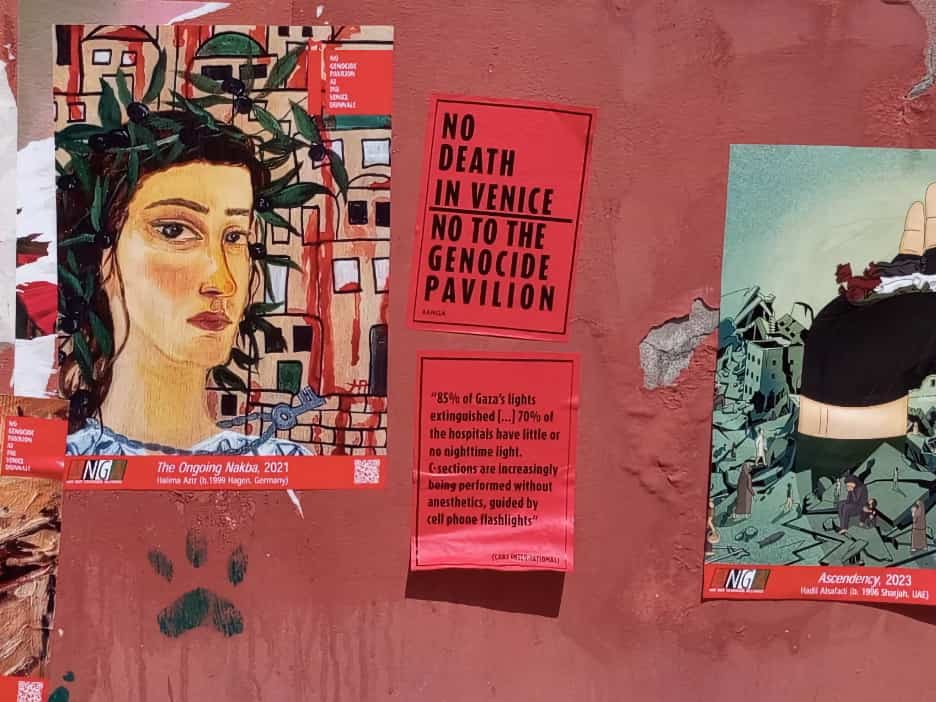
ANGA's flyposting of ‘No To The Genocide Pavilion’ and Palestinian art in the streets of Venice, 2024
Since the beginning of the current Israeli-led massacre in Palestine, described by a UN report as genocide, one thing that has become clear, regarding the politi-cal and material conditions of contemporary art, is that boycotts do work (see Dave Beech’s ‘To Boycott or not to Boycott?’ in AM380). When galleries, museums, universities, art prizes or book festivals part ways with a toxic corporate sponsor or with the ‘philanthropist’ who became rich through arms dealing, or when they apologise for institutional censorship, is it because cultural managers have been won over by the arguments laid out in an open letter or because they finally developed a meaningful ethical funding framework? No, it is because we - as artists, writers and other art workers - came together, organised and withdrew, or promised to withdraw, one of the few things of value we still have some agency over: our labour.
As of April 2026, Israel has killed over 73,000 Palestinians in its current war in Gaza. It has also led attacks across Lebanon, Syria and Yemen, and launched a full-scale war on Iran - all with support from the US and western allies. This support comes not just in weapons and diplomatic cover. Cultural organisations contribute to the normalisation of genocide through partnerships with complicit institutions, through sponsorship deals with companies profiting from the occupation, through a refusal to speak out, and through the silencing of Palestinian voices and those of their allies.
Over the past two and a half years, it has been precariously placed cultural workers, not institutions, who have organised together for collective liberation. The less the current system offers you, the less you have to lose from speaking out. Institutions, meanwhile, often beholden to unaccountable board members, have tried to retreat behind outdated liberal self-mythologising (language such as ‘neutral spaces’ or ‘dialogue’ frequently appears) while at the same time adopting the classic DARVO tactics of the abuser: deny, attack, reverse victim and offender.
This became crystal clear during the campaigns involving groups such as Fossil Free Books and Art Workers for Palestine Scotland against Baillie Gifford, an asset management firm which profits from fossil fuel extraction and investment in companies linked to Israel’s defence, tech and cybersecurity industries. Baillie Gifford gives small change to arts organisations while its executives get rich off Israeli occupation. The upside-down narrative peddled by cultural bureaucrats and asset managers is one of ‘intolerable pressure’ from ‘anonymous activists’ opposing their funding. The media hostility was precisely because the boycotts were working. In Edinburgh, Collective gallery cut its ties with Baillie Gifford in February 2024. Then Fruitmarket. Then Stills. Buoyed by this precedent, campaigning ramped up and book festivals soon followed.
Baillie Gifford is just one example. In Canada, artists across a range of different fields have also worked together to great effect. This February, it emerged that Scotiabank had fully divested from Elbit Systems, Israel’s largest weapons manufacturer. This divestment follows major boycott campaigns against the Giller Prize and the Scotiabank Photography Prize led by No Arms in the Arts, a broad coalition of groups including Writers Against the War on Gaza (WAWOG) Toronto and Artists Against Genocide. This same coalition has also successfully forced the Azrieli Foundation, which supports Israel’s illegal settler colonial project, out of the Toronto Arts Foundation.
In November 2023, Arnolfini gallery in Bristol announced the cancellation of two Palestinian film events (Artnotes AM477). In response, more than 1,400 artists announced a boycott. By May 2024, Arnolfini’s executive director had resigned and the gallery issued a full and unreserved apology. Strike Outset (Artnotes AM477) has been remarkably successful in raising awareness of the contemporary art fund’s connections to Zionist causes through its co-founder Candida Gertler and her husband Zak, a close friend of Benjamin Netanyahu and patron of the Jewish National Fund, an organisation which supports the illegal occupation of Palestinian land. In 2024, meanwhile, the Art Not Genocide Alliance (ANGA) petition to exclude Israel from the Venice Biennale garnered over 24,000 signatures. This year, over 200 participating artists have publicly opposed Israel’s return to Venice in a specially arranged pavilion in the Arsenale (Artnotes AM495).
By formulating clearly articulated and achievable aims, and having the patience to build broad coalitions, these campaigns demonstrate not only that art workers have power but also that we can enact significant change when we work together. A factor in this growing momentum is the sharing of information and learnings. This happens through casual conversations, organiser-led workshops and co-ordinated training sessions to map power and run effective campaigns. Both the Scotiabank and Baillie Gifford campaigns demonstrate the importance of strategy: the question is not whether Scotiabank or Baillie Gifford are worse than others in their industry, but where - as art workers - our leverage lies.
Through analysing one’s available leverage, the way systems are structured becomes comprehensible. The vulnerability of a gallery, for example, is probably not its exhibitions programme, which generally doesn’t involve that many artists and is set years in advance. The vulnerability is everything else. You cannot programme a book festival or an events programme if the artists, poets and writers you hope to platform simply refuse to work with you. This is what happened at Fruitmarket in Edinburgh, when many art workers and artist-run organisations simply refused to work with the gallery until it abandoned its relationship with Baillie Gifford. Baillie Gifford itself, meanwhile, wants to burnish its reputation by appearing as a bountiful local benefactor, so when its name turned toxic, it immediately cut ties with the book festivals it once claimed to love so dearly.
Every strategic call for withdrawal should be understood in the context of imposed austerity and the decades-long push for the arts sector to become dependent on private donations and corporate sponsorship. The concurrent erosion of traditional trade unions has necessitated alternative forms of collective organising. Now, the realisation is growing that the model of the hyper-individualised artist-entrepreneur was never tenable, and that one way forward lies in collective organising, which, beyond the specific goals of any single campaign, also involves distributed decision-making, mutual aid and other forms of community-building beyond traditional art world structures.
While art workers rise to this challenge, boycotts do not come without costs - and these frequently land on those least equipped to be able to cope with them. Co-ordinating boycotts can energise a collective but can also become exhausting. Organising involves spreadsheets and calendars, collective writing of statements and press releases, endless emails with obfuscatory cultural managers, dealing with a hostile press, keeping receipts. There are social media shadowbans. Work dries up for those who speak out. Fossil Free Books offers a mutual aid fund for writers to claim towards union fees and loss of income, but there is a big difference between, say, withdrawing from a panel discussion and cancelling an entire book deal or institutional solo exhibition. Every small win must be set within the wider landscape of continuing and unfathomable loss in Palestine, Iran, Lebanon and beyond.
The boycott movement is also being targeted by the Zionist lobby. The European Legal Support Centre (ELSC)’s 2026 report On All Fronts: The Multi-Sited Repression of Palestine Solidarity in Britain details many ways in which this occurs, for example, through intimidating and often legally groundless threats from groups such as UK Lawyers for Israel (Artnotes AM494). During the height of the publicity around Baillie Gifford, individual writers were subjected to aggressive hit pieces by right-wing newspapers. It is no coincidence that when in government, the Conservative politician Michael Gove spearheaded an attempted anti-boycott bill. Gove has received large donations from Zak Gertler, while Candida Gertler of Outset was a director of the right-wing think tank, Policy Exchange, that Gove co-founded.
Nonetheless, the work must continue. In March, Hay Festival, along with Wigtown Book Festival in Scotland, announced new funding arrangements with Airbnb, a company that profits from land occupations in the West Bank - in contravention of international law. The result was a collective groan across social media and group chats. As calls for another boycott bubble away, the question is: do we really have to do this again? At what point do we accept that large swathes of the culture industry are now so rancid as to be beyond repair? When do we change strategy and acknowledge that our refusal to work with such organisations should not be contingent on this or that particular ask? Has the time come for our refusal to be permanent?
As Diane di Prima has famously written: ‘No one way works, it will take all of us shoving at the thing from all sides to bring it down.’ Our bodies have a value - in protests and direct action. Our voices have a value - when speaking out for Palestine. And our labour has a value - never more clearly than when we choose as collectives to withdraw. Boycotts are one form of shoving. As the last two years have shown, yes, it’s tiring, but boycotts work.
Tom Jeffreys is a writer based in Edinburgh.
First published in Art Monthly 496: May 2026.






Peveril Garden Studios
140 Great Dover Street
London SE1 4GW
United Kingdom
Email info@artmonthly.co.uk