Artlaw Retrospective
Artists and Money
Henry Lydiate on art and artists’ complex relationship with money
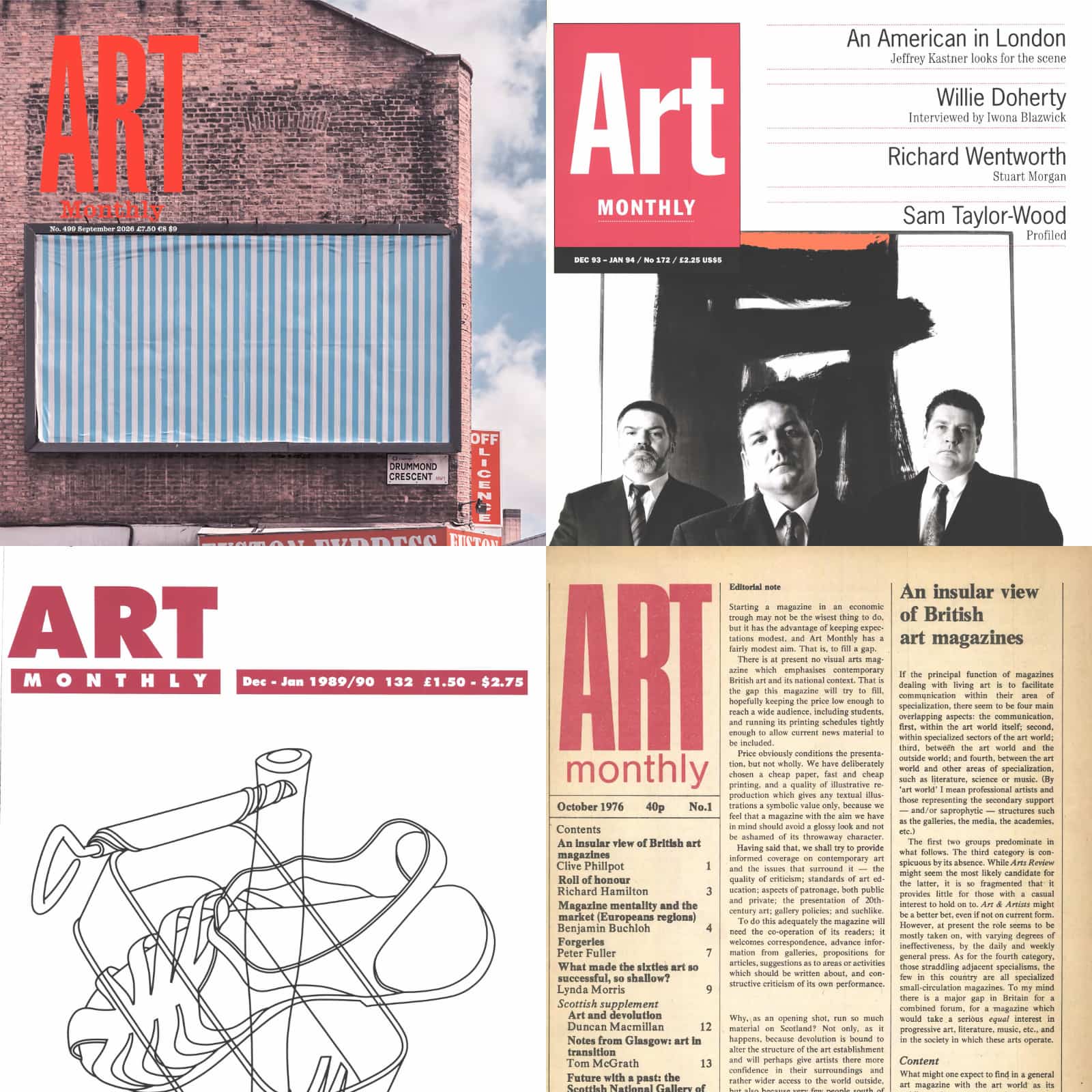
Art Monthly cover designs 1976–2026
When Artlaw’s first column was published in October 1976, interest in the relationship between artists and money had already been stimulated through discussion with artists about Marcel Duchamp’s life and work, and especially his mocking of the financial system of the art world with his piece Tzanck Check, 1919.
Daniel Tzanck was a Paris-based collector, enthusiast of modern art, and dentist. In 1919, visiting Tzanck for dental work, Duchamp chose to pay his bill of 400Fr ($115) with a cheque he created and Tzanck accepted. It was slightly bigger than life-size, entirely hand-made, to be drawn on a fictious ‘The Teeth’s Loan & Trust Company Consolidated of New York at 2 Wall Street’. The cheque served as a conceptual artwork that questioned the relationship between true economic value and artistic labour.
Duchamp’s views on money were closely tied to his minimalist lifestyle and critique of the commercial art market. He deliberately detached his artistic practice from financial motives, keeping his living costs low to maintain creative freedom. As for the cultural sector’s valuation of new artwork, Duchamp said it typically involves ‘deciphering and interpreting its inner qualifications’, perhaps referring to subjective opinions expressed by a motley crew of influencers, including: fellow artists, art scholars and critics, public-facing art museum and galleryinstitutions, art biennales, and artist’s foundations.
In 1976, discussions with artists also revealed a common fundamental question: why are artists poor? Artists gave customary reasons: they self-funded autonomous work, rarely being commissioned or sponsored to originate; and were usually paid the lowest price when new artwork was first sold, leading astute purchasers to buy directly from artists rather than pay additional premiums to art market dealers and auction houses. These reasons are as valid today as they were in 1976 – and in 1861, when London’s St James’s Chronicle newspaper observed:
‘It is a well-known melancholy truth that the tribe of auctioneers, connoisseurs, and picture dealers have monopolised the trade of pictures, and made it a matter of ridicule to purchase any modern production, or encourage an English artist. By this craft the leaders of taste of these kingdoms acquire fortunes and credit, whilst many of our painters, men of genius and industry, are absolutely starving.’
Artists’ poverty was similarly addressed by novelist Kurt Vonnegut, who caustically wrote: ‘The paintings by dead men who were poor most of their lives are the most valuable pieces in my collection. And if the artist really wants to jack up the prices of his creations, may I suggest this: suicide.’ And Thomas Hoving, director of New York’s Metropolitan Museum of Art until 1977, observed: ‘Does the art market treat art like any other commodity? Or are the commodities with which the art market deals converted into art by the process of the market? What do people really buy? Art is sexy! Art is money-sexy! Art is money-sexy-social-climbing-fantastic!’
In 1977, Artlaw first encountered artists making work intrinsically involving money when it was consulted by artist trustees of the Ceramic Workshop Edinburgh. The non-profit entity had been founded in 1969 to provide ceramic, screen-printing, darkroom and exhibition facilities. Despite its success, the workshop was forced to close in 1974 due to lack of external funding. After ceasing activities and paying its debts, only £1,512 remained. There was, however, an ‘uncomfortable’ provision in the trust’s constitution that, if it ceased operating, it must donate any remaining assets to another organisation with similar aims. The trustees were against surrendering the £1,512 and instead wished to change the trust’s legal constitution to allow it to invest the money: the investment would be an artwork, and the workshop would perpetually exist as such.
Artlaw advised and assisted the trustees, who formally resolved to convert their charitable trust into an investment artwork with the title £1,512. Accordingly, the trust’s remaining funds were entombed in perpetuity, with a requirement that tax-free interest from the investment would feed back to rejoin the original capital sum, at a rate that doubled its value every five years. The trustees estimated that by the end of its first century of investment, the original £1,512 would have accumulated a value of £410.7m; and that by the nature of its expansion would become a work of art that ‘in concept at least’ had the potential, through its absorption of capital, to ‘own the world’.
£1,512 is physically manifest as a locked briefcase, containing investment certificates to the value of the workshop’s remaining funds. It is an open-ended conceptual artwork, founded on toying with the then laws usually restricting, though occasionally permitting for exceptional purposes, perpetual accumulations of capital. It was first exhibited in 1977 at the Roxburgh Hotel in Edinburgh, then in 1978 at Düsseldorf’s Stadtisches Kunsthalle, and in 1979 at the Centre Pompidou in Paris.
Critical reviews of the artwork at that time, and since, have included discussions about the social exchange of money, and the economic base of art and time. Scottish contemporary art expert and scholar, Professor Craig Richardson, regards £1,512 as ‘a metaphor for the Scottish visual arts in the 1970s’, and cites Duchamp’s immense influence on the origination of an artwork of significance in the development of Scotland’s contemporary art in the last quarter of the 20th century.
Artlaw’s next significant ‘money work’ encounter was with US artist JSG Boggs. In 1984, Boggs was in a Chicago diner ‘having a doughnut and coffee and doodling on this napkin … sketching a numeral 1, and gradually embellishing it,’ as he later recalled. ‘The waitress kept refilling my cup and I kept right on drawing, and the thing grew into a very abstracted one-dollar bill’. The waitress offered to buy the napkin work, but Boggs refused. He then asked for his bill, 90 cents, and suggested ‘I’ll pay you for my doughnut and coffee with this drawing’. The deal was done and, as he was leaving, the waitress called out ‘Wait a minute. You’re forgetting your change,’ and gave him a dime. Boggs practised many such exchanges in the US and Europe over the next two years, as payment for his basic living expenses, including his rent; and determined that drawings of currency alone did not comprise not his artwork, but rather that the whole bartering transaction – including the receipt of legal currency as change – was the whole work.
In 1986, Boggs was living in London, successfully pursuing his art bartering practice, when a journalist suggested that such activity might be a criminal offence in England unless sanctioned by the Bank of England. Boggs therefore ‘wrote a letter to the Governor of the Bank of England, asking him permission to go on drawing likenesses of British currency … who wrote back denying permission, telling me what I was doing was illegal and that I was risking confiscation and arrest’. Boggs continued. He was subsequently arrested and indicted for offences of counterfeiting and forgery.
In 1987, the case went for jury trial at the Old Bailey, England’s Central Criminal Court. Boggs pleaded not guilty to four counts, alleging reproduction of a £10, £5 and two £1 Treasury Notes. If the jury determined that Boggs had indeed reproduced the currency, he would be found guilty: these were absolute offences, to which it was not a defence that the accused was an artist whose only intention was to create art.
Artlaw accepted Boggs’s invitation to join his defence team, whose strategy was to transform the public courtroom into a temporary art gallery by exhibiting a range of artworks, and calling expert witnesses to convey one key message for the jury: this is an artist on trial, not a mass murderer. An array of eminent art experts gave evidence for the defence. They offered the jury earnest, erudite, entertaining and illuminating discourses about the historical lineage of art as currency, bartering traditions, the economic value of art, the art marketplace, Dada, appropriation of found objects, Conceptual Art, Performance Art, trompe-l’oeil and Pop Art.
The judge directed the jury that all defence arguments were legally unsound or irrelevant: ‘This case is not about artistic freedom or freedom of expression or anything of that sort. You may have heard it described as a test case. Nothing could be further from the truth. This is a very narrow and specific case. Please don’t be deluded into imagining that you’re trying the contemporary art establishment. It provides no defence whatsoever that the drawings in question may be worth more than the originals or, for that matter, that they may in some manner provide the defendant with a principal source of his livelihood. Whether or not the defendant understood the law is immaterial.’ It was a jury direction to convict.
British juries, especially at the Old Bailey, fiercely resent being told by trial judges what to decide. After 15 minutes in retirement, the jury returned a unanimous verdict of not guilty on all counts. In the street outside the courthouse, members of the jury came out to shake Boggs’s hand, telling him: ‘It was the correct verdict. We loved your work.’ The jury’s verdict had been persuasively guided by Boggs’s defence team’s deep understanding and advocacy of his art bartering practice: at once conceptual, performative and graphically representational. The case earned Boggs a worldwide reputation as the artist who created his own currency, which pre-dated by three decades the advent of Bitcoin. Boggs is revered by many today as the ‘Patron Saint of Cryptocurrency’.
Artlaw has always addressed the art ecosystem’s financial landscape. By 1995, taxation of prizes and grants to artists had become a common concern: whether winners of prizes – such as the Whitbread, Turner and John Moores – were liable to pay income tax; likewise with other awards and prizes given by public and private donors; or competitions, ‘buying time’ awards, bursaries and artist in residence schemes, which are common features of the financial framework supporting artists in the UK. The law governing these situations was then interpreted and applied to such recipients by the Inland Revenue, today by HMRC. If artist taxpayers are aggrieved by an initial assessment decision, they can appeal to specialist tax courts.
Under UK tax laws, earnings from a trade, profession or vocation must be declared for income tax purposes: this includes all artists receiving income resulting from their activities as an artist. Leading judgments of the courts in relation to the taxing of prizes or grants have amplified and clarified the basic statutory position. Gifts or prizes given to or won by an artist are unlikely to be taxable, unless a prize or gift has been received as part of remuneration for services rendered. Grants or subsidies that directly relate to an artist’s trade, profession or vocation may be taxable: if a work is made specifically for a competition, then any prize won may be taxable. It remains unclear whether prizes won by artists who do not make work specifically for a competition/award, but who enter a work they have already made, would be liable to tax.
On 15 September 2008, the day the Wall Street investment bank Lehman Brothers filed for bankruptcy and triggered the global financial crisis of 2008, Sotheby’s in London began a two-day sale of 223 new works by Damien Hirst, fetching £111.4m. The initial idea for the public auction of new Hirst works came from Sotheby’s itself. Having agreed the idea, Hirst executed and consigned the new works, then energetically contributed to a highly effective publicity and marketing campaign. He gave numerous media interviews and photo-opportunities, and appeared on the cover of the European edition of TIME magazine the week before the auctions. ‘Beautiful Inside My Head Forever’ was the name Hirst gave to the whole project.
The mould this project broke is complex and many-faceted. Artists do not normally consign new works for sale at public auction, usually preferring to control their first/primary sales with dealers or collectors. Dealers in such works, when negotiating first/primary sales, customarily pitch prices at a level below those already achieved by any of their artists’ works at public auction: their intention is to encourage collectors to buy from dealers, rather than at public auction, and at the same time demonstrate to buyers that works can and do appreciate in market value when eventually resold at public auction.
Hirst decided to reverse this approach, telling the Sunday Times before the sales, ‘The first time you sell something is when it should cost the most. I’ve definitely had the goal to make the primary market more expensive.’ He appeared to have succeeded, and on a mammoth scale: it was widely reported that the prices achieved by his Sotheby’s sales were higher than those then currently asked by Hirst’s dealers.
Although the project turned out to be enormously successful, it was an extremely risky business venture, especially for Hirst. In the event, only 4% of the consigned new works failed to sell, but nobody – especially Hirst and Sotheby’s – was in a position to know or make an educated guess whether any of the lots would sell at all, let alone sell well. There was simply no precedent for holding this kind of sale of new studio work. As for Hirst’s own strategic objectives for the project, he told the New York Times the day before the first auction, ‘even if the sale bombs, I’m opening a new door for artists everywhere’. Hirst’s altruism deserves praise. But only the most commercially successful artists are likely to have the opportunity – let alone be able to afford – to take such monumental business risks.
In 2012, a lawsuit was filed in New York concerning Sol LeWitt’s Wall Drawing #448, 1985, for a private residence in Massachusetts; or, more particularly, the document signed by LeWitt with written instructions for drawing the mural and attesting that the resulting work would be LeWitt’s original: his authenticity certificate. A typical LeWitt certificate is headed: ‘This is to certify that the Sol LeWitt wall drawing number … evidenced by this certificate is authentic.’ It then specifies any lines, shapes, forms, configurations, colours, and the place and date of first ‘installation’. After which it states: ‘This certification is the signature for the wall drawing and must accompany the wall drawing if it is sold or otherwise transferred.’ Finally, it is signed and dated.
The lawsuit was filed by Roderic Steinkamp, a contemporary art collector and dealer, against the Chicago-based Rhona Hoffman Gallery, which specialised in ‘international contemporary art in all media, and art that is conceptually, formally, or socio-politically based’. Steinkamp owned LeWitt’s Wall Drawing #448 and authenticity certificate. In 2008, he consigned the certificate to the gallery for resale of the work via a written contract, in which the gallery agreed to be liable for ‘all loss, damage or deterioration’. In 2011, the gallery notified Steinkamp that the certificate had become ‘lost and irretrievable’. The gallery claimed for the loss on its insurance policy but the insurers declined to pay, and so did the gallery: hence the lawsuit.
Steinkamp claimed: ‘The original certificate, issued and signed by the artist who is now deceased, is a unique and irreplaceable document that cannot be generated anew or replaced. There is no substitute for the original certificate entrusted to the care, custody, and control of the defendants … Since the wall drawings do not constitute freestanding, portable works of art like a framed canvas or a sculpture on a podium, documentation of the work is key to transmitting it or selling it to a collector or institution … The original certificate is required for the sale of the wall drawing.’ He sought damages of at least $350,000 for alleged breaches of contract, bailment, negligence and conversion.
The suit raised challenging art and law issues, which were interrelated and based on the same set of circumstances: the existence of the certificate and its physical consignment to, and unexplained disappearance from, the gallery. If the breaches succeeded, Steinkamp would then have to satisfy the court that he had suffered quantifiable financial loss – and that is where market and cultural values would have become key issues.
The key criterion for establishing market value is not the estimated or asking price, but what has already been paid. LeWitt originated 1,259 wall drawings between 1968 and his death in 2007. Independent evidence existed about LeWitt’s works in the resale market, showing that auction prices ranged from $35,250 for Wall Drawing #767, 1994, sold at Christie’s New York in 2001, to $254,500 for Wall Drawing #41, 1970, sold at Phillips de Pury New York in 2009. Such sales were of physical works with their authenticity certificates. There appeared to be no evidence of market resales without such certificates, nor of sales of certificates alone – and therein was the greatest challenge: whether Steinkamp’s art lawyers could satisfy the court that a LeWitt certificate was an intrinsic element of the market value of the wall drawing it authenticated.
In this respect, it was self-evident that the LeWitt-signed lost certificate was unique and could not be replaced, since the artist had died four years before the gallery reported the certificate lost. Moreover, the gallery was a specialist in conceptual artwork; in which case, the gallery should ideally have tried to overturn the rejection of its insurance claim, which had occurred probably because the insurer had less understanding of the conceptual and legal significance of LeWitt’s certificates. In the event, this was perhaps what transpired, because the lawsuit was eventually settled out of court on an undisclosed confidential basis.
Around this time, Banksy emerged as a disruptor of norms within the art ecosystem. Initially operating from the early 1990s as a freehand street graffiti artist, Banksy soon began using stencils to facilitate swifter execution of street artwork – and avoidance of detection and arrest for criminal damage or trespass. His career started as an urban guerrilla artist, using the built environment as both his canvas and gallery to convey messages to the general public against war, capitalism and the establishment, which he did via satirical images often with epigrammatic text. He had no artworks for sale.
Banksy responded to his increasing popularity (and requests from people wanting – somehow – to own one of his works) by using his stencils to make reproductions of his publicly sited artworks. Some were printed on paper and offered for sale via eBay; others were printed on canvas and sold, more expensively, to selected collectors. In 2009, he established Pest Control as a separate online legal entity, registered in the UK as a limited liability company, partly to protect his personal identity, partly to authenticate his site-specific artworks, but mostly to handle the growing commercial dimensions of his practice. In this way, Banksy extended his artistic brand by adopting and adapting mainstream art business practices: creating and selling authorised versions of his works, and in signed limited editions; occasionally accepting commissions.
Perhaps the most memorable and widely known of all Banksy’s legal and business disruptive activities was his Girl with Balloon, 2004/06, shredding incident at Sotheby’s London in 2018. Banksy’s work has always been generative, in the Duchampian sense that its key concern has been for an image (alone or coupled with terse text) to stimulate intellectual engagement of the spectator – perhaps to think about their environment, and especially the location specifically chosen by the artist. In this case, the site-specific location for the key performance element of Banksy’s auto-destructive conceptual work was a live public auction room, in a world-leading auction house, in an art market capital city, during a prestigious week in the contemporary art market’s calendar; and timed to shred on the fall of the hammer confirming the highest bid of £1m.
An unidentified seller had consigned the work for sale to Sotheby’s. The shredder hidden within the frame could have been installed by the artist when making the work in 2006, and was unknown to the owner who consigned it to auction; or it could have been installed by Banksy with the owner’s collaborative blessing in preparation for its consignment to Sotheby’s. Shred the Love | the Director’s Cut was a short video posted on Banksy’s Instagram days after the shredding, including shots of the studio installation of a shredder within the frame of an artwork, and a test rehearsal of the shredding.
In the end, things turned out well for all parties including Banksy, because the highest bidder/buyer decided not to reject the shredded work, but to complete the auction transaction and pay to own it – promptly retitled by Banksy Love Is in the Bin, 2018, with a new authenticity certificate. And Sotheby’s was swift to capitalise on the incident, issuing a press statement: ‘Banksy didn’t destroy an artwork in the auction, he created one … the first artwork in history to have been created live during an auction.’ Only three years later, in October 2021, the shredded work was resold at Sotheby’s London for £18.5m. Perhaps Banksy failed in the attempted subversion or disruption of the art and money nexus, and instead demonstrated how the status and value of an artwork can change – to the direct financial benefit, primarily, of the collector rather than the artist.
On 1 January 2021, the UK legally ceased being a member of the European Union (EU), its Single Market and Customs Union (save for Northern Ireland’s special arrangements avoiding a hard border with the Republic of Ireland). Consequently, the UK no longer benefited from: EU funding; joint EU/UK law-enforcement and security cooperation including access to real-time crime data; joint EU/UK defence and foreign policy cooperation; the authority of the European Court of Justice for dispute settlement. For UK-based artists, art businesses and art institutions, Artlaw covered key aspects of how they might operate in a post-Brexit environment.
In October 2021, a 14-day live stream from Paris showed the Arc de Triomphe entirely wrapped in silver-blue fabric and red rope. This installation was conceived by US-based artists Christo and Jeanne-Claude in the 1960s, which they developed and financed, but were unable to execute before their deaths in 2020 and 2010 respectively.
From the outset of their practice, the duo developed the art of self-financing their projects. Jeanne-Claude said: ‘The only way to work in total freedom is to pay for it. When you accept outside money, someone wants to tell you what to do. So we fund each of our projects with our own money – through sales of Christo’s preparatory drawings, collages and early works. But we never know if they will sell fast enough to meet the expenses.’
In 1969, the artists added a business dimension to their practice by establishing a separate legal entity, the CVJ Corporation. ‘My Marxist education clearly helped me in using the resources of capitalism for my own ends,’ noted Christo, Jeanne-Claude adding: ‘But the reason for founding the corporation was mainly practical. For us it is very important to have a cash flow. We can pay for the early engineering studies for our projects because those bills come in sporadically. But when we start to hire workers to install the project, we have to meet the payroll every Friday. We can’t count on art sales to come in on time.’
CVJ owns most of the artists’ preparatory project artwork, safeguarded in several storehouses, mainly in Switzerland. Christo was blunt about the collection’s purpose: ‘When CVJ Corporation negotiates a credit line with a bank, these works of art serve as collateral. So they enable us to pay for our projects.’ In the decade following Jeanne-Claude’s death, Christo made sound business and financial plans to wrap the Arc De Triomphe – without him being hands-on. ‘I never thought it would ever happen,’ Christo admitted. ‘But I want you to know that many of these projects can be built without me. Everything is already written.’ CVJ operated beyond Christo’s death in 2020, and was instrumental in realising and managing the Paris project in 2021.
Throughout 2021, NFTs flooded the contemporary art ecosystem, prompting art economist Georgina Adam to comment: ‘The past year will mostly be remembered for the ongoing social and economic convulsions caused by Covid-19. But in the art trade, the old-world order was being demolished.’ Annual art fairs were cancelled or postponed, auctions pivoted to online-only selling, galleries communicated with clients via email and Zoom, and online viewing rooms performed poorly. One event ‘shook the market to its core’: Christie’s March 2021 online auction of Beeple’s born-digital Everydays: the First 5000 Days fetched $69.3m with fees, payment for which was accepted in cryptocurrency.
That NFT sale and its digital currency payment were both unprecedented in the art market, and had ‘a galvanising effect on the market for NFTs’; and others quickly racked up similarly eye-watering prices: $11.7m for Lava Labs’ CryptoPunk 7523, 2017, at Sotheby’s; $6.6m for another Beeple, Crossroads, 2020, via Nifty Gateway; and, in November at Christie’s, $28.9m for Beeple’s generative sculpture Human One, 2021. In Adam’s opinion, ‘the sudden and explosive arrival of digital art onto the art market has thrown a hand grenade into its traditional notions about price, quality and validation’ and ‘has laser-focused attention on this market, as the paradigm of new art, new buyers and a new way of transacting – even a new idea of art itself’.
In April 2025, US President Donald Trump triggered a global financial crisis, when he issued Executive Order 14257 ‘Regulating Imports With a Reciprocal Tariff To Rectify Trade Practices That Contribute to Large and Persistent Annual United States Goods Trade Deficits’. The Order imposed a 10% baseline tariff on the import of goods into the US from most countries, including the UK. Higher percentages were initially imposed on scores of ‘worst offender’ countries that had trade surpluses with the US (including China 54%, Switzerland 31%, India 26%, Japan 24%, and the EU 20%).
Governments of tariff-hit countries were thrown into ‘crisis mode’ deciding whether to retaliate, by imposing reciprocal tariffs on US goods imported into their own countries, or to accept tariffs they were unable to change; however, the Order reserved the power to increase tariff rates on any country that did retaliate, which China immediately did and had its initial 54% increased to 145% – but not on smartphones, computers and some other electronic devices entering the US from China (and vital to the trading of a number of US tech companies, notably Apple).
Art lawyers, including some based in the US, were unable to agree on the legal effect of the Executive Order on US imports of art. Unless and until there was authoritative clarification by or on behalf of the president, bewilderment and turbulence continued in the art ecosystem. For nearly 250 years, the US usually allowed tariff-free import of art, chiefly because taxing imports would ‘discourage foreign artists from exhibiting their work in the US, denying American artists the chance of proving to sceptical American collectors that home-grown talent was comparable to the best contemporary productions abroad … and that art tariffs also inhibited the importation of engravings of the old and modern masters that US artists required as examples to stimulate their own professional growth’. In the 1990s, in a clarification of earlier laws, Congress enacted the Harmonized Tariff Schedule (HTS), which exempts from import tariffs ‘paintings, drawings, pastels, original engravings, print and lithographs, original sculptures, objects of archaeological, ethnographic or historical interest and antiques of an age exceeding 100 years’.
Presidential Executive Orders are made under powers delegated by Congress under the International Emergency Economic Powers Act of 1977 (IEEP). Trump initially declared an emergency in relation to Canada and Mexico, which he later expanded to include most of the rest of the world because of trade imbalances (notably not Russia, Belarus and North Korea). IEEP, however, does not delegate authority to restrict imports or impose tariffs on so-called ‘informational materials’ that specifically include ‘artworks’. This derogation of presidential power chimes with the statutory exemption of artworks from import tariffs under HTS. Not all art lawyers, including some in the US, agree that HTS and IEEP together exempt imported artworks.
In February 2026, the US Supreme Court ruled that IEEP does not grant the president authority to impose tariffs, which only Congress has legal power to impose. Although the IEEP-based tariffs were ruled unlawful, the Supreme Court remanded decisions on how to handle refunds of previously paid tariffs to the lower courts, which are currently dealing with individual refund claims.
Henry Lydiate is an art lawyer and adviser to www.artquest.org.uk.
First published September 2026.
Art Monthly celebrates its 50th anniversary and 500th issue in October 2026. Henry Lydiate marks the magazine’s 50th year by reviewing his Artlaw column since its first publication in 1976. Throughout 2026, one broad subject is explored each month, noting significant events and issues, and commenting on key changes and developments to date.









Peveril Garden Studios
140 Great Dover Street
London SE1 4GW
United Kingdom
Email info@artmonthly.co.uk