Edinburgh Art Festival x Art Monthly Writer’s Award
Aftercare
Eilidh Akilade finds Edinburgh’s curators inspired by kink at the 2026 art festival
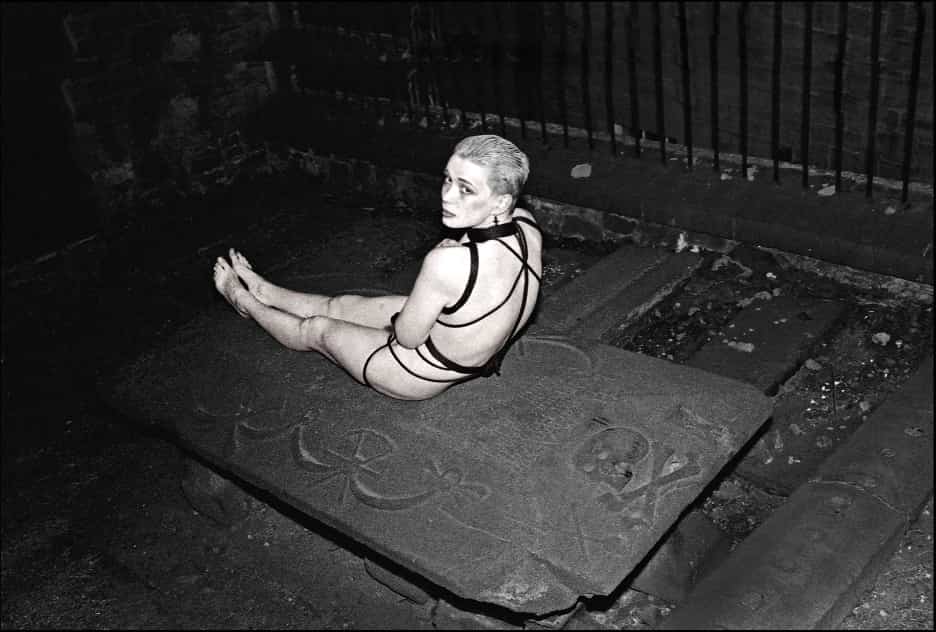
Del LaGrace Volcano, Sylvia on a Tombstone in Greyfriars, Edinburgh 1989, 1989
The day after this year’s Edinburgh Art Festival (EAF) had ended and deinstallation was already in progress, Eleanor Taylor, EAF’s curator, discussed over videocall how kink, the subject of this year’s festival, had recurringly entered office conversations. She added – while several works were being parcelled away and the background sound of peeled duct tape punctuated our call – that there are ‘so many interesting parallels with exhibition-making and curating’. Building on the annual festival’s commitment to platforming radical histories, EAF26 placed an emphasis on international queer communities, largely embracing artistic depictions of kink in these subcultures. With queerphobia rising across the UK and elsewhere, such curation appeared as a radical act of public attention for communities too often demonised by mainstream voices. The exhibitions instead presented kink as a practice that spanned care, aftercare, consent and the myriad ways one another’s desires are communicated. The question then is how to curate kink with care – particularly in the context of the UK’s largest annual festival of visual arts.
EAF@92 hosted ‘Love Bites Back’, an exhibition of dyke photography by the American artist Del La Grace Volcano. It focused on Volcano’s work from the early 1980s: a selection of works mostly shot in Edinburgh but also other parts of the UK. They form part of a body of work which complexly challenge traditional heteronormative imagery via the artists’ own experimentation with image-making, alongside their personal navigation of gender and sexuality. Offering an intimate encounter with queer desire, several works featured Volcano’s former partner, Sylvia, who we see in one photograph wearing a pair of sunglasses and a leather jacket, leaning against gravestones in Greyfriars Kirk cemetery; in another, she is naked and wide eyed, legs outstretched and leather-bound upon a tombstone. Volcano places queerness amid public life (and death), refusing to confine kink to the margins while also honouring its subversiveness. A palpable gentleness also calls out from such works – albeit charged with eroticism – as if to demand a reconceptualisation of queer desire itself. On the back of a freestanding wall was a large sheet of corrugated iron on which three scenes captured Volcano and a partner kissing in front of a clothesline, the greenery sprawling behind them. The photographs capture the sense of the slow, easy days of being in love; the ‘clotheslines pictures’, notes Volcano, are ‘really the epitome of domesticity’. In Volcano’s world, the two seeming oppositional categories of kink and domesticity sit delightfully side by side in this first room, offering a candid take on romantic love.
Gallery Two featured works primarily from Volcano’s time in London. Among them, images of oil wrestling, people wearing harnesses and a tender threesome of women. Much like BDSM practices, consent underpinned the curation of ‘Love Bites Back’. Everyone featured in the exhibition was approached for permission, this included clearing permissions to show the names of those found in ‘Fuck Chart, Chain Reaction’, 1997, which depicts a map of connected sexual encounters. For both Taylor and Volcano, the names and faces which do not feature are just as significant as those which do. Here, consent is a repeated act: first, in practising and documenting kink; then, decades later, in curating depictions of such kink with care.
‘Love Bites Back’ was presented alongside a sister show ‘Sensual / Mutual’ at London’s Auto Italia that instead focuses on the artist’s time in San Francisco and Santa Fe in the 1970s and 1980s. While EAF is just three weeks in August, ‘Sensual / Mutual’ runs from July to October, offering audiences more opportunities to engage with Volcano’s work. Collaboration and the care such acts demand isn’t undertaken superficially by EAF and Auto Italia, rather it is the essence of their shared curatorial practice.
To curate both shows, Volcano welcomed Taylor, EAF’s director Kim McAleese and Auto Italia’s director Maggie Matić to stay with them in their home in Sweden for a handful of days. Hours were spent in Volcano’s studios and archives, but the trip also offered a further intimacy: a coffee shared each morning, daily walks spent together, and meals cooked by Volcano – ‘my practice is a practice of care’, Volcano says, and cooking – a former profession of theirs – is an extension of that. ‘I do equate my work [...] in a way, or metaphorically speaking, to the slow food movement. You know, I want the work to stick to your bones. I don’t want you to just mindlessly consume it like a fashion magazine or fast food.’
How we consume queer art – particularly that which was not made for public consumption – was likewise questioned in ‘Carnal Desires’, an exhibition of works by Sadao Hasegawa, one of postwar Japan’s most influential, yet still under recognised, gay fetish artists. Taylor spent a week visiting Gallery Naruyama to become, as she says, ‘fully submerged’ in Hasegawa’s archive. Interestingly, despite the perceived shame that Hasegawa’s legacy could have brought on his family, the artist’s wish for his archive to be passed on to the gallery was respected.
A rich, self-invented folklore folds into each of Hasegawa’s drawings and paintings, which visibly and playfully disrupt the way pleasures are received or discovered on a body. Rendered in both black and white and full colour – electric purples, hot reds – we see penises held and sucked, masked figures watch couples voyeuristically, spiders similarly penetrate bodies and orifices, candle wax pours and spit drips onto feet. Hasegawa’s works suggest the multiplicity of submissive pleasures, as Taylor notes of the work: ‘[the men are] all sort of happy and smiling and into it. And there’s something in that, the dominance doesn’t necessarily negate this tenderness as well.’
Four vitrines held further examples of Hasegawa’s work across different stages of his career: from experimenting with drawing naked men, through comical magazine publications to fantastical depictions of bondage and bestiality. His works are abundant with detail, yet our time is rewarded; the longer one looked, the more Hasegawa’s works revealed. The second vitrine, for instance, held drafts of comic strips – bursting with jagged speech bubbles, cartoonish alarm and model-like abs – which featured Hasegawa’s notes neatly contained in the margins that register as an editorial care for his images. Small and intricately detailed, many of his paintings were intended for private viewing only rather than for exhibition.
Both ‘Carnal Desires’ and ‘Love Bites Back’ struck the right balance in refusing to handhold yet accepting the need for occasional explication. ‘I don’t think care means making things less challenging,’ Taylor notes. ‘It means taking responsibility for the conditions in which people encounter it.’ For EAF, aftercare – and care throughout – is crucial. All EAF artists had access to a bank of active listeners and therapists. Audiences were directed to online resources and EAF emphasised that their door is always open for those who wish to continue the conversation.Community holds and is held by this care.
This was also evident in Taylor and civic curator Elle Haswell’s invitation to Glasgow Leatherdykes – a trans-led group which runs social nights for those interested in leather and leather culture – which ran a workshop that explored the queer history of leather care and bootblacking. The workshop was hosted next door to Hasegawa’s ‘Carnal Desires’, alongside part of the research project Trans Masc Studies by artist Ellis Jackson Kroese. In curating such a space, both Kroese and EAF were keen that it could be a space where people gather, be comfortable and at ease.
Reflecting on EAF’s presentation of works by Volcano, but also the nearby show of Catherine Opie at the Royal Scottish Academy – an EAF partner gallery – one of the Glasgow Leatherdykes noted that ‘it’s great to bring current leather practice into the same space as those artworks and give people who see those photos and feel a sense of longing a way in, because leather is very much still alive’.
Relationships with such communities are a year-long endeavour, ‘[T]hat continuity is what really makes civic curating meaningful,’ says Haswell. Such continuity is likewise present in EAF’s dialogue with queer desire in its many forms. To curate with care – kink or otherwise – is a continuous act.
Eilidh Akilade is the winner of Art Monthly and EAF writing prize 2026.










Peveril Garden Studios
140 Great Dover Street
London SE1 4GW
United Kingdom
Email info@artmonthly.co.uk