Feature
The Absence of Presence
During a global pandemic, Mark Wilsher revisits the art historical legacy of presence to ask what we are missing
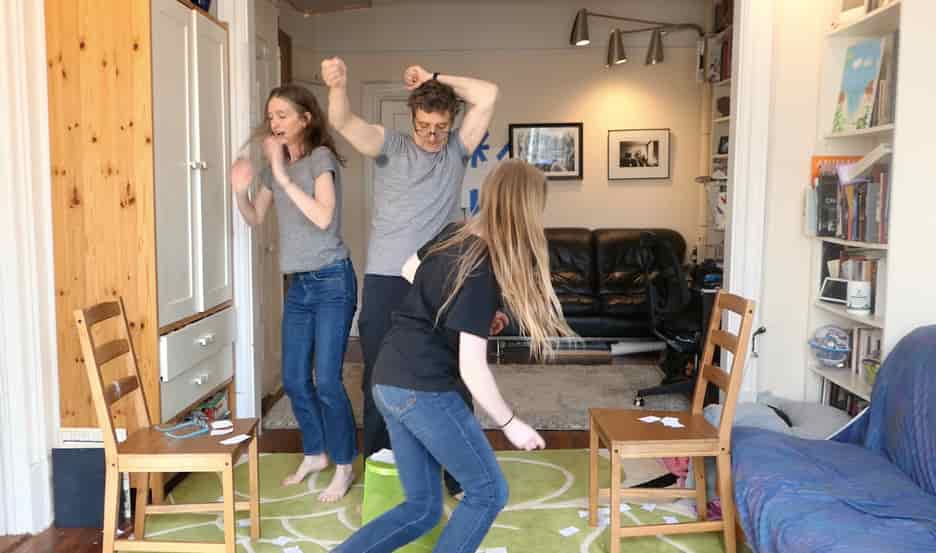
Kimberly Bartosik/daela, The Game, 2020
Mark Wilsher argues that enforced social distancing has served to remind us that in art as in life we are not just missing others, but also our own sense of bodily presence, exacerbated by increased digital communication and critical commercial pressures on artists to make work that translates easily into digital formats.
The worldwide closure of exhibitions and galleries brought on by the spread of Covid-19 has only served to accelerate and amplify some existing tendencies within the art world. Exhibitions were already increasingly being visited and sometimes curated entirely through phones and laptops. In the first couple of months, galleries scrambled to enlarge their digital presence by posting walk-through tours, 360° images that the visitors could clumsily click around, curators’ talks and thousands of images. Anything that would mean those stalled exhibitions sitting idle in shut-down galleries around the world could attract some attention and make good on the investment of time and money. This was very welcome at first and it gave the sense that life was carrying on as normal, but the limitations of a click-through installation very soon became apparent.
As the weeks went on, specific events and programmes emerged and these have tended to align themselves with their means of distribution by favouring digital, moving-image or image-based work (see Morgan Quaintance’s ‘Remote viewing’ in AM437). Putting aside for a moment the question of intended projection format and the scale of the cinema screen, this kind of programme seemed to suit the isolated experience of sitting at home under lockdown, face illuminated by the laptop’s glow. There was also a welcome intimacy and immediacy in seeing new commissions by artists and filmmakers operating in the same situation as ourselves. Thomas Hirschhorn’s personal elaboration of his work in progress Simone Weil map spread out on his apartment floor (a ten-minute video in ArtReview’s work-of-the-week series) kind of felt like we were all trying to make the best of it together. A set of new commissions from the Onassis Foundation, ‘Enter’, saw artists given 120 hours to explore the limits of what was possible within their own boundaries. ‘During the pandemic time-space,’ writes the curator, ‘houses, apartments, gardens, roof-terraces and balconies become our new site-specific stages. Children, husbands and wives, grandparents, roommates, even pets become, alongside their household goods, characters and props, as the artist’s laptop is turned into a creative superpower.’ It turned out that film and moving-image works were most prevalent in this series, inherently able to reach out and incorporate other places and other situations. But I also enjoyed the sense of immediacy in knowing that these pieces had been made under the same circumstances that I was working under. Watching The Game, 2020, by Kimberley Bartosik/daela, it was impossible not to feel connected to the artists’ family trying to stay sane in their apartment under quarantine. In the film, the family rush through a repeated sequence of actions derived from the things that they had each said and done under lockdown. As well as producing a frenzied piece of absurd theatre, it must have been a cathartic way to deal with each other’s annoying habits (the rules of the game are available for you to play at home).
All this was an acceleration of the way that galleries and dealers had been using their websites to put work online, although now the motivation was as much existential as simply commercial. In the process, however, there is a flattening-out or an equalising that reduces everything to a back-lit image no more than 13" across. In particular, the kind of art that suffers or is under-represented must inevitably be that which does not translate well to a digital file: sculpture, installation, environments, live performance. Perhaps not coincidentally, these are also some of the forms which historically emerged as challenges to the commercial art world. They are famously and often intentionally difficult to sell.
The enforced abstinence from gallery visiting has also made me wonder about the physical presence of artworks; more noticeable somehow in its absence. We don’t talk about presence much anymore, although of course it is everywhere and every kind of material production from printmaking to grand opera makes use of it. Postmodern criticism of the past 40 years tends to valourise interpretation, semiosis and perhaps especially imagery itself. But physical presence is still crucial, and its glaring lack under the current circumstances made me start to wonder why. What exactly is it that we are missing out on?
At the heart of Documenta 13 in a glass case in the rotunda of the Museum Fridericianum – in the ‘middle of the middle of the middle of’, as Lawrence Weiner put it – was a collection of significant objects that spoke to the themes of the overall project. Among many other items, there were the bottles that were the repeated subjects of Georgio Morandi’s paintings, the thermometer that Lee Miller took from Adolf Hitler’s bathroom, Etel Adnan’s palette knife, and artefacts from the National Museum of Beirut that had been fused together by explosions in the Lebanese Civil War. Tokens of real life. Like museum exhibits, old love letters or tourist souvenirs brought home, their power is drawn from our recognition of their history. They were there. This is the actual thing. Look closely, and you might see a trace, a remnant of the past caught on the surface of an otherwise unremarkable object. That sense of the object as evidence is the most obvious trick of presence that artists make use of to power their work. Cornelia Parker has mined this extensively, presenting anything from a feather from Sigmund Freud’s pillow in Hampstead to a selection of items cut in two by the guillotine that executed Marie Antoinette. More humorously, Andreas Slominski’s elaborate tales are authenticated by the presence of the objects left behind. Looking at a golf ball on the gallery floor of the Serpentine in 2005 we were told that a pro-golfer had chipped it over the gallery roof from Hyde Park and it had rolled down a ramp, through the window and come to rest right here. Look, see? One of the most audacious would be the round dent made in a piece of polystyrene foam by a team of people pushing a light aircraft into it until the nose cone made contact. The knowledge of the significance of the presence of the object is where the work lies in these cases, and it can generate a fizzing circulation of mind/body dissonance which translates as an aesthetic buzz.
Despite artists almost universally declaring the vital importance of media and materiality within their work, presence itself hasn’t really been a central concern of contemporary art since the late 1960s and 1970s when a flowering of related tendencies across the world insisted on a revolutionary encounter with reality that was also a political challenge to rethink the relationships of the world anew. Arte Povera and Mono Ha used raw material presence as a philosophical device to wake the viewer up from conventional perception. But, while these movements undoubtedly valourised materiality in their work with rocks, earth, raw materials and other ‘things’, it was American minimalist sculpture that most explicitly employed presence as an aesthetic aim and rhetorical device. Taking compositional relationships out of the work, often working at a human scale or above, minimal sculpture faced outwards toward the room and the viewer in space. Robert Morris’s pivotal 1964 Green Gallery exhibition installed large featureless grey plywood blocks in the corner, on the floor and hanging from the ceiling. Critic Barbara Rose wrote that they ‘destroyed the contour and space of a room by butting off the floor onto the wall, floating from the ceiling, or appearing as pointless obstacles to circulation’. I had thought I was very familiar with the black-and-white archive photographs of this exhibition, but when Sprüth Magers Lee staged a reconstruction of it in London in 2005 I was taken aback by just how over-sized and obtrusive these mute grey sculptures indeed were, even though I was expecting it. It could only really be appreciated in person. Standing in the room with work by Morris, Donald Judd or Carl Andre, that sense of self-conscious bodily presentness is unavoidable. Those artists were often informed by their reading of the phenomenology of Maurice Merleau-Ponty, published in an English translation in 1962, and their interest in presence could ironically sometimes come across as rather dry and cerebral. But it opened the path to a flood of work in the expanded field of sculpture, including architectural installations, live performance and body-based art that some identified as a ‘corporeal turn’.
A more recent manifestation of this strips the work down even further to nothing more – or less – than a direct encounter with another human being. At MoMA in 2010 Marina Abramović sat continuously face to face with individual members of the audience who queued round the block to experience her focused attention within the walls of the gallery. The exhibition title, ‘The Artist is Present’, was both a simple description of the situation and a promise of the quality of encounter due to her long practice and experience of meditative interior states. Over half a million people visited the show and 1,500 were able to sit down with her, many, apparently, having cathartic experiences or spontaneously bursting into tears. The massive popularity of this project must surely be more than a succès de scandale; it shows an appetite for the real in an ever-increasingly unreal age. What could be more real than the simple presence of a human being, mirroring and perhaps affirming your own existence? A 1964 instruction piece by Yoko Ono suggested that we use another person as a mirror.
One of the weirdest unexpected effects of the explosion of the online world since the millennium has been its impact on popular dance and choreography. Not the kind of cerebral, highbrow dance that might be programmed into a museum’s events season. I’m thinking about memes and a plethora of minor internet sensations on TikTok, or the animated celebration dances that players can buy and perform in Epic Games’s Fortnite. Whereas dance has always historically been concerned with the body and with the feelings generated by moving in relation to music or rhythm, this new breed of dances is either totally artificial – designed primarily to be triggered and watched by animated characters – or else choreographed for a compressed area of space around the face that can be seen on the screen of a mobile device. Hand gestures flicker around the head, arms frame the face and as a whole they recall nothing so much as Voguing, the dance subculture from the 1980s that was itself based on the look of a face framed ‘on the cover of a magazine’. This new kind of dance can be performed standing still. Hands and arms don’t bear the weight of the body, they elaborate, circulate and punctuate a still centre, and the whole is designed and aimed squarely at the lens of a smartphone camera. It is the pinnacle of an externally directed performance where the internal experience, that felt sense of bodily presence that has traditionally seemed inherent to dance, is largely irrelevant.
As a parent, I have spent several years witnessing the mind-imploding sight of primary-school children mimicking computer game character animations in the playground. Not just rapid micro-choreography like Fortnite’s Orange Justice, but also the subtle moves and postures of ‘idle’ animations that are meant to imbue characters with a sense of life when the controller has been put down for a few moments. Rather than remaining inert and lifeless, the character might shift gently from side to side, flex its knees or, after a minute, look around. In this way, children are inhabiting the imagined bodies of animations that condense and travesty what it is to be a human being. This sort of learned movement repertoire calls to mind Marcel Mauss’s 1934 essay ‘Techniques of the Body’, in which the author describes a series of particular styles of sitting, walking, swimming and digging, all specific to their own country and culture, and all acquired rather than inherent. Like traditions, ideologies and beliefs, there is nothing ‘natural’ about the way we use our bodies either. Mauss’s work was later to influence the ‘habitus’ concept of Pierre Bourdieu and the biopolitics of Michel Foucault. I think what I find so disturbing about seeing this in the playground is the rampant colonisation of bodies by the culture industry and the uncanny valley of the closed human-animation loop (see Aoife Rosenmeyer’s ‘We are the Robots’ in AM436).
Some of the most popular content to be found online can be read as a product of the disembodiment of the screen and, in fact, often tries to work against it, tries to reach out and affect us physically and sensorially. How else to explain the weirdly sexualised world of ASMR videos? The texture of small sounds and attention to intimate physical contact like brushing hair, or rustling a plastic packet? At the other end of the spectrum there are the many compilations of ‘jump scares’ that promise to thrill us with a sudden shock from a movie or video game. They distil what was originally a longer narrative experience down to just the climax – a condensation of affective thrills. At a further level of remove there are ‘reaction videos’, where we get to watch other people simply reacting to a TV show or a scary movie. They leap out of their seats, they scream out, they display a very strong performance of affect that might touch us, the audience of their reactions, through the screen. These examples of emergent online cultural forms all follow the fundamentally pornographic logic of ‘arousal – frustration – arousal’. This was the organising theme for the first part of the exhibition ‘Radical Passivity: Politics of the Flesh’ at the neue Gesellschaft für bildende Kunst in Berlin from September to October, which then travels to HGB gallery Leipzig. Featuring artists well known for their consideration of the body, such as Lee Lozano, Lydia Lunch and Paul Thek, the wider three-part show takes its cues from a ‘pharmacopornographic’ subjectivising biopolitics and explores what it calls a new digital corporeality. These new cultural forms have arisen within and precisely because of the narrow, disembodied sensorial experience of the screen. It is just the latest exhibition to explore this kind of terrain, but the Covid-19 lockdown only serves to underline our now almost complete surrender to digital connectivity, while also revealing its sensorial limitations.
Revelling in the aura of a significant object, being there in the same space and time, using all your senses to take in the reality of a unique experience – who could forget the disorienting sense of being menaced within a looming curve of steel by Richard Serra? Or the impossible-to-photograph smell of used sump oil that greets you as you enter Richard Wilson’s 20:50, 1987? These are the bodily dimensions of art that we are currently denied. The new digital corporeality becomes a less enticing prospect when it lacks the old kind of corporeality to play off against. I asked at the start what exactly it is that we are missing out on, beyond the social element of openings, events and parties, beyond the obvious difference between travelling to visit an exhibition and looking at a bunch of images on the website. Yes, the pandemic has skewed the art world even more towards readily saleable image-based works that photograph well. But I think what is really missing is the opportunity to feel ourselves reflected back by the work. We’ve been missing the experience of ourselves.
Mark Wilsher is an artist living in Norwich.
First published in Art Monthly 440: October 2020.







Peveril Garden Studios
140 Great Dover Street
London SE1 4GW
United Kingdom
Email info@artmonthly.co.uk