Review
Ana Mendieta
Bryony White reappraises Ana Mendieta’s influential practice
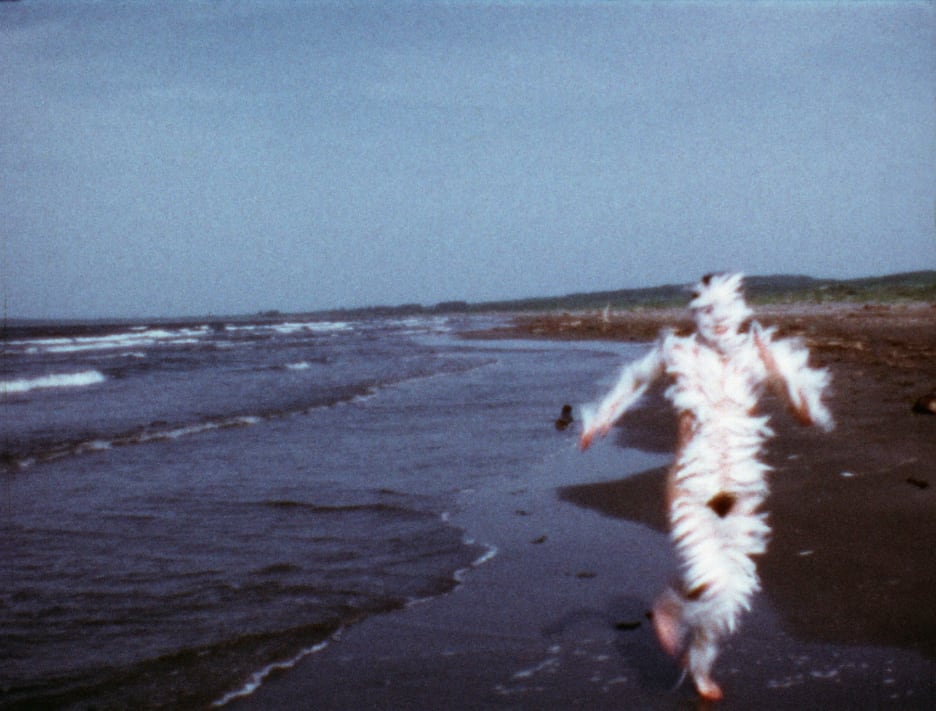
Ana Mendieta, Bird Run, 1974
At the close of Ana Mendieta’s exhibition at Tate Modern, she appears on a vast screen in the 1974 short film Bird Run: a distant figure sheathed in brilliant white bird feathers, part woman, part avian monster. She hurtles across Playa La Ventosa in Oaxaca, Mexico, careening through the surf, sprinting towards the camera, growing from a pale figure on the horizon into a laughing, carefree presence. In the final minutes of the film, Mendieta seems almost airborne. The feathers both emphasise and obscure her body, as in many of her ‘Siluetas’ series included here: in one, the earth holds its imprint like a grave; in others, fire consumes its outline or water gradually erases it. In many ways, the landscape appears in Mendieta’s work as not an inert backdrop but a force capable of transforming - and sometimes destroying - the body. Even the apparent freedom of Bird Run is edged with a defiant strangeness: Mendieta’s feathered figure moves between woman and animal, play and ritual, threat and joke.
Many of Mendieta’s films and object-based works in the exhibition occupy similarly unstable ground between body, material and landscape. They unsettle any sense that the environment in her practice, and in the world, is innocent or inert. Made from blood, feathers, flowers, sand, fire and earth, these works are often described as ‘ephemeral’. They survive through photographs and Super 8 films, many of which have been remastered for the exhibition. So far, responses to Tate’s retrospective have focused on how it addresses Mendieta’s place in the history of land art, placing her alongside figures such as Robert Smithson and Richard Long. While aligning Mendieta with land art productively foregrounds her engagement with landscape as both material and site, it risks glossing over what might be a more searing, subtle critique of Land Art as an engagement with ‘raw’ material and matter. To understand Mendieta’s encounter with the earth in solely formal or symbolic terms would be to deracinate it from the material violence upon which circuits of capital depend, and which Mendieta was committed to exploring. Within this framework, extraction names not only the violent removal of land and resources, but also the displacement of bodies, an entanglement to which Mendieta may have been especially alert, given her life was shaped by migration and exile.
There is little doubt that nature and the environment are central to Mendieta’s work, and her classification as a land artist is persuasive. Feminist art historians, including Jane Blocker and Amelia Jones, have long interpreted this investment in landscape through Mendieta’s exile from Cuba, when she was one of more than 14,000 unaccompanied children who, between 1960 and 1962, were sent by worried parents to the US as part of Operation Peter Pan in response to false fears, fanned by CIA propaganda, that Cuba’s new leader, Fidel Castro, would remove parental rights and place children in communist indoctrination centres. Mendieta’s work also draws on goddess mythologies associated with Cuban Santería and the philosophies of the Taíno people, bringing spiritual, cultural and autobiographical dimensions to her encounters with the land. In one photographic sequence, Mendieta attaches flowers to her head until she appears almost suffocated beneath them. In Tree of Life, 1976, she stands covered in mud and grass, her body pressed against the trunk of a tree until it is almost indistinguishable from its surface. Many of these works were created at Old Man’s Creek, when Mendieta was a student at the University of Iowa. The exhibition centres this relation in the gallery entitled ‘The Grove’, which frames the location as both a physical environment and a metaphorical space. Viewed during a heatwave in which local London temperatures exceeded 38C, and against the broader context of an intensifying ecological crisis, Mendieta’s work certainly assumes renewed urgency.
The volatility of Mendieta’s practice becomes especially significant when it is situated within the political and economic conditions of the 1970s. Her earth-body works emerged just as environmental degradation was becoming a matter of national political concern in the US. The first Earth Day took place in April 1970, the same year that the US established the Environmental Protection Agency, leading to the passage of legislation concerning clean air, clean water, pesticides and endangered species. The 1973 oil crisis further exposed the dependence of industrial economies on finite natural resources in the global south, transforming energy extraction into a pressing question of consumption, scarcity and geopolitical power. Mendieta’s works are not a direct illustration of these events, yet they constitute a more granular response to the period.
Extraction, in this context, involves more than the physical removal of oil, minerals or other resources from the earth. It also names a logic of abstraction that treats land, matter and living beings as separate from one another, thereby enabling its appropriation and the exploitation of people and their capacities. Capitalism does not merely act upon a pre-existing natural world, it helps produce the distinction between nature and social life, rendering land, matter and living processes legible as resources available for extraction and accumulation. To present Mendieta’s engagement with the environment as though it occurred outside these historical dynamics and material conditions risks reproducing this abstraction. It separates the spiritual or metaphorical meanings of the landscape from the material regimes of ownership and displacement through which landscapes are continually reorganised, and to which Mendieta was herself forcefully subject.
The contemporaneous development of Land Art makes this tension particularly important. Robert Smithson’s Spiral Jetty appeared in 1970, alongside monumental interventions by Michael Heizer and Walter De Maria. Such works frequently depended upon machinery, territorial access and the large-scale displacement or reorganisation of geological matter. Mendieta’s earth-body works operate at a markedly different scale. Rather than asserting technological mastery over the landscape, they expose the body to processes of erosion, decay and transformation. Her interventions are frequently temporary: water dissolves them, wind disperses them, and vegetation grows through or over them. Yet this ephemerality should not be mistaken for a retreat into an innocent or untouched nature. Mendieta’s work instead situates the body within the same material field as the earth, revealing both as vulnerable to forces of appropriation and violence.
While arguably one of the most innovative and expansive exhibitions at Tate recently, the exhibition’s ecological emphasis must also be understood as part of a broader effort to reorient Mendieta’s legacy away from the controversial circumstances of her death and her marriage with Carl Andre. Many reviews of the exhibition have praised this recalculation of her legacy. While this desire is understandable, by detaching Mendieta’s work from her death, the exhibition also risks muting the forms of violence that she herself made central to her practice, including the violence of ecological extraction and how it is inseparable from bodily violence. Similarly, the curatorial subordination of blood, sexual violence and bodily vulnerability risks implying that violence only entered Mendieta’s work after her death. Yet violence was already one of its principal formal and political languages. Refusing the sensationalisation of Mendieta’s biography does not require the sanitising of her art.
At times, the exhibition’s reframing of Mendieta’s life produces its own act of conceptual extraction by separating ecology from histories of capitalist violence; nature from the political economy through which it is produced; the photographic image from the embodied performance that generated it; and Mendieta’s environmental concerns from her sustained engagement with blood, mortality and sexual violence. The result is a version of ecological relation that can appear harmonious precisely because its constitutive antagonisms have been removed. Nature is neither a passive background nor a restorative space situated beyond capitalist abstraction. In Mendieta’s work, it is a contested field in which bodies and materials are absorbed, transformed, commodified and displaced.
Bryony White is a writer based in North Somerset. She is an assistant professor in the School of Creative Arts, Performance and Visual Culture at the University of Warwick.
‘Ana Mendieta’, Tate Modern, London, 15 July 2026 to 17 January 2027
First published in Art Monthly 499: September 2026.









Peveril Garden Studios
140 Great Dover Street
London SE1 4GW
United Kingdom
Email info@artmonthly.co.uk