Artlaw Retrospective
Artists and Public Policy
Henry Lydiate on the impact of political decisions on the visual arts
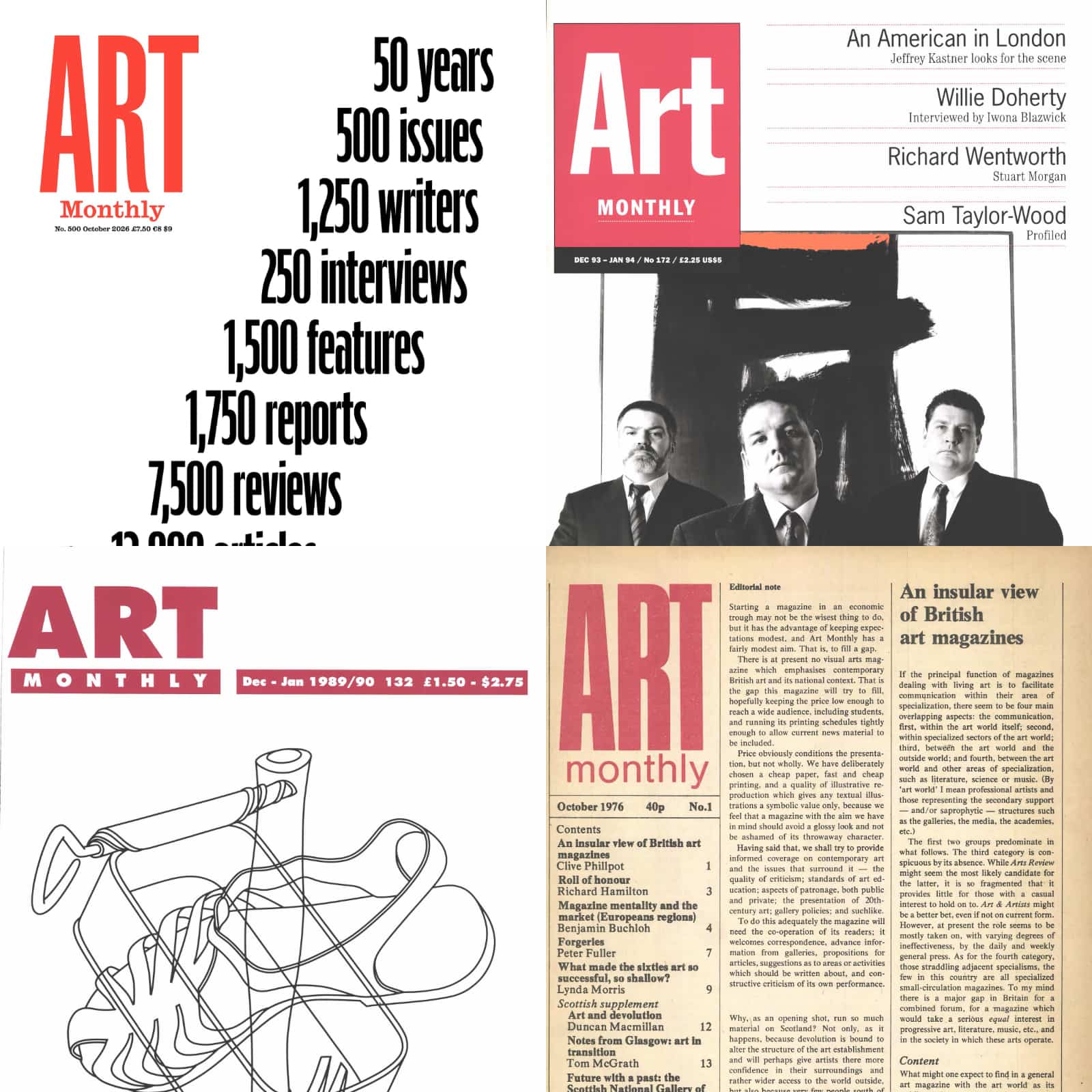
Art Monthly cover designs 1976–2026
When Artlaw’s first column was published in October 1976, interest in the relationship between artists and public policy had already been stimulated through discussion with artists about their life and work. Eduardo Paolozzi, Richard Hamilton, John Hoyland, Brian Clarke, Joan Hills and Mark Boyle were especially generous in sharing their experiences, and in supporting Artlaw over future decades.
In 1977, Artlaw first considered a radical public policy matter. It was raised by Boyle outside the Tate Gallery (now Tate Britain), after a visit with him to see a solo exhibition of recent work by a Boyle protégée. At the foot of Tate’s front steps, Boyle turned and pointed back at the building. ‘Everyone working in there is paid,’ he said, ‘except the artist whose works we just saw. That’s not right. She should be paid. Something should be done about it.’ That encounter sparked Artlaw’s advocacy for instituting an artist’s legal right to ‘Public Exhibition Payments’ (PEP) in the UK.
In 1978, the then Arts Council of Great Britain (ACGB) commissioned an independent Working Party to investigate the question of payments for living artists whose works were shown at ACGB or other publicly funded galleries. The enquiry was led by Marina Vaizey – art critic, broadcaster, exhibition curator, author and journalist – and included Artlaw as special adviser. The party’s conclusions were published, taking as axiomatic the rationale for PEP recently articulated by the International Association of Art: ‘Works by living artists exhibited in or on public buildings, galleries, museums and other public sites, and which continue thereby to provide a service to the public, should be subject to a continuing form of remuneration to their creator (comparable to performing rights for theatrical or musical works paid to author and composer), so long as he or she is alive and the work continues to be a public amenity.’ Responses from the art community were invited on the party’s suggestions for implementing PEP in the UK.
In 1979, following overwhelming responses supporting the suggestions, ACGB agreed a ‘Payment to Artists for Exhibition of Work’ policy, implemented with a standard fee of £100 (£650 in 2026) per solo show. This scheme was in place until 1994, when ACGB was dissolved into three separate arts councils for England, Scotland and Wales, leaving each devolved council to determine PEP policy within its own bailiwick. Since then, no formal or legally mandated PEP system has operated in the UK: public-facing galleries’ practices are voluntary and inconsistent, with payment depending on an individual institution’s budget, policy and funding sources.
In 1982, an ‘Art and Architecture’ movement was launched, promoting collaboration by UK artists and architects to develop projects for the built environment. Artlaw contributed advice and assistance to the initiative, especially drawing attention to similar activities since 1945 in continental Europe and the US. Many states had developed and operated public art funding policies, along the following lines: whenever a new public building, place or space was built or created, a percentage of the overall cost of the development was required to be spent on art or artists’ services, in order to secure collaboration between artists and architects for the benefit of the public. Some states, especially those whose built environments had been devastated during the Second World War, had enshrined such policies in ‘Percentage for Art’ legislation. Artlaw advocated enactment of such policies and/or legislation in the UK.
In 1984, Art Monthly’s then editor, Peter Townsend, commissioned a series of articles reviewing the surge of UK public art projects over the previous two years, explaining how artists, craftworkers and architects had successfully joined forces to bridge the gap between built environments and creativity. Art Within Reach: Artists and Craftworkers, Architects and Patrons in the Making of Public Art was published by Thames and Hudson in collaboration with Art Monthly, ACGB and the Crafts Council. Artlaw contributed a utilitarian examination and exemplification of key legal matters, including contractual frameworks. Publication was accompanied by an exhibition at London’s Air Gallery, showcasing high-profile public art projects.
In 1985, Artlaw supported the establishment of the Public Art Development Trust (PADT) as a legally registered charity. PADT’s core mission was to promote the commissioning, preservation, and public education of art in public spaces and places. PADT was the first independent agency in the UK solely dedicated to initiating, professionalising and managing public art projects, and acting as a link between artists, architects, public and private property developers. Over the next two decades, PADT defined the landscape of British public art, spearheading prominent infrastructure collaborations.
PADT’s most notable achievement was at Heathrow Airport, under the aegis of a British Airports Authority Art Programme, to transform stressful transit areas into ‘engaging cultural spaces’. In 1986, to mark the opening of Terminal 4, Brendan Neiland was commissioned to create the screenprint Terminal 4, which mirrored the glass reflections of the terminal. Concurrently, London Underground’s ‘Art on the Underground’ programme included a project for connecting commuters to Heathrow: Wilson McLean painted a Fly the Tube to Heathrow poster, featuring a paper aeroplane folded from a Tube map flying over an idealised British countryside, marking the expansion of the Piccadilly Line to its new station at Terminal 4.
For Terminal 3’s circulation corridors leading to the business class lounges, four emerging British artists were commissioned in 1995 to paint landmarks to welcome international travellers to London: Guy Noble’s Man Walking His Dog, Trafalgar Square; John Bartlett’s The Epic and the Everyday, a view of the City of London near St Paul's Cathedral; Haydn Cottam’s various paintings celebrating London’s markets in Soho, Portobello and Covent Garden; and Jonathan Waller’s Queen Mary’s Garden: Regent’s Park and Hyde Park.
For Terminal 1, in collaboration with architect Richard Rogers in 1996, a major project restored and reinstalled a massive series of enamel-on-steel panels by Polish artist Stefan Knapp. Originally commissioned in 1959, these abstract works were ‘rescued’ and integrated into the terminal’s Flight Connection Centre, relating the airport's historic art heritage to contemporary architecture. Other abstract acquisitions were later relocated to the airport’s corporate headquarters, including Victor Pasmore’s Soft is the Sound of the Ocean, 1985, and Marcia Raff’s Column 123, Series 1, 1989.
In 1987, the Art and Architecture movement was boosted by a government department’s sponsorship of a new publication: Art for Architecture: A Handbook on Commissioning. Compiled and edited by artist and curator Deanna Petherbridge, it was published by Her Majesty's Stationery Office for the Department of the Environment in association with the Calouste Gulbenkian Foundation. The publication explored collaborative methods for integrating visual arts and crafts into architectural projects; gave practical guidance on how to commission works from artists and craftspeople for public spaces and buildings; included case studies and technical requirements for successful collaborations; and legal frameworks and material were provided by Artlaw.
In 1988, Oxfordshire County Council became the first local government authority in the UK to adopt and implement a percentage for art policy. By 1992, over 50 city and district authorities had done likewise, securing funding for programmes of refurbishment, construction, environmental regeneration and planning, and for the creation of many public art officer posts dedicated to project implementation. By 1993, Urban Development Corporations (UDCs) had regenerated ten major industrial and urban areas: London’s and Liverpool’s Docklands, Manchester’s Trafford Park, Teesside, the Black Country, Cardiff Bay, Bristol, Leeds, Central Manchester, Birmingham and Plymouth. UDCs had been obliged by law to provide an ‘attractive environment’, and this requirement had not only ensured a steady supply of commissions to artists working in the field but also supported the development of the range of skills necessary for achieving successful public art projects.
In 1993, Artlaw advised and assisted ‘The Artists’ Campaign for Droit de Suite’, launched by the UK’s Design and Artists Copyright Society (DACS). The campaign aimed at persuading policymakers and legislators in the UK – and in the recently-created European Union (EU) – to enshrine an artist’s resale right in intellectual property law. Such a right had been enacted in France as droit de suite (right to follow) in 1920. During the 20th century, France’s legal right had been adopted in principle by other mainland European countries, albeit implemented in different ways – which were therefore ripe for being unified into a single system. The EU was best placed to achieve such harmonisation by requiring legislative implementation of a common scheme in all EU Member States, including four countries that had yet to enact artists’ resale rights/droit de suite: Austria, the Netherlands, the Republic of Ireland and the UK.
In 1997, a ‘New Labour’ government was elected and led by Prime Minister Tony Blair, who appointed Chris Smith as secretary of state for Culture, Media and Sport. Smith immediately established the Creative Industries Taskforce to define, measure and promote the economic value of the country's creative fields. In 1998, Smith’s taskforce published a Creative Industries Mapping Document: a landmark report providing the first official definition and economic measurement of the ‘creative industries’. The document established a new economic category that grouped together the arts, commerce and technology, and demonstrated that creative sectors were major economic drivers rather than – as some had suggested – subsidised drains on public finances, estimating they generated £60bn annually and employed 1.4m people. Over subsequent decades, this groundbreaking initiative has served as a global blueprint for mapping the creative economy in many countries worldwide.
In the UK, Smith’s document provided unique data and justification for greater governmental support for the arts than had been given for decades. In particular, it created a more sympathetic public policy climate for understanding and appreciating the needs and aspirations of the arts. Artlaw pursued its decades-long advocacy for artists as ‘constructive participants in society’, and reiterated calls for legislation to mandate artists’ rights to public exhibition payments, percentage for art expenditure on public development projects, and artists’ resale rights.
In 2001, the EU directed all Member States to implement, by 2006, a unified standard scheme of artists’ resale rights/droit de suite. The UK government began a series of consultations with the visual art community, with a view to drafting national legislation. Artlaw and DACS contributed their views, successfully countering the year-long media campaign by UK contemporary art dealers strongly opposed to the enactment of artists’ resale rights.
In 2006, the UK’s Artists’ Resale Right (ARR) Regulations became law. Accordingly, DACS ceased its campaign for ARR, and instead began administering and enforcing the UK’s scheme. In the 20 years since then, DACS has collected and paid out to UK artists over £100m in resale royalties. After the UK left the EU on 31 December 2020, Artlaw and DACS urged the government not to abandon the UK’s EU-driven ARR Regulations, which are now embedded within UK legislation as ‘EU assimilated law’.
Throughout 2006, a public policy wrangle was fought over the installation of Antony Gormley’s public artwork Another Place, 1997. It became the focus of extensive media attention, centring on decisions made under UK planning law that required the work to be removed from its then temporary location at Crosby Beach, on north-west Liverpool’s coastline. Another Place comprised 100 cast-iron, life-size, naked male figures installed at intervals along 3km of the foreshore and 1km into the sea: fabricated from casts of Gormley’s body, each faced seawards and was embedded into the sand to varying depths of the torso; the tides interacted with the figures, which became progressively submerged and weathered by marine life over time.
The work was owned by Gormley, who had previously been permitted to install it temporarily on tidal sandflats: at Cuxhaven on Germany’s northern coast in 1997, at Stavanger’s Sola Beach on Norway’s south-west coast in 1998 and at De Panne on Belgium’s north-west coast in 2003. Sefton Local Planning Authority (SLPA) had granted permission for its installation on sandflats at Crosby Beach for 18 months from July 2005.
In October 2006, a month before expiry of the temporary planning permission, an application was made for a four-month extension, to allow time to raise £2.2m to buy the work from Gormley. The application was rejected by SLPA, whereupon thousands of people joined local and regional campaigns appealing for the grant of permanent planning permission. Crosby’s Member of Parliament, Claire Curtis-Thomas, asked Tony Blair during prime minister’s questions: ‘At this precise moment, I have 100 rather attractive naked men outside my front door … This internationally renowned exhibition by Antony Gormley has attracted 600,000 visitors to the Sefton coastline and much-needed money … The arts are a driver for economic renewal.’ Blair responded: ‘It’s a lot better than what’s outside my door, which is the media every morning. But I suppose we should be grateful that at least they are clothed. The point my honourable friend makes is absolutely right.’
In March 2007, SLPA granted permission for permanent installation of Another Place at Crosby Beach, on condition that 16 figures were moved back from an area used by small sailing craft, and three others from bird feeding areas. With conditions fulfilled and funds raised to buy the work, it is now owned by Sefton Metropolitan Borough Council, which undertakes responsibility for its maintenance. Another Place at Crosby Beach is a major cultural tourist destination, attracting thousands of visitors annually: a ballet was performed around some of the figures, jet-skiers conducted slalom practice around them, and BBC Radio broadcast a play inspired by them.
In 2011, a bizarre public policy conflict arose over the ownership and neglect of Henry Moore’s bronze sculpture Knife Edge Two Piece, 1962–65. The artwork was sited at College Green opposite the Houses of Parliament but had fallen into severe disrepair through oxidation and graffiti – even the plaque identifying the work and its author was missing – and this prompted a search for the legal owner responsible for its maintenance. Its estimated market value was then around £5m (£8m in 2026).
Moore had donated the work ‘to the nation’ in 1967, the Contemporary Art Society paid the cost of casting, and installation was undertaken by the then Ministry of Public Building and Works, which was disestablished in 1970. When pressed, ownership of the work – and responsibility for its maintenance – was denied variously by DCMS, English Heritage, the Government Art Collection, the Greater London Authority, the Contemporary Art Society and the Henry Moore Foundation. The land on which the work then stood was owned by the Parliamentary Estate, which also denied ownership.
Artlaw encouraged the government to exercise common sense and assume ownership of the neglected orphan work. By the end of 2011, the extraordinary ownership impasse was resolved by the chair of the Speaker’s Advisory Committee on Works of Art, who persuaded the House of Commons formally to accept ownership and duty of care, officially bringing Knife Edge Two Piece into the Parliamentary Art Collection. This public policy resolution paved the way for complete restoration of the work in 2013, at a cost of £32,000: £21,000 from Parliament and £11,000 from the Henry Moore Foundation.
On 23 June 2016, a historic public policy decision was made when the public voted in a referendum that posed one question: ‘Should the United Kingdom remain a member of the European Union or leave the European Union?’ During the months before voting day, there were two official campaign groups: ‘Vote Leave’ essentially argued that the UK would be set free from EU constraints to prosper, while ‘Britain Stronger in Europe’ advocated that EU membership boosted UK prosperity and world status. Neither group’s campaign had addressed the relevance of EU membership to art and artists. Which is why key matters were covered in that June’s Artlaw column, ‘Should I Stay or Should I Go?’
In 2021, Artlaw advocated continuation of the government’s temporary scheme of Museums and Galleries Exhibition Tax Relief (MGETR). The relief was a tax policy, giving financial support for mounting and/or touring new public-facing exhibitions. The basis for calculating an exhibition’s eligibility for cash claims – ‘repayable credit’ – was ‘core’ expenditure paid for goods and services in the UK. The maximum amount repayable by UK Treasury was £100,000 for each touring exhibition and £80,000 for each non-touring one. MGETR had been introduced in 2017 for a fixed period of five years and was due to expire in 2022. Artlaw was not alone in calling for an extension of the government’s temporary scheme.
A leading advocate for MGETR’s continuation beyond 2022 was an alliance of the Crafts Council, Visual Arts Galleries Wales, Scottish Contemporary Art Network, Visual Artists Ireland, and Belfast Visual Arts Forum. Arguments were advanced based on evidence harvested from experiences of MGETR claimants over the previous four years. Since MGETR’s introduction, many UK museums and galleries had successfully relied on the repayment scheme to provide injections of much-needed cash, which enabled them to plan and mount and/or tour new exhibitions. These experiences demonstrated ‘the benefits for eligible organisations as a source of unrestricted funds that support core administrative functions, the commissioning of new work, artist residencies, and underwrites risk in artistic and curatorial practice’.
Furthermore, case studies and data evidenced a range of economic and social impacts, including: investment in talent development and training, educational activities, employee retention and growth, strengthening marketing and development of audiences (especially of UK-bound cultural tourists). In October 2021, the UK’s Autumn Budget extended MGETR policy for two years until March 2024, and was made permanent in the Spring Budget of 2024.
In April 2025, a few months after inauguration for a second term as US President, Donald Trump triggered a global financial crisis. Trump issued Executive Order 14257 ‘Regulating Imports With a Reciprocal Tariff To Rectify Trade Practices That Contribute to Large and Persistent Annual United States Goods Trade Deficits’. The Order imposed a 10% baseline tariff on import of goods into the US from most countries, including the UK. Higher percentages were initially imposed on scores of ‘worst offender’ countries that had trade surpluses with the US (including China 54%, Switzerland 31%, India 26%, Japan 24%, and the EU 20%). Governments of tariff-hit countries were thrown into ‘crisis mode’ deciding whether to retaliate by imposing reciprocal tariffs on US goods imported into their own countries or to accept US tariffs they were unable to change.
Art lawyers, including some based in the US, were unable to agree on the legal effect of the Executive Order on US imports of art. Unless and until there was authoritative clarification by or on behalf of the president, bewilderment and turbulence continued in the global art ecosystem. Artlaw considered the matter. For nearly 250 years, the US had usually allowed tariff-free import of art. In the 1990s, in a clarification of earlier laws, Congress enacted the Harmonized Tariff Schedule (HTS), which exempted from import tariffs ‘paintings, drawings, pastels, original engravings, print and lithographs, original sculptures, objects of archaeological, ethnographic or historical interest and antiques of an age exceeding 100 years’.
Moreover, Presidential Executive Orders are made under powers delegated by Congress under the International Emergency Economic Powers Act of 1977 (IEEP). But that statute did not delegate authority to restrict imports or impose tariffs on so-called ‘informational materials’, specifically including ‘artworks’. This derogation of presidential power chimed with the statutory exemption of artworks from import tariffs under HTS. Artlaw opined that HTS and IEEP together allowed tariff-free import of artworks into the US.
In February 2026, the US Supreme Court ruled that IEEP did not grant a president authority to impose any tariffs, which only Congress had legal power to levy. Although Trump’s purported IEEP-based tariffs were ruled unlawful, decisions on how to handle refunds of previously paid tariffs were remanded to the lower courts, which are currently dealing with individual countries’ refund claims.
In 2026, the UK government published its report on Copyright and Artificial Intelligence. This is a vast and complex matter, covering a wide range of interdependent and interrelated issues – political, economic, social, technological, ethical, legal – as they affect both creators and would-be users of digitised text and sound and image. There are three key issues. First, whether commercial industries should be permitted unrestricted use of authors’ copyright works to train AI tools – using copyright-protected artistic works without permission. Second, whether wholly computer-generated output should be protected by copyright and, if so protected, who should be the author/first copyright owner. Third, whether new works made by authors using AI tools should be protected by copyright.
Following consideration of thousands of responses to consultations over the previous two years, the report concluded that there was no current consensus on balancing AI innovation with creator’s rights and that further work was required to monitor international developments, including the outcomes of copyright lawsuits currently in train.
The government’s approach may be criticised for being over-cautious and indecisive. However, the report explained: ‘We must take the time needed to get this right. We will not introduce reforms to copyright law until we are confident that they will meet our objectives for the economy and UK citizens.’ In other words, the government needs more time for promulgating AI-related copyright reforms in order to strike a sound balance between ensuring that copyright owners are fairly rewarded for the economic value of their works and are protected against unlawful and unfair use of them, and, at the same time, allowing AI developers to access high-quality content.
Overall, the report demonstrates the government’s determination to make progress on AI issues for the benefit of the UK economy, to work closely with parliamentarians and all stakeholders throughout this process, and to shape the UK for decades to come. As a decades-long stakeholder, Artlaw will contribute to the government’s AI policy development work accordingly.
Henry Lydiate is an art lawyer and adviser to www.artquest.org.uk.
First published October 2026.
Art Monthly celebrates its 50th anniversary and 500th issue in October 2026. Henry Lydiate marks the magazine’s 50th year by reviewing his Artlaw column since its first publication in 1976. Throughout 2026, one broad subject is explored each month, noting significant events and issues, and commenting on key changes and developments to date.








Peveril Garden Studios
140 Great Dover Street
London SE1 4GW
United Kingdom
Email info@artmonthly.co.uk