Artlaw Retrospective
Ways of Working
Henry Lydiate considers how artists’ novel working practices have tested legal boundaries
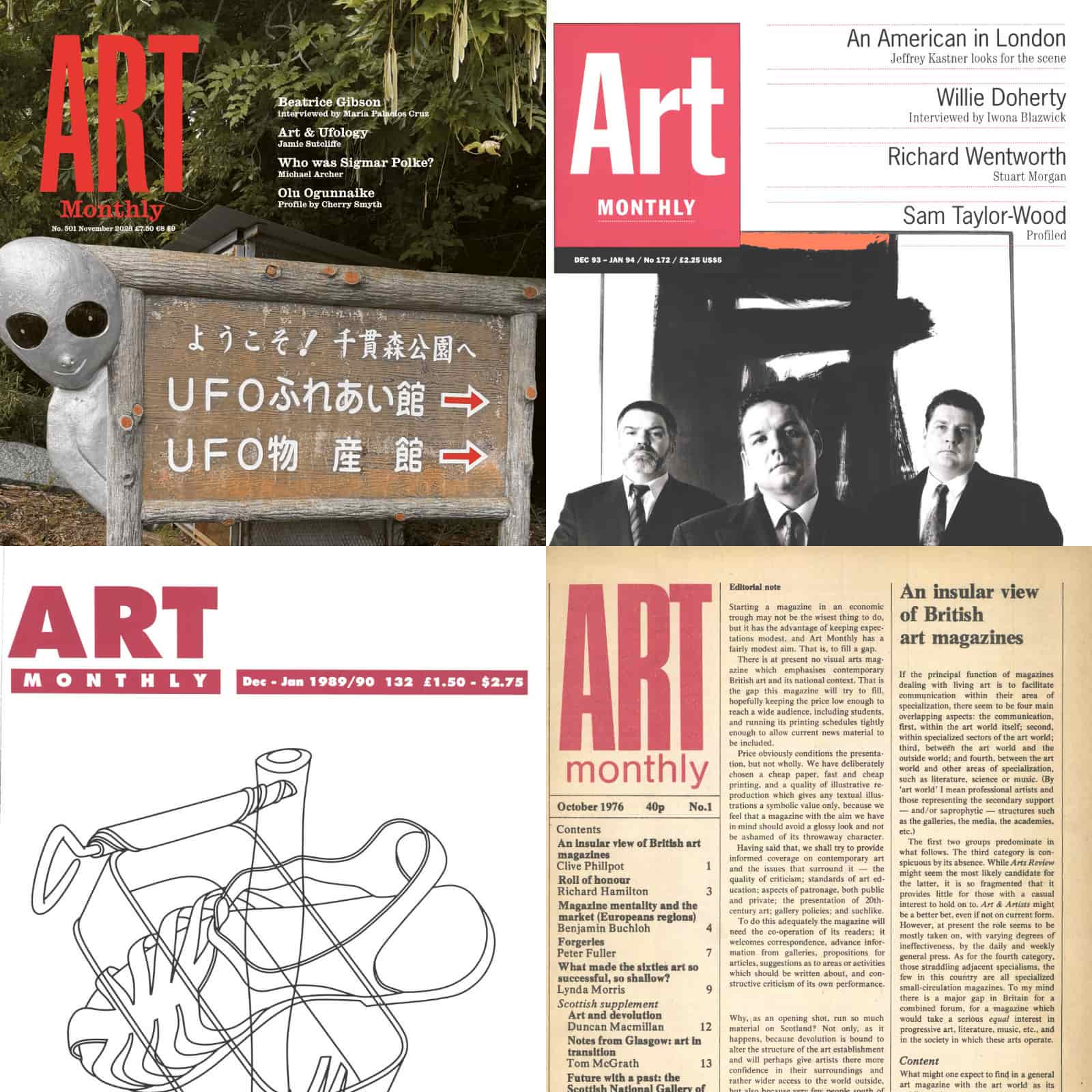
Art Monthly cover designs 1976–2026
When Artlaw’s first column was published in October 1976, interest in artists’ ways of working had already been stimulated through discussion with artists about the growing influence on them of Marcel Duchamp’s life and work, his friendship and collaboration with Richard Hamilton over the previous decade or so, and especially Hamilton’s reconstruction of Duchamp’s legendary artwork La mariée mise à nu par ses célibataires, même (The Bride Stripped Bare by her Bachelors, Even), 1915–23, commonly known as The Large Glass.
Many artists recalled first becoming aware of the significance of Duchamp and his work in 1962, when they saw a BBC television broadcast of Hamilton’s in-depth interview with Duchamp. The backdrop for the studio interview was a full-size photographic transparency of Duchamp’s original Large Glass. Artists recounted that they had been impressed by Duchamp’s articulation of his ways of working, and by Hamilton’s evident role as Duchamp’s artistic protégé – a close association that many artists have subsequently followed.
In 1964, Hamilton was commissioned to curate Duchamp’s first major European retrospective at the Tate Gallery (now Tate Britain) in 1966, which was expected to include Duchamp’s original Large Glass; but it was too fragile to travel to Tate from the US, where it was permanently kept at the Philadelphia Museum of Art. Duchamp agreed to Hamilton’s proposal to make a replica glass in the UK, but Tate’s trustees were unable to finance the reconstruction. Hamilton went to New York City to explain the funding problem to Duchamp, whose artist friend William N Copley agreed to cover the cost of reconstruction materials and, at Hamilton’s suggestion, to pay Duchamp an equal amount as a fee.
In 1965, Hamilton began reconstruction work at the Fine Art Department of the University of Newcastle upon Tyne, where he was teaching at the time. Hamilton’s students witnessed his work there and, a decade later, many of them shared with Artlaw their memorable discussions with him about the project. They recalled that Hamilton was guided by detailed documentation Duchamp had provided, including an edition of his Green Box, 1934: the green-flocked cardboard box containing 94 loose, unnumbered notes, photographs and sketches that act as a conceptual guide to The Large Glass.
Hamilton later wrote that he had followed Duchamp’s processes to ‘reconstruct procedures rather than imitate the effects of action … this monstrous construction in glass and wire and foil and paint, turns out to be a series of logical steps in a long process of contact with materials – with media’. The reconstruction took 13 months to complete; Duchamp gave the replica his approval by co-signing it with Hamilton, and it was transported to Tate.
In June 1966, the Duchamp/Hamilton glass was the principal exhibit in Tate’s landmark exhibition, ‘The Almost Complete Works of Marcel Duchamp’. The replica remained at Tate until March 1968, then was loaned to several exhibition venues in the US before returning to Copley in New York City. Many artists remembered Duchamp’s first and last live television interview, broadcast by the BBC four months before he died in October 1968, in which he was asked:
‘Perhaps the most famous work of yours is the work The Large Glass on which you spent eight years, and some years prior to that thinking about it. This was bringing an intellectual approach into a work of art which no one had seen for many years. There is in fact a published text, which was published sometime after the Glass was not finished, but was abandoned. Do you wish the Large Glass to be appreciated with the text, to inform it?’
‘Yes,’ Duchamp replied, ‘that’s where the difficulty comes in, because you cannot ask a member of the public to look at something with a book in his hand and follow the diagrammatic explanation of what he can see on the glass. So, it’s a little difficult for the public to come in, to understand it, to accept it. But I don’t mind that, or I don’t care, because I did it with great pleasure; it took me eight years to do part of it at least, and the writing and so forth. And it is for me an expression, really, that I had not taken from anywhere else, from anybody or any movement or anything, and that’s why I like it very much. But don’t forget that it never had any success until lately.’
In 1975, Copley donated his Duchamp/Hamilton glass to Tate, where it was permanently acquired and displayed. The close collaboration and replica-making challenged traditional ideas of original authorship, and cemented Duchamp’s enduring influence on contemporary and conceptual art in the UK, and eventually worldwide. Dawn Ades, the eminent art historian and acknowledged expert on Duchamp, succinctly characterised his influence thus:
‘Genius. Anti-artist. Charlatan. Impostor! Since 1914 Marcel Duchamp has been called all of these. No artist of the 20th century has aroused more passion and controversy, nor exerted a greater influence on art, the very nature of which Duchamp challenged and redefined as concept rather than product by questioning its traditionally privileged optical nature. At the same time, he never ceased to be engaged, openly or secretly, in provocative activities and works that transformed traditional artmaking procedures.’
In his 1968 interview, Duchamp was also asked to explain his ‘anti-retinal’ way of working. ‘Everything since Courbet has been retinal,’ he said. ‘That is, you look at a painting for what you see, what comes on your retina. You’d add nothing intellectual about it… A psychoanalytical analysis of painting was absolutely anathema then. You should only look and register what your eyes would see. That’s why I call them retinal: since Courbet, all the Impressionists were retinal, all the Fauvists were retinal, the Cubists were retinal. The Surrealists did change a bit of that, and Dada also, by saying: why should we be only interested in the visual side of the painting? There may be something else.’
It is evident that Duchamp’s influence has grown exponentially since his death. The 1960s generation of art college students, many of whom were taught by Duchamp’s fellow artists and friends, embraced his removal of traditional boundaries of visual art. Not only did the 1960s generation develop their art practices with such non-traditional thinking in mind, they also became tutors and mentors of subsequent generations of students and practitioners; and so on around the art world to date. They also imbued Artlaw with a sound understanding and appreciation of new and different ways of working, often characterised as ‘Duchampian’:
‘Dematerialisation of the object’ was inspired by Duchamp’s ‘readymades’. Conceptual artists declared that the ‘idea’ or ‘concept’ was the main driver of their work, making the physical execution secondary or completely obsolete; and many replaced paint and canvas with language, philosophy, documentation, dictionary definitions, diagrams, and written instructions as the final artwork. Richard Hamilton and Andy Warhol directly inherited this philosophy, treating advertisements, comic books and television as equally legitimate cultural influences as traditional painting.
‘Institutional critique’ of the contemporary art ecosystem was influenced by Duchamp’s submission of a urinal (Fountain, 1917) to an exhibition testing whether the context of the gallery, rather than the artwork itself, defined what ‘art’ is or could be. In the 1970s and 1980s, Marcel Broodthaers, Hans Haacke (Interview AM164 and 244) and Andrea Fraser (Interview AM464) questioned the roles of public-facing museum and gallery institutions, art market commercialism, and the political and financial structures funding cultural spaces; as did street artists in the 1990s.
‘Identity, persona, and gender fluidity’ were exemplified by Duchamp’s construction of a female alter ego, Rrose Sélavy, altering his physical appearance and signing artworks under her name. From the 1970s onward, artists used their own bodies and personas as their primary medium: notably, performance work of Marina Abramović, and Cindy Sherman’s series of ‘Untitled Film Stills’, 1977–80. Subsequent generations of queer and feminist artists shifted art content towards the fluid, constructed nature of identity, gender and celebrity.
‘Appropriation’ and ‘the death of originality’ were epitomised by Duchamp's manipulation of existing imagery, as with his 1919 ‘rectified readymade’: drawing a moustache and goatee beard on a cheap commercial postcard reproduction of Leonardo da Vinci’s Mona Lisa, given a playful French letteral word as his new title: L.H.O.O.Q. In the 1970s and 1980s, Sherrie Levine and Richard Prince directly appropriated advertising, photography and ahistorical art, moving the content away from ‘creating the new’ to ‘recontextualising the already existing’.
Such Duchampian ways of working often require creative legal thinking to answer artists’ questions, such as: can an idea or concept be protected against copying or plagiarism? Can a conceptual artwork be sold to a willing buyer? Can another author’s language and text be appropriated without permission? Do critiques of cultural and market institutions risk lawsuits for defamation of reputation? Do street artists risk arrest and prosecution for criminal damage to the property of others in the built environment? Do street artists own copyright in their works? Can street art images be registered as trademarks? Can the work of queer and feminist artists be safeguarded against censorship and vilification? Is the unilateral appropriation of other artists’ works legally permitted and ethically sound? Can a live performance work be sold?
Over the past five decades, Artlaw has witnessed Duchamp’s influence in the transformation of the contemporary art landscape in the UK and beyond, as the practices of the following selection of artists exemplify. Christo & Jeanne-Claude’s monumental environmental projects used the environment as a gallery since their first ‘wrapping’ project in 1968–69: they encased a section of the coast of Little Bay in Sydney, Australia with 9,300m2 of synthetic fabric and 56km of rope. Like Banksy in subsequent years, their works were executed in the spectator’s environment rather than placed in a gallery to which spectators were invited.
The realisation of their works presented huge challenges requiring the acquisition and successful use of non-artist skills: technical, legal, dealing with bureaucracy, business negotiations and financing. Each work was effectively a business project – some have been described as artworks using the law as a medium. Most projects were wholly or partly self-financed, which raised the inevitable question of how the artists generated income to support their practice and living costs; they did not create objects for sale, and the very nature of most of their creations prevented them from selling tickets to the general public wanting to see the results of their transformations of the public environment. Skilful use of the artists’ intellectual property rights was one answer to raising finance.
Under most national and international copyright laws, artists are given the exclusive legal right to prevent their temporary three-dimensional works from being photographed and the resulting images being reproduced and published and merchandised, and/or being filmed and broadcast live or later. In which case, they can use these rights to sell to photographers and filmmakers and broadcasters exclusive licences to record their artwork/events; and/or the artists can themselves sell their related drawings, collages, works on paper, photographs, film of their events, and the like. The obvious parallel business model is the selling of licences by a rock/pop band for exclusive media access to its performances and related merchandising.
The Ceramic Workshop Edinburgh was founded as a charitable entity in 1969, to provide ceramic, screen-printing, darkroom and exhibition facilities. Despite its success, the workshop was forced to close in 1974 due to lack of external funding. After ceasing activities and paying its debts, only £1,512 remained. There was, however, an ‘uncomfortable’ provision in the trust’s constitution that, if it ceased operating, it must donate any remaining assets to another charitable organisation with similar aims. The trustees were against surrendering the £1,512 and instead wished to change the trust’s legal constitution to allow it to invest the money: the investment would be an artwork, and the workshop would perpetually exist as such.
Artlaw was consulted by the artist-trustees, who formally resolved to convert their charitable trust into an investment artwork with the title £1,512. Accordingly, the trust’s remaining funds were entombed in perpetuity, with a requirement that tax-free interest from the investment would feed back to rejoin the original capital sum, at a rate that doubled its value every five years. The trustees estimated that by the end of its first century of investment, the original £1,512 would have accumulated a value of £410.7m; and that by the nature of its expansion would become a work of art that ‘in concept at least’ had the potential, through its absorption of capital, to ‘own the world’.
£1,512 is physically manifest as a locked briefcase, containing investment certificates to the value of the workshop’s remaining funds. It is an open-ended conceptual artwork, founded on toying with the then laws usually restricting, though occasionally permitting for exceptional purposes, perpetual accumulations of capital. It was first exhibited in 1977 at the Roxburgh Hotel in Edinburgh, then in 1978 at Dusseldorf’s Stadtisches Kunsthalle, and in 1979 at the Centre Pompidou in Paris.
Critical reviews of the artwork at that time, and since, have included discussions about the social exchange of money, and the economic base of art and time. Scottish contemporary art expert and scholar Professor Craig Richardson regards £1,512 as ‘a metaphor for the Scottish visual arts in the 1970s’, and cites Duchamp’s immense influence on the origination of an artwork of significance in the development of Scotland’s contemporary art in the last quarter of the 20th century.
In 1984, US artist JSG Boggs was in a Chicago diner ‘having a doughnut and coffee and doodling on this napkin … sketching a numeral 1, and gradually embellishing it’, as he later recalled, and that ‘the waitress kept refilling my cup and I kept right on drawing, and the thing grew into a very abstracted one-dollar bill’. The waitress offered to buy the napkin work, but Boggs refused. He then asked for his bill, 90 cents, and suggested ‘I’ll pay you for my doughnut and coffee with this drawing’. The deal was done and, as he was leaving, the waitress called out ‘Wait a minute. You’re forgetting your change,’ and gave him a dime. Boggs practised many such exchanges in the US and Europe over the next two years, as payment for his basic living expenses, including his rent; and determined that drawings of currency alone did not comprise his artwork, but rather that the whole bartering transaction – including the receipt of legal currency as change – was the whole work.
In 1986, Boggs was living in London, successfully pursuing his art bartering practice, when a journalist suggested that such activity might be a criminal offence unless sanctioned by the Bank of England. Boggs therefore ‘wrote a letter to the Governor of the Bank of England, asking him permission to go on drawing likenesses of British currency … who wrote back denying permission, telling me what I was doing was illegal and that I was risking confiscation and arrest’. Boggs continued. He was subsequently arrested and indicted for offences of counterfeiting and forgery.
In 1987, the case went for jury trial at the Old Bailey, England’s Central Criminal Court. Boggs pleaded not guilty to four counts, alleging reproduction of a £10, £5 and two £1 Treasury Notes. If the jury determined that Boggs had indeed reproduced the currency, he would be found guilty: these were absolute offences, to which it was not a defence that the accused was an artist whose only intention was to create art.
Artlaw accepted Boggs’s invitation to join his defence team, whose strategy was to transform the public courtroom into a temporary art gallery by exhibiting a range of artworks, and calling expert witnesses to convey one key message for the jury: this is an artist on trial, not a mass murderer. An array of eminent art experts gave evidence for the defence. They offered the jury earnest, erudite, entertaining and illuminating discourses about the historical lineage of art as currency, bartering traditions, the economic value of art, the art marketplace, Dada, appropriation of found objects, Conceptual Art, Performance Art, trompe-l’oeil and Pop Art.
The judge directed the jury that all defence arguments were legally unsound or irrelevant: ‘This case is not about artistic freedom or freedom of expression or anything of that sort. You may have heard it described as a test case. Nothing could be further from the truth. This is a very narrow and specific case. Please don’t be deluded into imagining that you’re trying the contemporary art establishment. It provides no defence whatsoever that the drawings in question may be worth more than the originals or, for that matter, that they may in some manner provide the defendant with a principal source of his livelihood. Whether or not the defendant understood the law is immaterial.’ It was a jury direction to convict.
British juries, especially at the Old Bailey, fiercely resent being told by trial judges what to decide. After 15 minutes in retirement, the jury returned a unanimous verdict of not guilty on all counts. In the street outside the courthouse, members of the jury came out to shake Boggs’s hand, telling him: ‘It was the correct verdict. We loved your work.’ The jury’s verdict had been persuasively guided by Boggs’s defence team’s deep understanding and advocacy of his art bartering practice: at once conceptual, performative and graphically representational. The case earned Boggs a worldwide reputation as the artist who created his own currency, which pre-dated by three decades the advent of Bitcoin. Boggs is revered by many today as the ‘Patron Saint of Cryptocurrency’.
Alison Jackson is a London-based artist who came to wide public attention in 1999 when she published her lookalike photographs of celebrities in compromising positions. Jackson developed her work into BBC television’s broadcast series Double Take, for which she won a British Academy of Film and Television Arts Award for Best Innovation in 2002. Jackson uses conventional mainstream broadcast media and publishing as both her art form and dissemination medium; though she also exhibits in art galleries.
Jackson is not a conventional television director, but an artist with exclusively artistic parameters. She uses media to subvert and question notions of celebrity, and toys with the ‘it’s on television/in print, so it must be true’ response by viewers. Her aim is to explore the blurred boundaries between reality and the imaginary – the gap and confusion between the two – to ‘recreate scenes of our greatest fears which we think are documentary but are fiction’. Jackson employs skill and judgement in intentionally sailing close to – and successfully circumventing – hazardous boundaries of laws relating to confidentiality, defamation and related celebrity rights.
Banksy had no gallery or representation in the 1990s, initially operating as a free-hand street artist, sometimes – and then increasingly – using stencils to facilitate the swifter execution of work to help avoid detection, arrest and prosecution for criminal damage, and/or civil suit for trespass to other people’s property. He was an urban guerrilla artist, using the built environment as both his canvas and gallery to convey messages to the general public – with images and often epigrammatic text – against war and capitalism and the establishment. He had no objects for sale.
Banksy responded to his increasing popularity, and requests from people wanting – somehow – to own one of his images, by making reproductions of his publicly sited works: some were printed on paper and offered for sale via eBay; others were printed on canvas and sold, more expensively, to selected collectors. He appointed his old college-days friend, Steve Lazarides, as his dealer until 2009, when he established Pest Control as a separate online legal entity registered in the UK as a limited liability company, partly to protect his personal identity, partly to authenticate his site-specific artworks, but mostly to handle the growing commercial dimensions of his practice. In this way, Banksy extended his artistic brand by adopting and adapting mainstream art business practices: creating and selling authorised versions of his works, and in signed limited editions; occasionally accepting commissions.
Duchamp’s worldwide influence is exemplified by the work of artists in East Asia and in Russia, notably: Gao Zhen and his friend and colleague Ai Weiwei; and Pussy Riot. On 10 May 2026, when Gao marked his 70th birthday in a Chinese prison, hundreds of artists, musicians, writers, human rights advocates and cultural leaders worldwide called for his release and urged US President Donald Trump to raise Gao’s case directly with China’s President Xi Jinping at their personal summit meeting held days later.
Gao had emigrated from China to the US in 2022. While in Beijing visiting his family in 2024, he was arrested, 100 of his artworks were seized, and his wife and seven-year-old son were banned from leaving China. Chinese media described Gao as a ‘so-called artist, who caters to Western political agendas through pseudo-art that vilifies and insults revered figures’. He was detained for ‘insulting, defaming, or otherwise infringing on the reputation and honour of heroes and martyrs’: crimes of ‘historic nihilism’ or ‘distorting history’ under new laws enacted in 2018.
Gao’s indictment focused on satirical sculptures and installations he made between 2005 and 2009: notably, Execution of Christ, 2009, a bronze life-size installation of seven unmistakable likenesses of Mao Zedong aiming rifles at a figure of Christ. The firing squad represents an institutional critique of authoritarian power and historical repression of Christianity.
Mao founded the People’s Republic of China in 1949 and subsequently presided over some of the most traumatic censorship in China's recent history. He led the governing Chinese Communist Party (CCP), which monopolised artistic creation, replacing traditional and diverse works with USSR-style Socialist Realism: art was required to serve ‘workers, peasants, and soldiers’, focusing on idealised portrayals of daily life and CCP leaders. Artists who criticised the CCP or failed to align with official aesthetic standards, such as using traditional ink painting, were persecuted and forced into ‘re-education’.
From 1966 until Mao’s death in 1976, his Cultural Revolution policy was characterised by destruction of ‘Four Olds’: ideas, culture, customs and habits. Art was reduced to ‘revolutionary romanticism’ and intense propaganda, artists were often forbidden to create, and many artworks were destroyed. After 1976, censorship relaxed slightly, allowing the introduction of western techniques and the ‘85 New Wave’ (85NW): a nationwide avant-garde art movement, marking the birth of contemporary Chinese art. Artists rejected socialist realism, instead creating experimental, conceptual and western-influenced art to explore new artistic languages and self-expression.
During the 1980s, 85NW flourished, primarily driven by artists born just before or during the Cultural Revolution, including the Gao Brothers, Zhen (born 1956) and Qiang (born 1962), and their friend Ai Weiwei (born 1957). Around 100 self-organised, avant-garde groups staged exhibitions and performances across China: they focused on social reform and freedom of expression, transitioning from strict realism to experimental practice. 85NW laid the foundation for Chinese art of the 1990s and beyond, challenging the traditional state-sanctioned art system, and was part of a larger, broader intellectual movement in the 1980s known as the ‘New Enlightenment’. In 1989, however, the CCP ordered an army massacre of thousands of protestors in Beijing’s Tiananmen Square, after which experimental art was repressed, and many artists worked ‘underground’ or in exile.
By 2003, a contemporary artistic community of over 30 artists, designers and publishers had developed in a de-commissioned 50-year-old military factory complex in Beijing: the 798 Art District, where the Gao Brothers and Ai worked. In 2011, the CCP ordered closure of the Gaos’ studio, and Ai was arrested and detained for 81 days without charge. Following Ai’s release, his passport was confiscated and only returned after four years, when he was eventually allowed to leave China. In 2015, he emigrated to Germany, then moved to live in the UK and Portugal.
Since 2013, led by President Xi, there has been a significant expansion of art censorship, mass surveillance and a deterioration in human rights. In 2024, repression intensified, especially for critical depictions of Mao, Xi, or CCP policies. Artists often self-censor to avoid being monitored, harassed or arrested, and many hold private, word-of-mouth exhibitions to showcase forbidden work. In recent years, international institutions have been pressured to cancel exhibitions of Chinese art critical of the CCP. Dissident artists living abroad report digital harassment and threats to their family members remaining in China, while enactment of new national security laws in Hong Kong has led to self-censorship by artists and art traders in the island-city.
In March 2026, after two years in prison, Gao Zhen was arraigned in a closed court. His one-day trial concluded without an immediate verdict, pending which he remained in custody. In August 2026, he was convicted and sentenced to the maximum penalty of three years imprisonment. His brother, Qiang, said ‘even if a work was made 15 years ago, it can still be turned into a crime if today’s political climate changes’, and that there has been a recent hardening of Beijing’s backlash against perceived dissidence, as part of ‘a wider pattern of tightening control’.
The United Nations Human Rights Office recently joined a growing chorus of international advocacy groups calling for Gao Zhen’s immediate release, saying his case ‘raises concerns with regard to retroactive application of criminal law and use of criminal sanctions to punish artistic expression’. Ai continues to advocate for Gao Zhen, keeping his friend’s case in the international spotlight and, with hundreds of others, petitions for his release. In 2026, Thames and Hudson published Ai’s essay, ‘On Censorship’, exploring the evolution of censorship from authoritarian states to western democracies. Ai argues that, while China’s censorship is ideological and overt, western institutions also practice a form of corporate and institutional censorship, and warns against the rise of globalised surveillance and digital control – whatever political system we find ourselves living under.
In 2011, Pussy Riot was formed in Moscow: a punk feminist protest and performance art collective of a dozen artists who challenged politics in Russia. Pussy Riot staged unauthorised, provocative performances in public places, filmed as music videos and posted online. The group’s lyrical themes include feminism, LGBTQ+ rights, and criticism of President Vladimir Putin’s policies and links to leaders of the Russian Orthodox Church.
In 2012, Pussy Riot performed Punk Prayer inside Moscow’s Cathedral of Christ the Saviour, which was condemned as a sacrilegious act by the Russian Orthodox Church. Three group members were arrested, tried, convicted, and sentenced to two years in a penal colony for ‘hooliganism motivated by religious hatred’. One member’s immediate prison sentence was later suspended on appeal. The trial and sentences attracted considerable attention and criticism worldwide: by prominent artists and performers, particularly in the West, and by human rights groups, including Amnesty International, which designated the women as prisoners of conscience.
As Pussy Riot subsequently continued to perform, Russian authorities used anti-extremism laws to ban and remove several of the group’s videos from the internet, repression that was later condemned by the European Court of Human Rights as a violation of freedom of expression. Russia’s censorship developed into a total outlawing of the collective within the Federation, and was intensified by criminalising anyone’s intentional online searches for Pussy Riot’s content: Russian citizens could face fines for accessing their material, even without sharing it.
A Moscow court officially designated Pussy Riot as an ‘extremist and terrorist organisation’, banning all its activities in Russian territory, and many of its members fled the country. Under this designation, any public endorsement of their work, including liking a post or owning their symbols (such as their iconic pink balaclavas), carries the threat of a prison sentence. Pussy Riot continues its activism exclusively outside Russia.
Days before the official opening of the 2026 Venice Biennale, Pussy Riot and the feminist activist group FEMEN staged a highly publicised protest against Russian participation in the Biennale. More than 50 group members, wearing bright pink balaclavas and waving Ukrainian flags, beset the Russian Pavilion and forced it to close its doors. ‘Russia’s best citizens are either imprisoned for anti-regime and pro-Ukraine actions or killed in jail, while Europe opens its doors to Putin’s officials and propagandists,’ Pussy Riot and FEMEN said in a joint statement, adding that ‘if art is meant to represent a country at the Venice Biennale – something like the Olympics of the art world – then artists imprisoned for their anti-war, pro-Ukraine stance are the real face of modern Russia’.
Henry Lydiate is an art lawyer and adviser to www.artquest.org.uk.
First published November 2026.
Art Monthly celebrates its 50th anniversary and 500th issue in October 2026. Henry Lydiate marks the magazine’s 50th year by reviewing his Artlaw column since its first publication in 1976. Throughout 2026, one broad subject is explored each month, noting significant events and issues, and commenting on key changes and developments to date.







Peveril Garden Studios
140 Great Dover Street
London SE1 4GW
United Kingdom
Email info@artmonthly.co.uk