Feature
Angry White Man
Sigmar Polke’s new paintings miss their mark argues Patricia Bickers
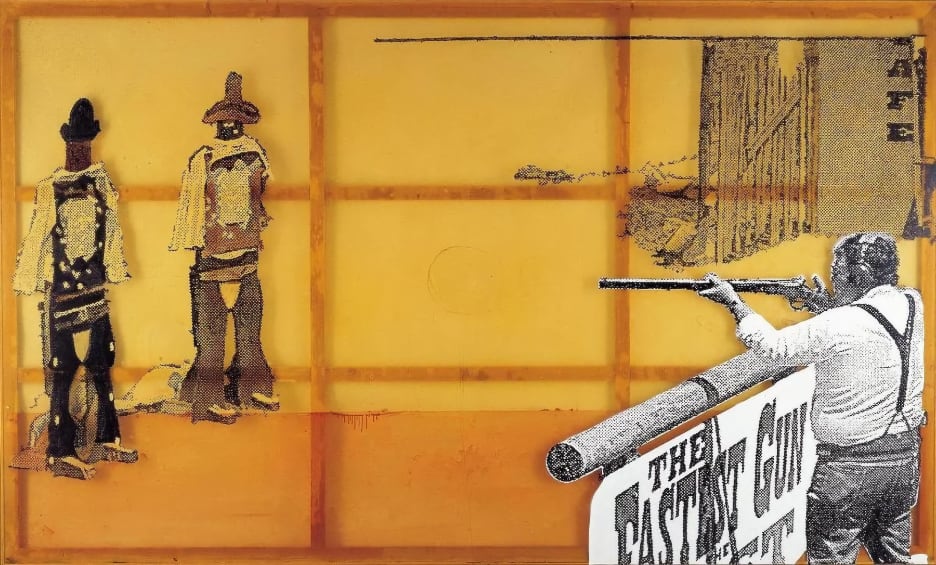
Sigmar Polke, Fastest Gun in the West, 2002
It is not often that a painting can make you laugh out loud but one that surely does is Sigmar Polke’s 1969 black and white abstract painting that bears the irreverent message: ‘Higher Powers Command: Paint the Right Hand Corner Black!’ (‘Hohere Wesen befahlen: rechte obere Ecke schwarz mal en!’), rendered as though typed – complete with mis-registered letters – along the bottom edge.
While Roy Lichtenstein worked his way systematically through Modernism culminating, though not concluding, in 1965-66 with the ‘brushstroke’ paintings that spoofed the high seriousness of Abstract Expressionist rhetoric, Polke characteristically took a short cut via a painting titled Modern Art (as per the label at the foot of the painting), painted in the politically pivotal year of 1968. Polke rehearsed in this single work the full repertoire of non-representational painting styles from gestural to hard edge in a rapid shorthand for every form of non-representational painting from Tachisme to Abstract Expressionism. Set out on the canvas like a sampler or primer, the painting recalls Marcel Duchamp’s valedictory Tu m’ painted for the collector Katherine Dreier exactly 50 years earlier. While many commentators have notionally added the missing verb to complete the phrase – the preferred version being ‘Tu m’ennuies’ (‘You bore me’) presumably in reference to the ‘retinal’ art of painting – Duchamp himself would only say mischievously, ‘You can add whatever verb you want, as long as it begins with a vowel …’ Polke’s approach is altogether more direct: having effectively reduced a powerful tradition of painting to a set of generic forms and stereotypical gestures, Polke next tackled the entire edifice of Modernism’s perceived moral and aesthetic authority in Higher Powers Command …
However, this act of giant-slaying is perhaps best understood as the act of a ‘late disappointed lover of Modernism’, as Thomas McEvilley has described Polke, rather than as the act of a vandal. In fact, he did not arrive at this point as directly as might first appear. On the contrary, this painting could be said to be a pared down version of an earlier, more complex and less resolved work, the extraordinary installation Showcase Piece of 1966, in which ‘Higher Beings’ commanded him not to paint a bunch of flowers, as he had intended, but to paint flamingoes instead – which he did. Had Polke’s sole aim been merely to take pot shots at Modernism, Higher Powers Command … (a key work in the Froelich collection of works by Polke part of which is displayed on Level 3 at Tate) would merely have been an amusing footnote in the history of painting in the second half of the 20th Century. However, from the start Polke has managed the difficult trick of attacking painting, in particular its status and recent history, while simultaneously reinventing it for himself. In the course of doing so, he has stripped it down to the bone, literally revealing the stretcher through resin-coated supports or loading the surface with images or textures till it groans from the weight of materials and meanings. At the same time he has submitted painting to all manner of indignities using parody, irony, humour, and occasionally an excoriating wit, in order to demystify it. In short, Polke is locked in a love-hate relationship with painting.
Perhaps it is this that makes Polke’s work always seem so fresh and relevant – that and his equally ambivalent relationship with American art and culture, an ambivalence that like his relationship with painting was also, perhaps, that of a disappointed lover. At a time when the so-called special relationship between Britain and America has never seemed so compromised or compromising, this show at Tate Modern, however fortuitously, seems particularly timely – and not just because of the subject matter of his most recent work that overtly savages American gun culture and imperialistic aggression. Polke has always situated his work at a confluence of influences from American and European art, but perhaps this stance has never seemed more telling than now.
Yet, although his influence can be seen in the work of, say, the late Martin Kippenberger and Franz West, to mention two other serious jokers, at its most laconic Polke’s humour is reminiscent of that of John Baldessari. Like the German painter, Baldessari has not only engaged in a long and fruitful conversation with Duchamp in his work, but in the 1960s he too interrogated painting, in particular what was at the time recent American painting, in a series of black and white photo-text and text only paintings. Unlike Polke, though, Baldessari was done with painting by 1965 and thought of these works as ‘replacements’ for painting which he intended to be read rather than looked at. In Composing on a Canvas, 1967-68, for instance, the text derives from a ‘How to paint …’ manual, while in Clement Greenberg, painted at the same time, Baldessari quotes the words of the great critic back at him, leaving viewers to make of them what they will. And while Baldessari was engaged, at least partly, in a specifically West Coast/East Coast dialogue with formalist painting, back in the newly divided Germany and far from the sunny skies of California, Polke and two other like-minded artists, Gerhard Richter and Konrad Lueg, were bent on resisting the creeping Coca-Colonisation of postwar Europe, and that included American art, as well as American popular culture in particular and consumerism in general.
As David Campbell has pointed out, Capitalist Realism was both inspired by and a reaction against Fluxus. As students of Joseph Beuys at the Düsseldorf Academy they were exposed to Fluxus ideas but quickly became disenchanted as its transgressive, intermedia approach to art hardened into orthodoxy; in particular Beuys’s injunction against painting was rejected, even though their own practice at this time tended towards performance rather than painting. Whereas Fluxus events veered towards the anarchic, Capitalist Realism was from the first more targeted while its content was intended as a direct rebuttal of the depoliticisation of art during the Cold War era, both in America and western Europe. Their stand had particular resonance in West Germany because of its status as ‘the frontline state’ in the ideological battle between East and West. As Richter was later to say, ‘This term somehow attacked both sides: it made Socialist Realism appear ridiculous, and did the same to the possibility of Capitalist Realism as well.’
The almost simultaneous appearance in the late 1950s of Pop Art in the UK and the US, and of Nouveau Réalisme in France and Capitalist Realism in West Germany, all of which directly engaged with popular – and largely American – culture, at first obscured, perhaps, the very different, culturally specific nature of that engagement. Though in a letter written to the Neue Deutsche Wochenschau in 1963 the artists, including Manfred Küttner, originally referred to their work as ‘German Pop Art’, it was edgier, less apparently celebratory than its American or British counterparts. While Andy Warhol’s relationship with his source images remains enigmatic, a position that finds its parallel in his use of mechanical processes, Polke’s ironic stance towards images and slogans associated with West Germany’s postwar economic miracle is fairly unambiguous. Similarly, Polke increasingly fused the problematics of content with those of painting. The series of ‘Rasterbilder’, painted between 1963-69, are typical in this respect. Derived from ‘rastering, originally a German term for a commercial printing process used to reproduce images by means of dots and lines to create tone, this technique – often distorted and multilayered but always painted rather than printed – became Polke’s signature as surely as the benday dots used in colour separation became Lichtenstein’s. Polke’s paradoxically painterly use of this technique becomes a distancing device that simultaneously asserts the primacy of painting and the persistence of the image, even when reduced almost to the point of unreadability as in The Duke and Duchess of Windsor painted in 1965 or seemingly to pure abstraction as in the gorgeous recent work, Anyone Can Have Out-of-Body Experiences at Will, 2002, that is included in the current exhibition at Tate Modern.
There is very little distancing in Polke’s current show, least of all between the artist and his subject matter. Initiated by the Dallas Museum of Art, ‘The History of Everything’ is largely focused on recent American history. In what might be a self-parodying reprise of Modern Art, the show takes its name from two of the paintings included, The History of Everything I and II, 2003, which neatly lay out, in grid-like fashion, a lexicon of images, ‘rastered’ in varying degrees of readability. Throughout the show are scattered works which contain characteristic references culled from sources as various as 18th-century engravings and 16th-century woodcuts, the history of art and news photos, and there are several frankly humorous works such as How Fish Can Boost Your Brain Power, 2003, and Guardian of the Threshold, 2003, which pokes fun at what looks like a very British nudist camp, and was apparently painted especially for the British leg of the tour. However, the overwhelming impression is of an outpouring of work by a very Angry White Man. Polke’s targets are, in fact, very much those of Michael Moore in his bestselling book Stupid White Men and his film Bowling for Columbine. Chief among these is America’s macho gun culture, particularly in works like Gun Seller, Splatter Analysis, This Discovery Could Have Grave Consequences for Mankind – a still life of a broken tube of ‘Premier Field 7 1/2’ lead shot in front of a Remington advertising board – and I don’t Really Think About Anything Too Much, featuring a smiling woman standing holding a gun in front of a human target presumably at a shooting range, all painted in 2002. Me and My Buddies Would Vote for You, 2002 , throws sex into the mix, and features a lap dancer in a downtown Texas bar. There are also several paintings featuring scarecrow-like cowpokes whose profiles resemble Gary Larson’s lugubrious cartoon characters from The Farside such as Do the World a Favor and Eat a Bullet, and The Fastest Gun in the West, both also of 2002. Outside the exhibition space, opposite the bookshop, is displayed a large landscape painting: National Historic Monument, Little Big Horn, 2002. Like a warning from history, this picture frames the entire show.
Yet for all the anger that inspired the ‘Dallas’ works, their targets are too easy. For an artist capable of painting the far more powerful Goya-inspired work, Three New Commandments Found, of 1998, in response to the Bosnian conflict and which is also included in the show, these new paintings are, to coin a phrase, too much like shooting fish in a barrel. Unlike that earlier painting, these pictures are one-dimensional and illustrative, they do not engage the viewer and, as Polke knows only too well, There is Nothing More Real than Pictures You Can’t Get Out of Your Mind, as the title of another work in the show and painted the same year tells us. This is a pity, because if ever there was a time when Polke’s work seemed relevant, it is now. This is not the show to introduce new audiences to the full extent of Polke’s work, including sculpture, installation and photographs, nor is it the show that will encourage us to begin the much-needed reappraisal of his role in the context of postwar European art and its relationship with American art. That show has already happened. It was back in 1995 when the then Tate Gallery Liverpool hosted what was, shamefully, Polke’s first survey exhibition in this country. ‘Sigmar Polke: Join the Dots’ was the right show at the wrong time.
‘Sigmar Polke: History of Everything’, Tate Modern, London, 2 October 2003 to 4 January 2004.
Patricia Bickers is editor of Art Monthly.
First published in Art Monthly 271: November 2003.






Peveril Garden Studios
140 Great Dover Street
London SE1 4GW
United Kingdom
Email info@artmonthly.co.uk