Report
Deep Cuts
Isobel Harbison examines the wild discrepancies in arts funding across the Irish border
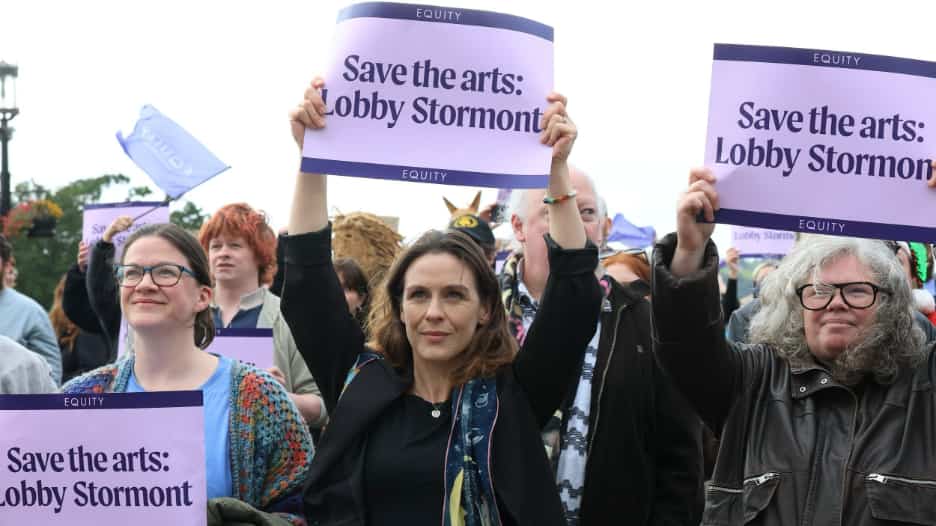
‘Save the Arts’ protesters outside Stormont, 8 September 2026
If she wasn’t raising her five-year-old, she told me over the phone, she would move her family only one county over, where she would stand a better chance of making a reasonable living as an artist. What difference does one county make? It would mean moving from ‘Northern Ireland’ to Ireland’s South and to a different jurisdiction for artists’ funding.
‘She’ is speaking to me anonymously, but she is among many artists that I have spoken to who find accessing financial support in the North of Ireland challenging, certainly in comparison to their counterparts south of the border and east of the Irish Sea. The figures are staggering. Arts funding per capita - the total amount of money a government spends on the arts by population - is £5.07 per person in the North of Ireland, compared with approximately £7 in Wales, just over £13 in England (advantaging London) and about £16 in Scotland. Overall funding in the North of Ireland is now significantly lower than when the Peace Agreement was signed in 1998, slipping down from £14m to just £9.5m in 2025 (as reported by Cian Smyth in Arts Professional). In yet another stark contrast, the Irish government outstrips them all by investing €30 - approximately £25.90 - per capita in art.
If you look at how the differences shape up from the vantage point of individuals, artists resident in England might apply for National Lottery Project Grants of up to £100,000 (with a £30,000 cap for individual-led projects), or ‘Developing Your Creative Practice’ (DYCP) grants from between £2,000 to £12,000 - and that’s before exploring other funding avenues from a broader range of public grant providers, or regional modern and contemporary art museums that possess commissioning and/or collecting capacities.
In the North of Ireland, however, it is completely different. There are two individual funds: one competitive fund for individual artists capped at £10,000 (SIAP, ‘Support for Individual Artists Programme’ award) and a once-in-a-lifetime ‘major’ grant capped at £15,000 that is given to one established artist every year. In the English system, artists can repeatedly apply for large grants as soon as they have been processed. In the North of Ireland, that once-in-a-lifetime award is just that, and artists cannot apply for the SIAP yearly. There is also an international travel bursary available to artists in the north to cover return flights (no accommodation or stipend is included). This bursary now prioritises disabled artists and artists from ‘generally unionist communities’ who are ‘currently under-represented’ within their grantees. That final subset is apparently legal under Section 75 of the Northern Ireland Act, 1998, but seems worthy of further reflection, given the well-documented history of gerrymandering in the north and shifting voting and polling demographics, as well as the volume of international invitations offered to artists based on the value of their work rather than their ideological inheritances.
In the South of Ireland, which has had a different post-Brexit economic trajectory, the public funding landscape is better. As well as the emergent ‘Basic Income’ scheme and Aosdána system of artistic honours, the Arts Council of Ireland provides agility awards (up to €5,000), project awards (up to €80,000), community artists schemes (€15,000), Next Generation awards (€25,0000) and annual bursary awards of up to €20,000. Although prioritising artists living in the south, this bursary does accommodate some geographic flexibility for Ireland-focused artists, so artists based in the North can therefore apply for the €20,000 if they can demonstrate the work’s value to an Irish audience; this has led some artists to design projects that include a cross-border element (curatorial and/or thematic). Basic human needs are thus encouraging (or should that be forcing?) artists of all backgrounds, including some brilliant ‘generally unionist’ ones, to look south not only for a living wage but also for creative inspiration, acknowledgement and opportunity.
‘Island’ is a word that increasingly recurs in southern cultural diplomacy. The ‘Shared Island Initiative’ was set up by the Irish government in October 2020 and aims ‘to build a more connected, prosperous and sustainable island of Ireland, grounded in the Good Friday Agreement. It encourages cross-border collaborations between individuals and civic and cultural organisations (I am one grateful beneficiary). The scheme continues to diversify its cultural focus, the Irish government allotting €20bn in funding until 2035. Both that sum and the timeframe are significant, as many notable pundits have predicted that within this period a border poll will be triggered, which may or may not result in Irish reunification - read Fintan O’Toole and Sam McBride’s 2025 book For and Against a United Ireland for more on that. To some, this deployment of public funding would indicate unification planning from the south by stealth. The continuous impoverishment of public cultural resources in the north would also seem, however haphazardly, to hasten this poll’s eventuality.
But what about our artist friends in the north right now? At the time of writing, a demonstration has been planned by a range of creatives at Belfast’s Stormont on 8 September, with a ‘No Confidence’ message for the minister for communities, Gordon Lyons (previously of the Democratic Unionist Party). According to the campaign group Equity, the gathering aims at an ‘end to arts funding cuts and the delivery of a long-promised arts policy’, with those attending Question Time in Stormont to ask the minister about future arts funding policy. Given the current withholding and absence of such a policy for the coming decade, and real-terms cuts to ACNI of 40% over the past ten years, the minister should surely commit to something - and fast.
Ultimately, the problems are structural. Unlike in Ireland and England, which broadly speaking have ministries of culture, the ACNI reports to the Department of Communities. This not only funds a range of other vital services - including housing, pensions and social security - but also funds how the North negotiates the continuing reverberations of localised generational trauma. Secured funding for artists in the north will involve radically rethinking how or whether art and culture fits into the vast remit of this ministry, with a nuanced understanding of the autonomous value of art. While it operates under the British Treasury, equitable resolutions found by the minister and the Northern Ireland Executive might usefully be assisted by British ministers and cultural policymakers, in conversation with artists in the region and, ideally, with the support of the newly installed of-Irish-heritage prime minister, Andy Burnham. The initial signs appear to be more of the same though, with no arts funding policy in place and with Burnham recently stating that an Irish border poll was ‘off the table’. Yet I wonder how all these things are connected, how such failures to distribute cultural funding will ultimately influence a border poll, the configuration of the United Kingdom, and a British art history yet to come.
As I write, my artist friend with the five-year-old waits to hear whether her project with the English art gallery will be green-lit. Then she can apply for ACE funding, which will hopefully last her family another short while. Readers, while the state continues to underserve its artists, it is time to make interesting alliances and collaborations.
Author’s note: Both the ‘North of Ireland’ and ‘Northern Ireland’ refer to the same six counties. Northern Ireland is the term currently recognised by the state, so for some people it reaffirms its colonial and hegemonic formation. The North of Ireland speaks to a potential future post partition. I see these choices as part of a broader conversation.
Isobel Harbison is a writer based in Dublin and London.
First published in Art Monthly 500: October 2026.



Peveril Garden Studios
140 Great Dover Street
London SE1 4GW
United Kingdom
Email info@artmonthly.co.uk