Report
Letter from Essex
Greg Thomas suggests that Essex’s history of radical individualism has led to a variety of conflicting attitudes
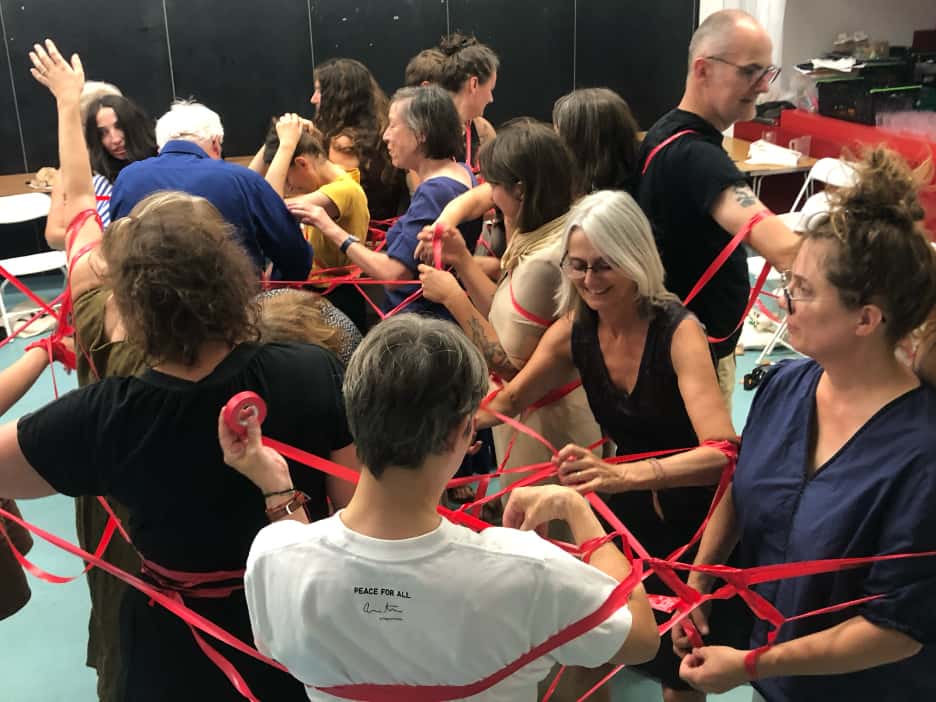
Daniel & Clara, Rewilding Imagination Lab, 2026
On 7 May 2026, Reform UK made thumping gains in local elections across Essex, winning the leadership of the County Council and taking 53 of the 78 seats. Within in a few days, council chair Karen McIvor had announced that the National Anthem would be sung at the end of every full council meeting. The governing party also swiftly introduced an apparent ban of LGBT-themed events in public libraries, before partially backtracking under political pressure.
At the lower level of the county’s two-tier governance system, Reform gained 11 seats on Basildon Council, 13 in Rochford and 11 in Epping, the outer London district where the wave of anti-migrant hotel protests began in June 2025. Southern and western Essex, where the above regions are sited, subsequently became plagued by flags hung from lampposts.
A week previously, on 30 April, Daniel & Clara led the first in a monthly series of packed-out Rewilding Imagination Labs at Firstsite in Colchester. A report by Victoria Matthews on the artist’s website gives an outline of the number of ‘experiments’ and ‘personal reflections’ that took place. Experiment 4 comprised a ‘collaborative drawing exercise: each participant used seagull feather quills and black ink to make gestures on a concertina-folded scroll. As the paper was folded, the ink gesture was doubled. The next participant worked into the mirrored form, then folded again, carrying the image forward while simultaneously obscuring what came before.
‘What emerges’, Matthews records, ‘is not a single drawing but a sequence of interruptions, overlaps, and partial inheritances. A crude calligraphy forms, a tapestry marking time, measuring a moment of community.’ This seizure on the moment of collaborative creativity, produced using such an egalitarian social structure, is an index of Daniel & Clara’s wider methods. Rooted in moving image but now encompassing participatory and performance art, mail art and more, the work arrives out of a seemingly telepathic creative kinship - they refer to ‘Daniel & Clara’ as a singular entity, ‘a third being’ formed through collaboration.
Clara is from Portugal, but Daniel grew up in the village of Layer-de-la-Haye, just outside Colchester, with deep family ties to the Heybridge Basin - he has a gentle estuary twang to prove it. After meeting in Brighton in 2010, the pair spent six years living ‘almost off grid’ in a beach house in Portugal before returning and living with family in Mersea Island as the pandemic hit. They have been back in Essex ever since.
The theme of ‘Rewilding Imagination’ serves as a useful moniker for Daniel & Clara’s wider interests. Much of the duo’s practice bears an almost investigative bent, with proposals and prompts, like that described above, intended to coax the artists and their participants out of a sense of familiarity with their own minds and bodies. The aim is a kind of defamiliarisation with the self, a renewed sense of ‘the strangeness and mystery’ of consciousness, with the re-enchanted natural world as both an analogue and wellspring for the feelings and aptitudes that might emerge.
There is a radicalness at play through a focus on the parameters of the self as grounds for ecological and political awakening. For Daniel & Clara, ‘Rewilding Imagination’ is also part of a social network of alternative and left-leaning spaces across Colchester, including institutions such as the East Anglian Folklore Centre, which is shortly moving to Harwich, the artist-run studio spaces at Cuckoo Farm and various venues that support a lively contemporary folk music scene. This network offers alternative possibilities of community and socialisation in a county which might seem, at a glance, to have been an incubator for radical misanthropy and ethno-nationalism.
There are, of course, well-studied contrasts to acknowledge at this point: between relatively well-connected regional urban hubs, replete with cultural infrastructure - Colchester boasts a university and an art school - and smaller and poorer conurbations more isolated from economic centres and transport networks. In Essex’s case, both the suburban fringes of London and the coastal flatlands have proved to be fertile ground for nativist populism. Nigel Farage’s seaside seat of Clacton lies in the north-west district of Tendring, just above Jaywick, England’s most deprived neighbourhood.
In nearby Manningtree, on the Stour Estuary, the artist Charlie Godet Thomas creates work at the fringes of written and visual form with a lithe sense of the relationship between optical and grammatical categorisation. His miniature word-maps, often created on found envelopes, also reflect an ecological sensitivity and a related interest in - he tells me - ‘how we experience and navigate a world in which so many previously stable systems are faltering’.
This year’s ‘Unfolding Landscapes’ series uses little captioned planes of painted colour to establish structuralist games that evoke various physical systems impacted by climate change. Unfolding Landscape (Up in Flames) names the structural layers and atmosphere of the sun over a series of yellow-to-orange-to-pink rectangles: SOLAR FLARES, CHROMOSPHERE, RADIOACTIVE ZONE, CORONA, PHOTOSPHERE, CONVECTION ZONE. The diagonally framed blue-green spaces of Unfolding Landscape (Flying Machine) do the same for the earth’s atmosphere: CARBON DIOXIDE, PARTICULATES AND SOOT, SULFUR DIOXIDE, WATER VAPOUR AND CONTRAILS, NITROGEN OXIDE. Is this a take on Pieter Breugel the Elder’s 16th-century painting Landscape with the Fall of Icarus for an era of extreme weather?
Like Daniel & Clara, Thomas has personal connections to Essex, in this case through his partner whose parents are from the rural north. ‘As you might expect from a London-born Welsh Bermudian, I’ve never felt settled in any one place,’ he states. Thomas lived for six years prior to Essex in Mexico City, where several of his larger-scale wall-based text-works were exhibited. ‘This is my first time not living in a city, so it has been a big change … the Stour Estuary is incredibly beautiful. The rhythm of the water coming and going and the expressiveness of the landscape is something I hadn’t expected would have such an impact on me and my work.’
Riverine and coastal ecologies have seeped into Thomas’s practice. This year he is a writer-in-residence for the Arise Riverfly initiative, a citizen science training programme for volunteers interested in monitoring the health of freshwater in the area. Moreover, even outside Essex’s urban centres, Thomas points to the number of creative and cultural infrastructures which offer ‘strong resistance to bigotry and racism’ through alternative iterations of community. The Nose Bookshop in Walton-on-the-Naze and Manningtree Arts are, he says, ‘relentlessly generous to the local community’, running artist-led projects, local history projects, community climate action sessions and more.
The picture of cultural and creative networks within Essex is thus, perhaps, more complicated than a simple contrast between progressive urban centres and reactionary isolated towns. Could it also have something to do with the tradition of radical individualism memorably evoked - but hardly contained - by elitist journalistic coinages such as ‘Essex Man’ and ‘Essex Girl’, and by the well-worn idea of the Basildon-bred ‘working-class Tory’? Could this same tradition of individualism also be a source for, say, the anarchistic and environmentally conscious off-the-grid methods of Daniel & Clara?
Jonathan Meades’s 2013 documentary The Joy of Essex unpicked the county’s history of experimental communities, such as the Hadleigh farm colony founded in 1891 by William Booth, Christian-socialist founder of the Salvation Army. Dennis Hardy and Colin Ward’s cult 1984 book Arcadia for All evoked an early-2Oth-century, working-class Shangri-la in the self-built housing movement along the south-east coast. In the Gerry-rigged shacks and converted boat-homes of today’s Mersea island, you can see the inheritance of this anti-authoritarian individualism; so too at Dial House, the pacifist-anarchist commune established by Crass co-founder Penny Rimbaud and artist Gee Vaucher in Epping in 1967.
Much of Essex’s alternative history, including modernist seaside architecture and planned communities, was highlighted by the Radical ESSEX project of 2016-17, initiated by Southend’s Focal Point Gallery. The Irish curator Claire Feeley, previously of Dissenter Space (Report AM466) has been leading Focal Point since November 2025 and is outspoken on how Essex’s culture has been lambasted for its uneducated materialism. ‘There’s a ton of mythology around Southend’, she notes. ‘A frequent backhanded compliment is: “the people are so real”, which basically means we’re uncultured and unsophisticated.’
Focal Point’s programme has, Feeley tells me, remained ‘unapologetically experimental’ since it was founded in 1990, ‘coincidentally the same year that the term “Essex man” was coined’. Although she notes a limited infrastructure for artist-led spaces (‘there are amazing artists here, but we suffer from being close to London which inflates rental prices, making studio space almost unaffordable’), Feeley adds that Focal Point is in the vanishingly rare position of being directly council-run. This leaves her, as director, having to justify the existence of a gallery as a public asset ‘against this new consensus that low taxation has to be the norm, and that any kind of public spending is a bad thing’.
At the same time, it gives the lie to the idea that Reform’s slash-and-burn approach to local authority spending is necessarily finding fertile ground in an Essex-bred suspicion of public culture. Indeed, Southend Council is a unitary authority, independent of Essex. Its minority Labour leadership survived Reform gains in May, potentially providing a more sympathetic hearing for Feeley’s continuous refrain to councillors: ‘libraries should exist, galleries should exist.’
At a granular level, Feeley adds, there is genuine autodidacticism in the city: ‘If you want to join a reading group you have to join a queue.’ Added to the mix of artist-led grassroots art and folk culture, then, is a progressive streak within local government in Essex - somewhat like that which powered the construction of new towns such as Harlow and Basildon during the 1950s and 1970s - that has percolated into a positive civic pride. ‘Politicians may believe their jingoism plays to the crowd, but they underestimate the depth of empathy and solidarity in Southend,’ Feeley says.
Jonathan Meades’s 2013 documentary evoked an Essex man individualism that had as much to do with self-built homes and experimental communes as Thatcherite cruelty. In today’s Essex, that vexed cultural legacy continues to be played out across the estuaries and townscapes.
Greg Thomas is a critic and editor based in Glasgow.
First published in Art Monthly 501: November 2026.










Peveril Garden Studios
140 Great Dover Street
London SE1 4GW
United Kingdom
Email info@artmonthly.co.uk